

When life throws a major curveball, our first instinct might be to ask, Why is this happening to me? Whether it’s illness, financial crisis, heartbreak or simply being stuck, obstacles can feel like proof that we have failed—or that life is punishing us.
Nichiren Buddhism, however, offers a radical and deeply empowering alternative. Instead of looking at a crisis as a dead end or as something we deserve or don’t deserve, we can ask, What if this challenge is exactly what I need to transform my life and inspire others?
This is more than positive thinking; it’s a profound Buddhist principle called “voluntarily assuming the appropriate karma” (Japanese: ganken ogo), which teaches us to see our problems as opportunities for growth. We can choose to use even our deepest struggles as the means to reveal our strength, transform our lives and inspire others.
Origin of the Concept
Now, before you think, Why would I ever choose hardship? and stop reading, let’s first look at how this idea appears in Buddhist writings.
In “Teacher of the Law,” the 10th chapter of the Lotus Sutra, the Buddha praises the spirit of bodhisattvas who dedicate their lives to seeking enlightenment for themselves and others:
These people voluntarily relinquish the reward due them for their pure deeds and, in the time after I have passed into extinction, because they pity living beings, they are born in this evil world so they may broadly expound this sutra.[1]
The Great Teacher Miao-lo (711–82) later expressed this passage with the term ganken ogo, translated as “voluntarily assuming the appropriate karma.” To break down the term:
Gan (vow) indicates a wish or deep resolve to fulfill one’s purpose in this life, especially to lead all people to enlightenment.
Ken (simultaneously) points to things occurring together.
O serves as a particle connecting ideas.
Go (karma) refers to being born into our present circumstances because of past causes and conditions.
Together, this phrase suggests that we willingly take on our unique circumstances to fulfill our vow.
Nichiren Daishonin also writes about this concept in “The Opening of the Eyes,” describing the joy that bodhisattvas feel in deliberately choosing their karma:
If they see that their father and mother have fallen into hell and are suffering greatly, they will deliberately create the appropriate karma in hopes that they too may fall into hell and share in and take their suffering upon themselves. Thus suffering is a joy to them. It is the same with me [in fulfilling the prophecies]. Though at present I must face trials that I can scarcely endure, I rejoice when I think that in the future I will escape being born into the evil paths.[2]
In this sense, voluntarily assuming the appropriate karma is a principle that presents an appreciative, proactive view of life. Suffering is not seen solely as a result of past karma; it is fuel for fulfilling our vow to help others. That vow can help us bring forth the power to take on and transform hardships.
Ikeda Sensei explains in his afterword to The New Human Revolution:
We have chosen, in accord with our vow as bodhisattvas, to be born into the evil age of the Latter Day of the Law with all sorts of destinies, or karma—illness, financial hardship, family discord, loneliness, low self-esteem and the list goes on—to help guide others to enlightenment. But by chanting Nam-myoho-renge-kyo, striving in our Buddhist practice for ourselves and others, and dedicating our lives to kosen-rufu, our vibrant life force as Bodhisattvas of the Earth and the expansive life state of Buddhahood well forth within us. Our lives will brim with the wisdom, courage, strength, hope and joy to overcome every hardship and daunting obstacle that arises. As we bravely triumph over the onslaughts of karma, we demonstrate the validity of the teachings of Nichiren Buddhism and the tremendous benefit of our Buddhist practice, and we further advance kosen-rufu. In fact, we have willingly taken on these hardships and sufferings in order to do just that.
Karma and mission are two sides of the same coin, and our karma directly becomes our unique and noble mission. That is why, when we dedicate our lives to kosen-rufu, there is no destiny that we cannot change.[3]
We chant Nam-myoho-renge-kyo to open the way for ourselves and others—our parents, family and friends. As we chant in this way, our prayers no longer remain only about solving a personal problem. They become prayers infused with the vow to awaken others to their inherent dignity and widely spread the Mystic Law (kosen-rufu). This is the strongest kind of prayer and the very means by which we can change the course of our lives for the better and inspire those we care about to do so as well. With that spirit, as Sensei assures us, “there is no destiny we cannot change.”
Not ‘I Chose This,’ but ‘I Choose This’
When we talk about having volunteered or vowed to take on karma, we might wonder what we were thinking in the distant past. But the real focus of this concept is how we choose to live right now.
It’s not only thinking, I chose this. More importantly, it is thinking, I choose to face this challenge now! and living to our utmost in the present moment. Sensei says:
The crucial turning point is not set at some future time; it is right now. Right now, this very moment, is the turning point in which, through the benefit of the Mystic Law, we can transform “extreme hardship in this life” into the “blessings of … the one vehicle [the world of Buddhahood].”[4]
Prayer That Causes the Sun Within to Rise
How do we keep moving forward when our karma feels overwhelming? We can chant Nam-myoho-renge-kyo. Through chanting, we bring forth the Buddhahood that already exists within us. Sensei compares this to the sun rising: “Just as the light of the countless stars disappears when the sun rises, when we make the sun of Buddhahood rise within us, even the most painful karmic sufferings vanish completely.”[5]
We do not chant to escape reality. We chant to face reality, transform it and help others do the same. This determination brings forth the life force of a bodhisattva—the courage and wisdom necessary to overcome every obstacle.
Second Soka Gakkai President Josei Toda once said, “If, when you are in a seemingly desperate situation, you pray with the determination not to retreat a single step, you will start to transform karma into mission.”[6] Our daimoku is the sound of our resolve not to be defeated.
A Joyful Dance
Together, the concepts of “voluntarily assuming the appropriate karma” and “lessening one’s karmic retribution”[7] are key to Nichiren Daishonin’s view of changing one’s destiny. Rather than passively endure hardship or see it as punishment for past karma, we learn to see it as a precious opportunity, as part of our mission to help others transform their sufferings and prove what true happiness means.
This reflects the compassionate spirit of the Bodhisattvas of the Earth—those who vow to spread the Mystic Law in the confused, turmoil-filled age after the Buddha’s passing. Sensei writes:
It seems that “dancing forth” is a fitting image for the appearance of the Bodhisattvas of the Earth. After all they do appear on the scene fully aware of their mission to spread the Mystic Law. They don’t come forth reluctantly because Shakyamuni told them to; rather, the Bodhisattvas of the Earth leap forth and dance exuberantly with the sense: “Our time has come at last!”[8]
This self-motivated, “dancing” spirit enables us to live with abundant life force, achieve our goals and experience deep, indestructible happiness. President Toda describes it like this:
Attaining Buddhahood means achieving the state in which we are always reborn overflowing with abundant and powerful life force; we can take action to our heart’s content based on a profound sense of mission; we can achieve all our goals; and we possess good fortune that no one can destroy. Because we can live tens, hundreds, thousands, tens of millions of lives in this way, our happiness truly knows no bounds.[9]
From Personal Victory to Shared Hope
When we chant to overcome a pressing problem—whether in work, money, health, family or relationships—our victory becomes a source of hope for others.
In volume 1 of The New Human Revolution, Sensei recounts the story of a woman who emigrated with her husband and children to Brazil. After her husband died from illness, she found herself in a desperate struggle to provide for her children in a foreign country, sinking into deep despair and even contemplating suicide.
Explaining the concept of voluntarily assuming the appropriate karma, Sensei encouraged her:
If someone who had always lived like a queen and enjoyed every luxury were to say, “I became happy as a result of taking faith,” no one would bat an eye. …
By triumphing over great poverty, a person who has been poor can give hope to others who are struggling with financial hardship. By regaining vitality and good health, someone who has been battling illness can light a flame of courage in the hearts of those in similar straits. By creating a happy and harmonious family, a person who has suffered great anguish over discord in the home can become a model for others plagued by family problems.
Similarly, if you, a woman who has been left widowed in a foreign land where she does not speak the language, become happy and raise your children to be fine adults, you’ll be a shining example for all women who have lost their husbands. Even those who don’t practice faith will admire you and come to seek your advice. So you see, the deeper and greater the suffering, the more magnificently one can show proof of the powerful benefit of Buddhism. You could say that karma is another name for mission. …
When you realize your great mission as Bodhisattvas of the Earth and dedicate your lives to kosen-rufu, the sun that has existed within you since time without beginning will begin to shine forth. All offenses you have committed in past lifetimes will vanish like mist, and you will embark upon wonderful lives permeated by deep joy and happiness. …
Viewed from the profound perspective of Buddhism, your suffering is like that portrayed by a brilliant, highly paid stage actress cast in the role of a tragic heroine. When the play is finished, the actress goes home to a life of ease and comfort. Your life is the same. Moreover, the story you play out on the stage of life’s theater will have a happy ending. There is no need to worry. You will definitely become happy. I say this with absolute certainty. Just as a great actress relishes performing her tragic role, please rise from the depths of your sorrow to boldly act out a magnificent drama of human revolution.[10]
Through transforming her situation, she would become a source of hope and inspiration for others facing similar hardships. This is the essence of turning karma into mission.
‘The Greater Our Obstacles, the Greater Our Assurance of Attaining Buddhahood’
No person, family or society is free from difficulty. What Buddhism teaches is how to use our suffering to build an unshakable self and attain Buddhahood in this lifetime.
Founding Soka Gakkai President Tsunesaburo Makiguchi said, “The greater our obstacles, the greater our assurance of attaining Buddhahood.”[11]
Instead of being defined by what happens to us, we can decide what meaning to create from it. Faith gives us the power to face our realities without being defeated by them. Rather than waiting for an obstacle-free life, we know that our mission unfolds right where we are, in the reality we are facing now.
President Toda reminds us to enjoy transforming our karma into mission: “Outwardly at times, we might look like a ‘Bodhisattva Poverty’ or ‘Bodhisattva Sickness,’ but that is merely a role we’re playing in the drama of life. We are in fact bona fide Bodhisattvas of the Earth! Since life is a grand drama, we should thoroughly enjoy playing the role we have undertaken and demonstrate the greatness of the Mystic Law.”[12]
“Voluntarily assuming the appropriate karma” tells us that nothing we face is meaningless. When we choose to face our challenges with purpose, even the greatest difficulties can become the means to create stories of victory that inspire others and prove the power of the Mystic Law.
‘Bipolar Disorder Has Become My Greatest Blessing’

Emily Grossman / Montclair, New Jersey
Living Buddhism: Hi Emily. Thanks for sharing your story with us. You’ve experienced many benefits through your Buddhist practice, including transforming your mental health. Before we get into that, can you share how you were introduced to Buddhism and what your life was like up to that point?
Emily Grossman: Absolutely. Growing up, I was extremely hardworking and conscientious. I did well in school, participated in several extracurricular activities and had a nice group of friends. In my senior year of high school, I was accepted into a prestigious university in Atlanta.
However, once I got there, I was quickly diagnosed with bipolar disorder, a mood disorder in which one’s thoughts and emotions go from very high to very depressed quite rapidly. I had to return home for treatment, and it took about seven years before I found anything that was truly effective. During that period, I experienced 12 psychiatric hospitalizations and was nearly institutionalized in a state hospital in my home state of New Jersey.

What did the symptoms of bipolar disorder look like for you?
Emily: People are familiar with what depression looks like. For me, it meant that it was incredibly difficult to get out of bed or go to class. I stopped taking care of myself.
The mania was different. I would see and hear things that weren’t there and go days without sleeping. Eventually, I would crash into another depression.
As a college student, there was this constant back and forth of attending classes, being taken to the hospital, coming out, trying to catch up on schoolwork and then starting the cycle again. But the structure of school was helpful for me. When school ended and that structure disappeared, things really began to fall apart. I was watching all my college friends move on with their lives, and I felt completely stuck.
What happened next?
Emily: I found a treatment that worked at least a little. I also began to think deeply about what made me truly happy. I realized that it was my dream to become a great educator and inspire youth and adults. However, my family and friends did not think I was capable of it due to my disorder.
Still, I applied to Columbia University and was accepted to Teachers College for their master’s program in education. I was still symptomatic and struggling, but I was trying to will myself through.
When you’ve experienced psychosis, your executive functioning stops working properly. Tasks that require multiple steps, like using the ATM or driving, became difficult. I had Post-it notes everywhere to remind myself of basic things.
Then one day, I was sitting with a friend in class and I said to her, “One day, I’m going to move to Southern California and become a Buddhist.”
She replied, “I’m from Southern California, and I’m a Buddhist. There’s a meeting tonight. You have to come!”
At Teachers College there was a whole group of students who were SGI members. They really supported me, and that’s how I started. I received the Gohonzon about a year later in 2006.
Did you begin to see changes right away?
Emily: Yes. My first prayer was to end contact with my abusive partner. I also wanted to get a job after graduate school teaching sixth or seventh grade and needed reliable transportation. Every single one of those prayers were answered by the time I graduated.
What about with your mental health?
Emily: Within several months, my cognitive and executive functioning began to return. There was nothing else I was doing that could have explained such a change. It was as if my brain was repairing itself, and I felt sharp again. I could drive and concentrate on my schoolwork in a much more profound way that year.
Within a few years I was no longer going in and out of the hospital. I also found a wonderful therapist, which I consider a benefit of chanting Nam-myoho-renge-kyo
I still take medication, but I have been completely symptom-free from bipolar disorder, with the only residual being anxiety (which I’m chanting to totally overcome), for 17 years.
That’s incredible. What aspects of Buddhist practice helped you the most?
Emily: I learned very early on the idea of turning poison into medicine. I realized I could transform my painful experience with bipolar disorder into a source of healing for myself and others.
I also was struck by the idea that I was not a victim and that I had agency and choice. I could transform something deep within and bring out my Buddha nature.
In my prayer, I made strong determinations. I will overcome this difficult obstacle. I will come to a place of self-love and acceptance.
You are now on faculty at a university, teaching about mental health recovery. How did that come about?
Emily: After graduate school, I became a middle school teacher, and I encountered many students who were struggling with their mental health. I was told by the administration of my school that I couldn’t give them advice directly as their teacher, but I could refer them to a guidance counselor.
As I chanted wholeheartedly about this, I realized that I wanted to devote my life to helping people who were struggling with mental illness overcome their challenges. I chanted to find an opportunity to do this, a job that would give me experience in the field without requiring me to go back to school or take out another student loan.
After chanting a lot, I took on responsibility as a young women’s division leader, first in my district and then at the chapter level. Soon after, I found and enrolled in a free training course that allowed people who had experienced mental health challenges to become peer mentors. I chanted to find a job in this field and got the first job that I applied for.
I found all of this work exhilarating, yet I wanted to be teaching others and sharing knowledge again. I realized through chanting that my true mission was to heal people with my story.
I asked a friend and expert in the field how I could do that, and he told me: “You can’t. That job doesn’t exist.” When I heard that, I didn’t become discouraged. We have a practice that makes the impossible possible, so I began directing my prayer toward finding a job that would allow me to fulfill my mission.
I also put energy into networking, and, sure enough, a contact sent me a job posting that would involve training mental health professionals by sharing one’s personal experience. I got the job!
I love this work. I have been training mental health professionals for the past 13 years. Most recently, I was appointed to the faculty of a large university in
my home state of New Jersey. In addition to training others, I contribute to research on how people with mental heath challenges can be rehabilitated, a field known as psychiatric rehabilitation.
While I don’t yet have my doctorate, a requirement for most faculty members, I was appointed due to my work and lived experience.
When that trusted colleague told me all those years ago that telling my mental health recovery story wasn’t a real job, he was right in one sense because at that time that job didn’t exist. I am convinced that through my strong determination and chanting for the past 21 years, I created a career path out of thin air, one that is truly connected to my mission.
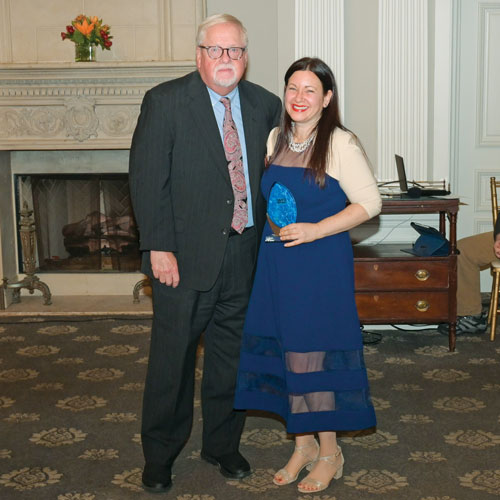
You transformed your karma into your mission! How do you understand “voluntarily assuming the appropriate karma”?
Emily: By transforming our karma, we can show actual proof of Buddhism, inspiring others to challenge their situations too.
Everyone has some difficult karma to work through. For me, bipolar disorder has become my greatest blessing because it was the karma I had to work through to show actual proof of how this practice works. It has become my greatest tool for introducing others to Buddhism and finding my life’s work.
Through chanting and supporting our kosen-rufu movement, I have built a life of my dreams. I have published a book about my experience, won several awards for my work, and now I’m in a loving, healthy relationship, another long-held dream of mine.
Can you tell us more about that?
Emily: While I was growing happier with each passing day, I still felt like something was missing. I wasn’t in a romantic relationship. About four years ago, my therapist told me that I had to become happy within because no one could give me happiness. I realized she was right.
Through chanting, I developed deep appreciation for my life as a single person. I saw that I could care for myself in every way. At the same time, I made a determination to show actual proof that there was nothing we couldn’t accomplish through Buddhist practice. But first, I had to realize my value as a human being and believe I was worthy of a loving relationship.
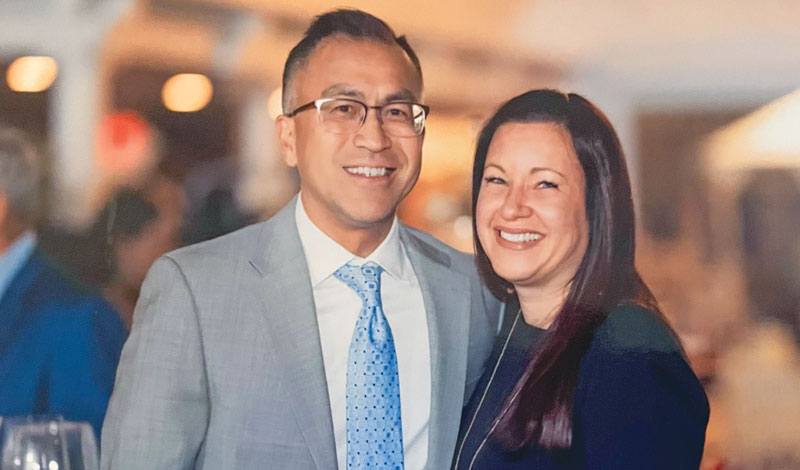
What helped you come to believe that?
Emily: I doubled down in supporting the women in my district, and I began chanting to realize that I am a Buddha.
At first, it was hard for me to believe this with my life, so I found a picture of my first-grade self and placed it near my altar. Somehow, by chanting for that little girl, I could see and believe that she was a Buddha. And if she was inside me, then I had to be a Buddha too. Plagued by low self-esteem my entire life, this was a hard-won realization. For the first time I knew with my life, not just intellectually, that I was a Buddha.
Based on this inner shift, I started dating again and met Cesar. We’ve been together for two years, and the greatest thing is that we complement each other’s already full lives. I’m so grateful to this Buddhist practice for enabling me to meet such a wonderful man.
Each day, I determine to be the best partner I can be. Now, I share my story with women of every age—that the key to healthy relationships is to recognize that we are Buddhas; a realization that only comes through consistent daimoku, and working for kosen-rufu.
This, too, is something I chose as my karma to encourage others.
Do you have any advice for those challenging difficult circumstances?
Emily: Chant consistently. I once had a senior in faith tell me, “Your life is up and down because your Buddhist practice is up and down.” My life really stabilized in a beautiful way when my chanting became consistent. Also, chant to never, never, never give up. When we come up against a wall, our daimoku breaks it down brick by brick, and Ikeda Sensei says that what lies on the other side is a vast expanse.
What is your determination for the future?
Emily: I strive to be a light for everyone around me and shakubuku others through my presence. I want to contribute to a more peaceful world by helping others discover their true happiness, and I will continue to use my experiences to do so.
From the August 2026 Living Buddhism
References
- The Lotus Sutra and Its Opening and Closing Sutras, p. 200. ↩︎
- “The Opening of the Eyes,” The Writings of Nichiren Daishonin, vol. 1, p. 243. ↩︎
- The New Human Revolution, vol. 30, pp. 838–39. ↩︎
- A Religion of Human Revolution, p. 92. ↩︎
- Ibid., p. 91. ↩︎
- June 2018 Living Buddhism, p. 5. ↩︎
- “Lessening one’s karmic retribution”: The principle that one can experience the effects of bad karma from the past to a lesser degree because of Buddhist faith and practice. ↩︎
- The Wisdom of the Lotus Sutra, vol. 3, p. 252. ↩︎
- Ibid., p. 253. ↩︎
- The New Human Revolution, vol. 9, revised edition, pp. 273–74. ↩︎
- A Religion of Human Revolution, p. 96. ↩︎
- Toward a Century of Health, pp. 16–17. ↩︎
You are reading {{ meterCount }} of {{ meterMax }} free premium articles