
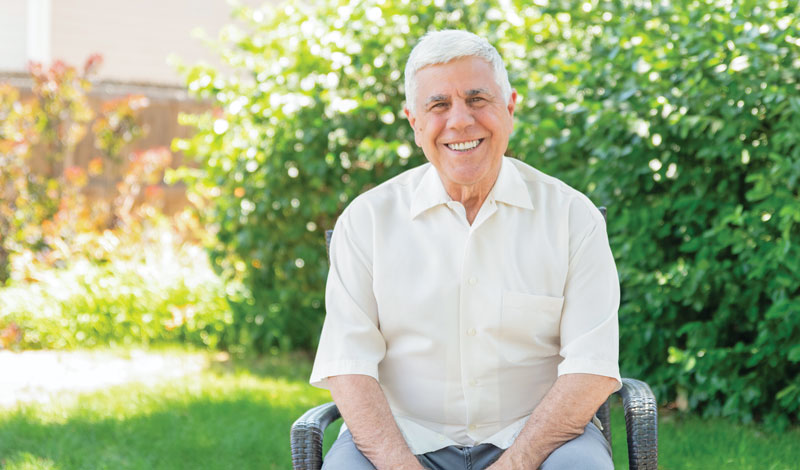
Living Buddhism: Dennis, you’ve been a Coloradan for over 70 years, but spent the first five years of your life in Manhattan. A great deal happened in those five years. Can you take us back there with you?
Dennis Angelo: Sure, those memories are still vivid for me. Summers, kids played stickball in the streets, which grew blazing hot at midday until a fire hydrant was cracked open. I remember my father’s Plymouth with its wide backseat and the smell of cigarettes. And I remember my father waving from a fifth story window of Knickerbocker Hospital and me waving back to him one last time.
He was sick.
Dennis: He got cancer and died soon after. My mom was on her own for a time. Then she remarried a close friend of my dad’s who with him had managed our apartment. But not long after this, though, he died as well, stabbed over a tenant’s dispute. We heard the entire incident through the walls of our room—this, too, I remember.
We could not afford to live on our own in the city, so my mom sent me to my aunt’s in Colorado. Three months later, my mom and my two older siblings came too, but those three months for me were deeply painful.
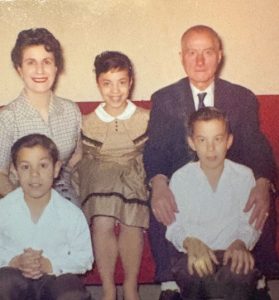
Tell us about your early years in Denver.
Dennis: In Denver, my mother worked two jobs to support her three kids, while I, for my part, got in trouble. Climbing tall buildings was something I loved—in fact, I’d scan for this particular crane commissioned only for tall buildings. Its turquoise ladder was easy to spot and ran all the way up to the operator’s cab. The thrill of the climb and 360 view of the city were for me, reward enough. But as I fell in with bad friends, I put my skills to bad use—by the age of 12, I was known for stealing from upper floors, what police called “a second story man.”
What pushed you off that path and onto a better one?
Dennis: Buddhism, no question. At 19, in April 1969, a friend took me to a meeting. I was met at the door by the sound of Nam-myoho-renge-kyo being chanted by people of every age and color inside. Though entirely different from the crowd I’d grown up with, I sat down, feeling right at home. At the time, I sold drugs, and got a call from a buyer, but on that day answered: “Not now, I have something more important to do.”
This practice and community set my life on a new trajectory, though not, for me, a straight one. I quit my practice at one point, then started again—I stumbled, course-corrected and pressed on. A moment I consider a concrete checkpoint is when I first learned the Buddhist concept of sansoshima—or, in English, “the three obstacles and four devils.” These are the forces that work to prevent a person of faith from growing and fulfilling their life’s mission.
Just as rockets must fight enormous gravitational forces to launch into space; as planes face headwinds to take flight, a person of faith striving to develop himself will contend with the three obstacles and four devils. You can see why, for a young man who, all his life, had been pulled toward all the wrong things, this concept was a revelation and touchstone.
I started to study as I hadn’t before, to listen and ask more questions. Why are we born with the karma we have, and how can we transform it? The more that I studied, the more empowered I felt, perceiving that my causes—good or bad—had a real effect on me and others.
Within two years of Buddhist practice, I’d left a minimum wage gig for a union job that quadrupled my pay. The most legitimate money I’d made in my life got put to legitimate uses. My mom, for the first time from me, had help with the groceries and rent. I was beginning to understand that I owed a debt of gratitude to others, for all the ways they supported my life.
And you, in turn, began to support others.
Dennis: I did, especially as a Soka Group member behind the scenes. I married my first wife, and we had two beautiful children—my daughter, Alyx and my son, Steven—and supported them the best that we could. But as I said earlier, my path was no straight line—when we divorced, I spiraled completely. I began to self-medicate, crashed out, lost my car and struggled to show up to SGI activities.
Fortunately, I had a friend in faith who had the courage to tell me I needed to change. I got away from bad influences and moved in with my mom, where I slowly rebuilt my life. I began chanting on Saturday mornings with a group of young men, with whom I vowed to not miss this commitment.
But one Friday night, at a party with colleagues from work, one pulled out a bag of cocaine. On his invitation, I used and that night barely slept, but in the morning dragged myself to morning daimoku. That morning, with the guys, I thought to myself, I don’t want to feel this way ever again. And from that day forward, I never relapsed. I owe this to those Saturday morning chanting sessions.
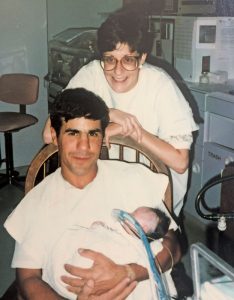
You met your wife, Elaine, in 1984 and married the following year. Two years after that, your daughter, Jenny, was born. Tell us about that day and how it changed you.
Dennis: Jenny was born fighting for her life, fighting for and from her first breath. Born with multiple birth defects, we were told she would not likely survive. Rushed to Children’s Hospital as soon as she was born, she spent nine months there in intensive care. The cost without insurance ran into the millions, but between private and public insurance, we hardly paid a thing. After nine months, we came home with Jenny, with a cart of medical equipment, some training and many fears.
We received three points of guidance from a senior in faith in the first few terrifying days of Jenny’s birth. The first was to never quit practicing; the second was that by chanting Nam-myoho-renge-kyo we could turn suffering into joy; and the third was to pray that Jenny would one day practice this Buddhism herself so that she could change her own karma. The point was that Jenny was not a problem to be managed. She had a mission that was hers alone. And part of this mission,
I would soon find, was to awaken me to mine.
Chanting for Jenny’s victory, I decided who I wanted to be. All my life, I’d half-blamed my mistakes on the fact that I’d grown up without a father. But Jenny reminded me every day that there were those who depended on me. My fears subsided, and I saw what an extraordinary opportunity this was. It was time, for Jenny’s sake, that I become the father I’d never had.
She really propelled your growth.
Dennis: Definitely. For me and also for Elaine, Jenny’s greatest advocate for decades. Elaine learned to navigate the legal landscape for Jenny’s care, eventually receiving pay for the work she’s done as a mother since Jenny was born.
We both felt called to deepen our prayer and wrack our brains to come up with solutions. For years, I’d worked in stucco and plaster at an hourly rate, but was increasingly outdone by the younger guys, their sheer energy besting my skill. I saw that I’d need to strike out on a completely new path if I wanted to support my family. In 1990, with abundant daimoku, I gained the wisdom and courage to launch my own stucco business.
That must have been scary at a time like that.
Dennis: It was scary—I couldn’t afford to fail. By this point we’d had our son, Ben—maybe 1 year old at the time. Elaine’s income was our major source of income as I got the business off the ground. We tightened our belts, and I dialed in on expenses, channeling my savings toward materials and personnel. Fully focused on demonstrating actual proof, the business slowly gained a good reputation and trust. Within one year, I’d secured enough scaffolding for four custom homes, and these were contracted all at once. By our fourth year in business, the returns were enough to build a custom home of our own, with easy access for Jenny. For 25 years, the business thrived.
Ikeda Sensei writes, “The sun of happiness rises brightly in the lives of those who valiantly take on, here and now, the challenges presented by their circumstances, their lives, and the struggle of kosen-rufu.” (The Wisdom for Creating Happiness and Peace, part 2, revised edition, p. 55).
Over the past 20 years, I’ve reinvented myself several times, always basing myself on faith. Since 2009, I’ve run my own delivery service, bringing ice and gourmet chai all over town.
In my 40 years in Arvada, I’ve seen the city change a lot. After the pandemic, people’s sense of connection was weakened, and with it their trust in one another. In the summer of 2021, there was a fatal shooting in the town square, which contributed to a climate of fear. I felt that something had to change, and I began asking myself what that was. Of course, Buddhism is clear: We ourselves must change first if we want to transform our environment. I began asking myself, in front of the Gohonzon, what were the ways that I needed to grow.
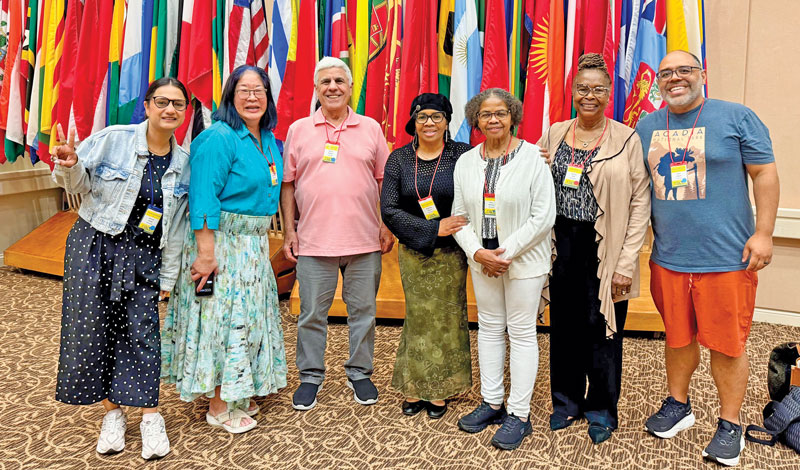
In October 2023, I attended the SGI-USA Florida Nature and Culture Center, where I wrote a memo to Ikeda Sensei. It would be the last letter I’d write to my mentor while he lived. “I am the one,” I wrote, “and now is the time to establish the youthful foundation of peace in the place where I live.” I meant that I would stand up, not waiting for help, to introduce and foster young people of faith.
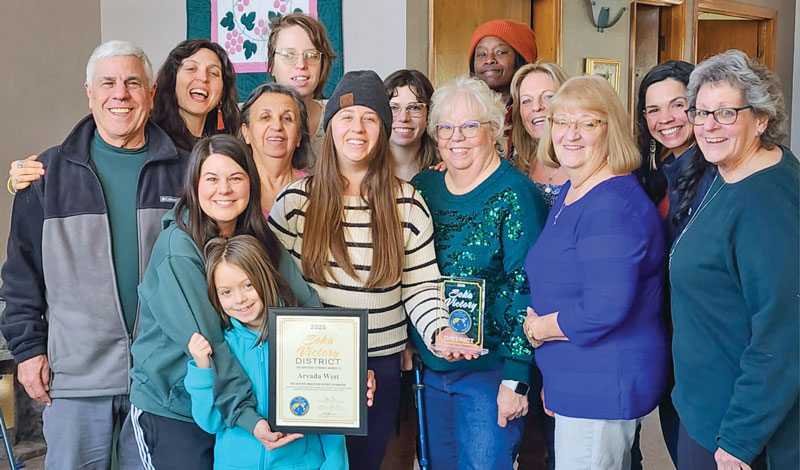
Coming back to Arvada, I spoke with my wife, then my district team. We began to open our home every Tuesday night for SGI members and their friends to chant. I know firsthand how transformative this can be—having a time and a place where you can reliably chant with your friends. We gear the meeting toward the person youngest in faith, holding an intro if we have guests, a slow gongyo for new members, or, if we’re all seasoned long timers, a chanting session. As we did this, people began showing up—first a handful, then a dozen, then 20. It grew rather quickly and to our surprise, became a place where people wanted to bring their friends and grow together
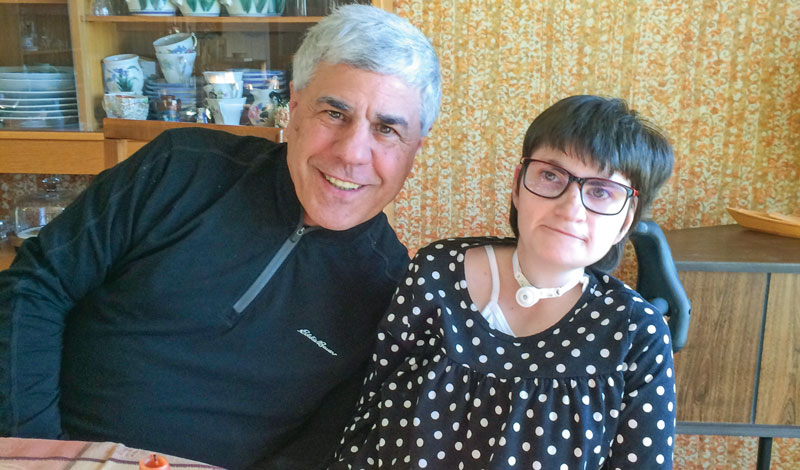
in faith. In the past two years, nine people have received the Gohonzon in our district, and we are all growing together in community. What’s more, Jenny looks forward to these, calling the young women who come “the chanting girls.”
“When will the chanting girls come over?” she asks Tuesdays of me and Elaine.
Just this past June, we had a huge celebration commemorating the 30th anniversary of Sensei’s visit to Denver. We pulled out all the stops, with singers and bands and all kinds of performances—one of which I joined, playing harmonica. We had breakout discussions throughout the center on various themes. Our beautiful new center seems to shine with its own shakubuku spirit—people simply passing by deciding to stop in. One woman who came by got to talking with me and the others at the door. Though we’d just met, she felt comfortable enough to share that she was in the process of a divorce.
“I was married five years, my first marriage,” I told her. “We divorced and it felt like the end of the world. Then a few years went by, and I met Elaine and we’ve been married for 41 years. As for my kids, I’m tight with all four—from my first and my current marriage.”
She looked pleased—excited, even, it seemed, to be met with such optimism. “That’s what I’m talking about!” she said. She stayed a good while, just talking with us, and has since been back for several activities.
It reminded me that what people are looking for most is what I was so fortunate to find at 19. They are looking for optimistic people, who have climbed from suffering to the summit of happiness, who can say, “I love my life.”
You are reading {{ meterCount }} of {{ meterMax }} free premium articles