
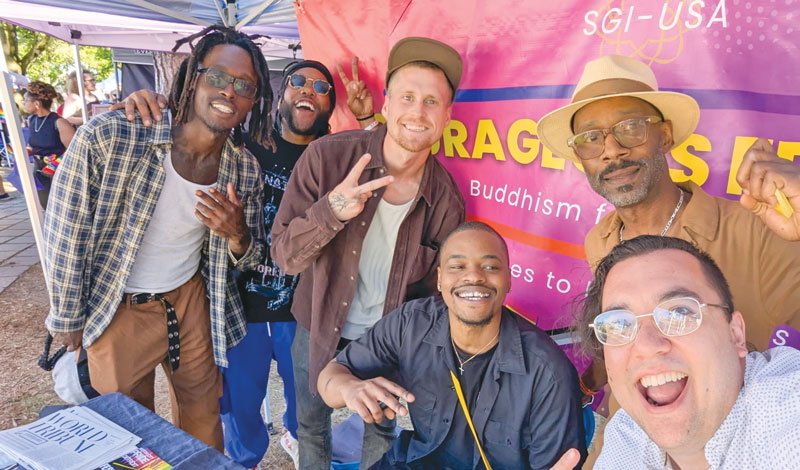
This section features Ikeda Sensei’s seminal guidance to the members of the United States. The following is an excerpt of his speech given at an SGI-USA representatives training session in Miami, March 11, 1993. The full speech can be found in My Dear Friends in America, fourth edition, pp. 272–77.
A Satisfying and Invigorating Gongyo
Nichiren Daishonin teaches that the object of fundamental devotion (the Gohonzon) exists within our lives. He inscribed the Gohonzon so that we common mortals may bring forth the brilliance of this inner object of devotion.
We must never forget this basic point. We ourselves hold the fundamental key, every one of us. We practice faith so that we may proudly hold our heads high and, in our respective spheres, lead the most valuable lives in which all our desires are fulfilled.
By reciting the sutra during gongyo, we humbly praise the Buddha, which means we are automatically praising and reinforcing to the utmost our own Buddhahood.
Chanting daimoku allows us to accumulate the supreme treasure of the universe in our lives day by day. The origin of the universe is Nam-myoho-renge-kyo, our lives are Nam- myoho-renge-kyo and the Daishonin’s name is Nam-myoho-
renge-kyo. Chanting daimoku enables us to tap this supreme power in our own lives and, at the same time, make it resonate powerfully in our surroundings. Therefore, we need fear nothing.
In “Offering Prayers to the Mandala of the Mystic Law,” the Daishonin writes that the four great bodhisattvas will surround and protect those who embrace the Mystic Law, walking by their side at all times on the journey through life (see The Writings of Nichiren Daishonin, vol. 1, p. 415).
Formality is not important. There are no rigid formalities for gongyo laid down in the Daishonin’s writings. What counts is that gongyo refreshes and invigorates your lives.
Just as a morning walk or jog may be pleasantly exhilarating for both the body and the mind, please do a gongyo that is personally satisfying to you—one that leaves you feeling refreshed and uplifted both mentally and physically. …
Cherishing Those Around Us
Nichiren Daishonin strongly desired that his followers play an active part in society, while treasuring others with open, magnanimous hearts. In a letter to Shijo Kingo, he writes: “I am most grieved over your lord’s illness. Although he has not professed faith in the Lotus Sutra, you are a member of his clan, and it is thanks to his consideration that you are able to make offerings to the sutra. Thus, these may become prayers solely for your lord’s recovery” (“The Three Kind of Treasure,” WND-1, 848).
Though this passage refers to Shijo Kingo’s lord, it should by no means be taken to imply that Buddhism encourages feudalistic mores and values. Worthy of greatest respect is our humanism with which we pray ceaselessly for the health and happiness of all with whom we have a connection, whether or not they practice Buddhism. Our practice of faith enables us to illuminate everything in our environment with the sunlight of unlimited fortune and benefit.
While in Rio de Janeiro, I met a female pioneer who had contributed greatly to the development of kosen-rufu in that country. She was accompanied by her husband, who was not a member. I said to him: “I hope you will make your business even more successful and that you will cherish your wife even more dearly. This in itself represents faith.” I made this remark based on the aforementioned passage from Nichiren’s writings.
There is absolutely no need to feel constrained or ill at ease because some members of your family are not practicing. I hope you will lead your families wisely and cheerfully toward harmony and happiness.
As good sons and daughters, we should take care of our parents whether or not they practice faith. It is the same in our relationships with our partners. We practice faith so that we may become exemplary children, partners and parents.
In stark contrast to this spirit of generosity is the elitist mentality that rejects those who are not practicing and the self-righteous logic that asserts, “I’m practicing, so anything I do is perfectly fine.” Nikken [former Nichiren Shoshu high priest] is the ultimate example of this. …
Glorious Sunshine State
Florida, which is home to Miami, is truly the glorious Sunshine State. It overflows with the sun’s blessings. It is also a pivotal gateway to Latin America, Canada, Europe and Africa. And, what’s more, there are no earthquakes! …
Let us contribute further to the prosperity and development of the southeastern part of the United States. Plans for the Florida Nature and Culture Center are only the beginning. When the new center is finally opened, I hope you will treasure it as you would your own homes. The care you put into looking after the castles of Buddhism—our SGI centers—translates into your own good fortune.
Please strive to live with a heart so rich that, should you quarrel with your partner, after the storm has blown over, you can say: “Honey, let’s go to the palace of hope. Let’s visit the castle of eternity!” and then walk hand in hand to this golden abode.
The Land of Eternally Tranquil Light (the Buddha land) does not exist in some distant place nor is it imaginary. It is to be realized in our actual lives and in the actual land in which we dwell. …
With broad-minded and generous hearts as wide as today’s expansive blue skies, may all of you who reside in this wonderful paradise further extend our network of friendship.
Praying for your increasing good health, longevity, wealth, freedom from accidents and abundant happiness, I close today’s speech. Thank you very much.
You are reading {{ meterCount }} of {{ meterMax }} free premium articles