

Human revolution is a term we often hear in our Buddhist practice. At its core, Ikeda Sensei described it as “the transformation of one’s life and one’s karma. It is the achievement of true happiness and fulfillment. … It is the foundation for peace.”[1]
Achieving this inner transformation doesn’t happen all at once. It involves strengthening our resolve to improve ourselves, even just a little each day. Sensei emphasized that “Nichiren Buddhism is a philosophy of human revolution.”[2] He went so far as to say that “nothing is more important in life than achieving human revolution.”[3]
Let’s explore what human revolution truly means and how to carry out this profound, life-changing process.
The Origins
Second Soka Gakkai President Josei Toda was the first to use the term human revolution within the Soka Gakkai. Imprisoned during World War II for standing up to Japanese militarism and refusing to abandon his Nichiren Buddhist practice, he experienced a profound awakening while incarcerated. Through repeatedly reading the Lotus Sutra, he awakened to the realization that “the Buddha is life itself.” This realization sparked a deep inner transformation that he later called “human revolution.”
Upon his release, he was confronted with the devastation of postwar Japan. He felt a powerful mission to share Nichiren Buddhism—a profound practice and philosophy capable of empowering people to rebuild their lives inside and out. His own transformation was a fundamental shift from living a life based on self-interest to living with a mission to propagate the correct teaching of Buddhism for the happiness of all people.[4]
President Toda used the term human revolution to describe the process of attaining Buddhahood in this present existence—a radical departure from the prevailing belief in Japan at the time that enlightenment was achieved only after death.
His disciple, Daisaku Ikeda, later serialized the novel The Human Revolution, chronicling President Toda’s efforts to spread Buddhism. The spirit of the novel is captured in its well-known line: “A great human revolution in just a single individual will help achieve a change in the destiny of a nation and, further, will enable a change in the destiny of all humankind.”[5]
What Is Human Revolution?
While the word revolution often suggests political or social upheaval, in this context it signifies a dramatic inner change. Doing our human revolution means “transforming our state of life at the deepest level.”[6] In the Buddhist view, it means shifting our fundamental life state from being mired in the lower six paths to living with Buddhahood at the center of our lives. Sensei explained:
People spend their days fussing and fretting about immediate, minor problems, and before they know it, their lives are over. Many end their lives still trapped in the cycle of the six paths, or lower six worlds—that is, the worlds of hell, hungry spirits, animals, asuras, human beings and heavenly beings.
Human revolution is a revolution in our actions and behavior. It means to purposefully engage in behavior that is grounded in compassion, in actions that break free from the cycle of the six paths and bring us to the worlds of bodhisattvas and Buddhas.[7]
His words “purposefully engage” indicates an active, intentional effort to diligently chant Nam-myoho-renge-kyo, become aware of our innate tendencies and take responsibility to become the best version of ourselves.
Sensei wrote: “Faith can enable us to counteract the negative aspects of our personality and bring out positive aspects. … Buddhism teaches the way that each of us, just as we are … can realize happiness by bringing out the best of our innate disposition and potential.”[8] Rather than denying our flaws, we can transform them into sources of value and strength.
Human revolution is not anything special. It takes place when a young person who dislikes studying decides that they will make an effort to study for the sake of their future. Or when a parent, who was previously only concerned with the happiness of their family or friends, decides to go beyond their limited realm of concern and reaches out to those who are suffering to find a way to enable them to become happy.[9]
Sensei once outlined seven indicators of human revolution—health, youthfulness, good fortune, wisdom, passion, conviction and victory.[10] These qualities help us concretely gauge how our inner transformation is taking root in our daily life.
Moreover, he stressed that “being a true Buddhist practitioner also requires bringing forth one’s compassion, which embraces all of these characteristics.”[11] President Toda acknowledged that it’s not always easy to embody compassion. But acting with courage translates into compassion. “Human revolution,” Sensei said, “ultimately means awakening to our mission as a Bodhisattva of the Earth and striving joyfully and courageously in the effort to realize kosen-rufu.”[12]
What Does It Mean to ‘Do’ Our Human Revolution?
What does it mean to engage in our human revolution? It means establishing a life state of absolute happiness. Each of us has our own karma and, therefore, our own unique challenges to grapple with. Whatever personal struggles we may encounter, committing to “do” our human revolution by facing those challenges head-on with faith and transforming the situation is the first step to inner change. Additionally, we can take these three steps.
First, we chant to the Gohonzon—the object of devotion established by the Daishonin to enable all people to reveal their inherent Buddhahood.
Sensei says, “It is by believing in the Gohonzon and dedicating ourselves to the mission of working for the happiness of humanity that we can bring forth the Buddhahood within our own lives.”[13]
Through chanting Nam-myoho-renge-kyo to the Gohonzon, we can always find a path forward to create value from any challenge we face. The key lies in building a strong life state that nothing will shake. Sensei vividly describes this:
Living in this saha world, it is impossible to stop the winds of suffering from blowing. Our only alternative is to become strong. When we develop dauntless fortitude, like mighty trees, we will be untroubled by even the most powerful gales. In fact, we can even find them exhilarating. The aim of our Buddhist practice is to carry out our human revolution so that we can lead such lives and develop such inner strength.[14]
Second, we transform our lives by supporting others. By participating in Soka Gakkai activities and working for the happiness of others, we can break out of our narrow, selfish concerns and expand our life state. “The commitment to others’ well-being propels us to transform our own life condition and carry out our human revolution,” Sensei writes.[15]
Third, we advance through cultivating our bond of mentor and disciple. Sensei’s own human revolution unfolded through his vow to fulfill President Toda’s vision for lasting peace. Looking back on his own journey, he said, “When one is completely dedicated to the path of mentor and disciple, he or she experiences no doubt or confusion, no uncertainty or fear.”[16]
A Change in One Person Has Ripple Effects
One person’s human revolution inevitably ripples outward, leading others toward happiness, “just as splitting one joint in a bamboo stalk leads the way to easily splitting all the other joints.”[17]
The Chinese character for “human being” (ningen) literally means “between people,” reminding us that our lives are shaped through our relationships. As we change, our environment responds. Each moment contains limitless potential to transform our lives and others. Sensei writes:
Through our steady daily Buddhist practice, we quite naturally bring forth from within us the life states of bodhisattva and Buddhahood—which are characterized by a heart or spirit that is steadfast, always victorious, trailblazing, progressing, resilient, resolute, courageous, compassionate, tolerant, encouraging, appreciative and undefeatable. We possess the extraordinary means embodied in the principle of three thousand realms in a single moment of life, which allows us, through a fundamental change in our hearts, to transform ourselves, our surroundings and our society.[18]
Sensei continues:
Changing our hearts is not a matter of doing something that will only temporarily lift our mood or make us feel better, without changing our reality. A true change in our heart is more profound; genuine inner change produces actual change in our lives. Deepening our “heart”—our life state—is the true value of our religion of human revolution. When we speak of obtaining benefit through our Buddhist practice, we are ultimately referring to our inner transformation at the deepest level.
That’s why we need to have a serious attitude in faith. If we allow ourselves to be defeated by negative functions and give in to complaint, our hearts will lose their vibrancy. The subtlest difference in our hearts can produce dramatically different results.
The Daishonin describes the workings of the heart, or life, as being “strict,” adding that every one of the three thousand realms exists in our lives (see The Record of the Orally Transmitted Teachings, p. 22). Our hearts determine whether we attain Buddhahood. That’s why “it is the heart that is important.”[19]
Changing Our Inner Life State Can Transform the Land
Sensei reflected on how hundreds of millions of people experienced hellish suffering from two world wars, considering what caused such deep misery. He concluded: “If we ponder that, we arrive at the inevitable conclusion that human beings themselves must change—that we must transform ourselves into beings of compassion.”[20]
History has seen many kinds of revolutions—political, social, economic, cultural, technological. But without inner change, external reforms alone cannot bring true improvement. This is the reason Sensei shared that human revolution is the most essential revolution in the 21st century.
Nichiren Buddhism teaches the oneness of life and its environment: Society reflects the hearts of the people who live there. Nichiren writes: “If the minds of living beings are impure, their land is also impure, but if their minds are pure, so is their land. There are not two lands, pure or impure in themselves. The difference lies solely in the good or evil of our minds.”[21] Lasting social change therefore begins with transforming ourselves.
It’s Time to Create Our History of Human Revolution
Human revolution is not a goal, but rather an endless journey of growth. Every moment is a fresh opportunity to renew our determination to keep growing. “We will never hit a limit, a dead end, in our journey for self-perfection. Faith is the engine, the power source for our ongoing human revolution,” Sensei shared.[22]
In his afterword to The New Human Revolution, Sensei, who appears in the novel as Shin’ichi Yamamoto, urges us to live as actors of the great drama of human revolution:
It is my sincere hope that Soka Gakkai members will make the completion of The New Human Revolution a fresh starting point and stand up as “Shin’ichi Yamamotos” to work for the happiness of others. I pray that, through their tireless, tenacious efforts, they will create their own brilliant history of human revolution.[23]
Through the process of continuously transforming any poison into medicine and overcoming all obstacles, we can establish the life state of absolute happiness, in which living itself is joy.
Learning That I Have Infinite Power
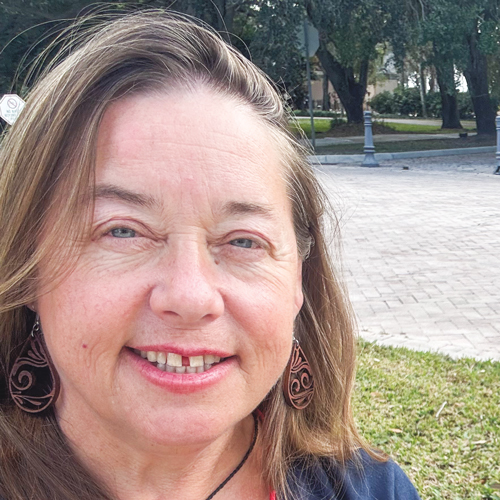
Wendy Markowitz / Half Moon Bay, California
Living Buddhism: Hi Wendy! Thank you for speaking with us today about human revolution. To begin, can you tell us about your childhood?
Wendy: My mom was a preschool teacher, and my dad was a salmon fisherman and a Vietnam veteran who lost half his leg in the war and struggled with PTSD. I had a brother, two years older than me, who had a difficult time in high school. Our home was filled with disharmony—there was frequent fighting, sometimes even physical. It was really difficult to grow up in that environment.
Because of this, my mom and I leaned strongly into Christianity. I remember leading Bible studies when I was 13. I was seeking, asking myself: Why am I here? What is my purpose?
In my freshman year of high school, I encountered a young woman named Tahirih, who was a year older than me. She told me she practiced Buddhism and invited me to a meeting at her house. It was the first time I heard the sound of daimoku. I remember telling her: “There is something that makes you different from other people and this is it.” I immediately started practicing Nichiren Buddhism and started participating in SGI activities.
A year later, in 1984, when I was 15, my mom supported me in receiving the Gohonzon. Two years after that, seeing the changes in my life, she also began practicing and received the Gohonzon herself.
What were some of the first benefits you experienced through Buddhist practice?
Wendy: Anytime there was fighting or issues in my home, I would chant until I could hear everything calm down. That was my first real actual proof of this practice. I realized that one person’s inner change really can transform an entire family.
Looking back on more than 40 years of practice, what would you say have been your greatest benefits?
Wendy: First and foremost is a complete family revolution. Because of my upbringing, I struggled a lot in romantic relationships. In my 20s, I consistently chose the wrong partners and experienced a great deal of suffering. I chanted a lot of daimoku to find the right person.
And I did. My husband is one of the most supportive human beings I know. We have built a beautiful family, with two incredible children. In fact, on our very first date, he took an interest in Buddhism and began chanting right away. Together, we’ve lived and done research in Alaska, New Zealand and other places. I often say I couldn’t have even chanted for someone like him, because I didn’t know such a person existed!
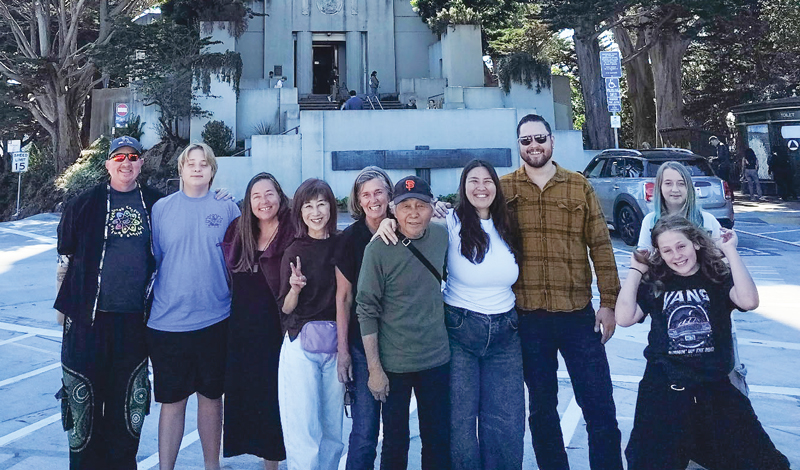
We now have a son in high school and a daughter in middle school. We rarely ever fight, we chant together and we participate in SGI activities together. Our kids love bringing their friends to meetings. It’s a complete 180-degree turnaround from the environment I grew up in.
My other great benefit is my career. No one in my family had gone to college. But when I met Ikeda Sensei in 1993, I made a vow to study dolphins and whales and become a professor. It was a determination that just came out of my life. That was my dream.
Basing my life on Sensei’s guidance, I began believing in myself because he believed in me. I felt like I could do anything. Through my Buddhist practice, I’ve conducted dolphin and whale research with world-renowned scientists and published academic chapters that have been published in textbooks. I recently began my first tenure-track position at Skyline College in the Bay Area, where I’m developing new programs for students.
Incredible! In Buddhism, we often say that our human revolution is the basis for all transformation. What was the inner change that took place for you to build a harmonious family?
Wendy: Growing up, my suffering was rooted in the belief that I had no power. I felt completely at the mercy of my environment and circumstances.
When my father became controlling and we were trapped in an argument, I would chant to communicate—from my Buddhahood to his—and we could talk. That helped me understand the power I have to transform my relationships. By my 20s, I understood that I was no longer a victim of my environment. I could determine the kind of life and environment I wanted to create. Through that, I gained deep confidence in my own power.
When was the first time you heard the term human revolution?
Wendy: I first heard it at a district meeting when I was still in high school. I remember hearing that the human revolution of a single individual can change the destiny of a nation. As a young person I remember feeling so inspired by that. I thought, If I transform my heart, I can change the destiny of the entire world.
That belief—that one life truly matters—became the driving force of everything.
As a teenager, it transformed the way I perceived myself. It opened my life to the life of the universe. I started feeling like, my life is huge! Over time, I came to understand that life brings challenges: illness, mental and physical health struggles, financial difficulties. And I’ve realized that facing these things is my fortune because it allows me to transform something in my life that is inevitably holding me back. If it shows up in my environment it’s because my life is ready for it and now I can revolutionize this aspect of my life, not only for my sake, but also for the sake of my children, grandchildren and seven generations in the future. My human revolution is my chance to become truly happy and contribute to the happiness of others.
In recent years, a family challenge has enabled you to tap into deeper human revolution. Can you tell us about that?
Wendy: Our son, Tanner, has struggled his entire life with emotional outbursts that didn’t make any sense. As a mother, I would always try to fix, fix, fix. Eventually he was diagnosed with OCD, which felt like a monster. It took over our entire household. If your kid is suffering, you want to give him what he needs to feel better. As a mother, I kept trying to fix everything, constantly asking, “Do you need this? Do you need that?” But the harder I tried to control it, the more helpless I felt and the worse it became.
What was your prayer at the time?
Wendy: I was chanting for him to get better, be strong and for him to win. I was chanting this way but, in my heart, I felt hopeless. I couldn’t imagine how this could ever get better. Then one day last summer, while chanting, I realized that I was chanting as if the problem was outside myself. I suddenly understood: this was my karma. It was my mission to transform it.
From that realization, a powerful resolve emerged. I decided the way to change this deeply rooted karma was to do shakubuku—to introduce many new youth to our district. That became my singular prayer.
Once I shifted my prayer, I stopped worrying—and everything began to change.
How did things begin to shift?
Wendy: The first thing that happened was that Tanner told his therapist, “I don’t know why, but it’s suddenly easier not to do the rituals I used to do.” I knew exactly why. His treatment began to move forward dramatically, and for the first time, his hope came from within himself. He started setting his own goals.
In terms of our district, we have welcomed five new members in 2025. The fortune had been there, and guests had been coming out but once I changed the way I prayed, they started expressing interest in receiving the Gohonzon. I also have more awareness for all the young people in my environment, and I share Buddhism wherever I go!
The district leaders are really wonderful and have been making an effort to create opportunities for youth. The women have been holding a consistent gathering for the young women, where they study Sensei’s guidance, and the men have been doing the same for the young men.
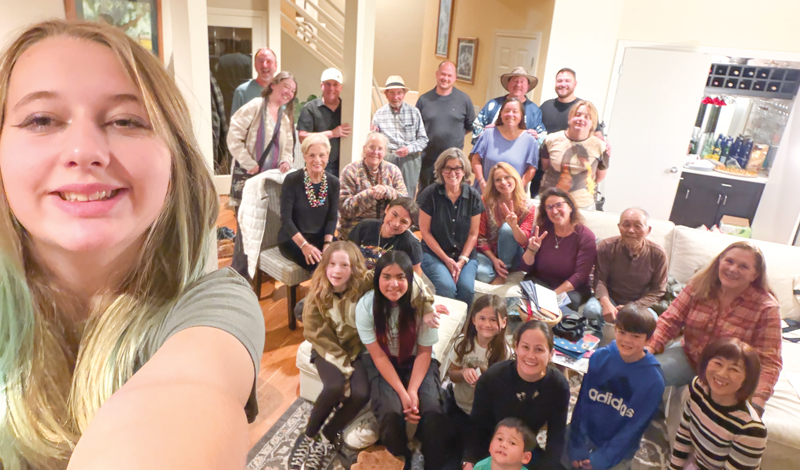
One of my daughter’s friends has been coming to SGI meetings with us since she was 6. One day she asked at an SGI activity, “How can I receive the Gohonzon?” She’s 11. I’ve known her parents since she was 6, so we went to visit them and they said they would love to support her in her Buddhist journey, so she received the Gohonzon in October. With her friends present, we enshrined it in her room. Now she’s teaching her younger brother how to do gongyo.
Another 11-year-old young woman joined last November and has been instrumental in helping her grandmother start practicing again! Seeing these things unfold has been incredibly moving. Because I joined at 15, I have great confidence that these young people can change the karma of their entire family through their Buddhist practice.

How would you explain human revolution to someone who finds it hard to understand how an internal change can impact the outside?
Wendy: I think it’s important to study. There is a Buddhist concept called “oneness of life and its environment.” I remember I got into a fight with my boyfriend. And then I got into a fight with my best friend and I was really struggling. I suddenly realized that, all I have to do is change myself and the shadow, or my environment, will change. I didn’t have to wait for them to change.
And if you really think about it, it makes sense. If something is your karma and it’s been with you lifetime after lifetime, then the entire fabric of your life, the lives of your family, the lives of the people in your environment are all there because of karma. Then of course, if you change, the things around you will change because you are changing the fabric. It would be weird if it didn’t. Human revolution is simply the decision to change your heart or determination. When you do, everything follows.
Any closing thoughts?
Wendy: Although I met Sensei, I formed a relationship with him through reading his guidance. My relationship with him has enabled me to believe that anything is possible. It has helped me realize my vow. If you can seek to unite with your mentor’s heart, you can also open your life up to infinite potential as a human being.
Without Sensei and the SGI, my life would look nothing like it does today. I feel immense gratitude and a strong desire to repay that debt by contributing to the organization, so it continues for generations to come. That, ultimately, feels like my reason for being here.
From the February Living Buddhism
References
- A Religion of Human Revolution, p. 4. ↩︎
- The New Human Revolution, vol. 19, p. 185. ↩︎
- Discussions on Youth, new edition, p. 391. ↩︎
- See The Wisdom for Creating Happiness and Peace, part 2, revised edition, p. 26. ↩︎
- The Human Revolution, p. viii. ↩︎
- The Wisdom of the Lotus Sutra, vol. 4, pp. 217–18. ↩︎
- The Wisdom for Creating Happiness and Peace, part 2, revised edition, p. 6. ↩︎
- NHR-16, 10. ↩︎
- The Wisdom for Creating Happiness and Peace, part 2, revised edition, p. 5. ↩︎
- NHR-19, 85–88. ↩︎
- Ibid., 187. ↩︎
- Ibid., 188. ↩︎
- NHR-14, revised edition, 72. ↩︎
- The Wisdom for Creating Happiness and Peace, part 2, revised edition, p. 49. ↩︎
- NHR-19, 62. ↩︎
- My Dear Friends in America, fourth edition, p. 491. ↩︎
- A Religion of Human Revolution, p. 8. ↩︎
- Ibid., 203. ↩︎
- Ibid., 203–04. ↩︎
- The Wisdom for Creating Happiness and Peace, part 2, revised edition, p. 9. ↩︎
- “On Attaining Buddhahood in This Lifetime,” The Writings of Nichiren Daishonin, vol. 1, p. 4. ↩︎
- Discussions on Youth, new edition, p. 257. ↩︎
- NHR-30, 840. ↩︎
You are reading {{ meterCount }} of {{ meterMax }} free premium articles