
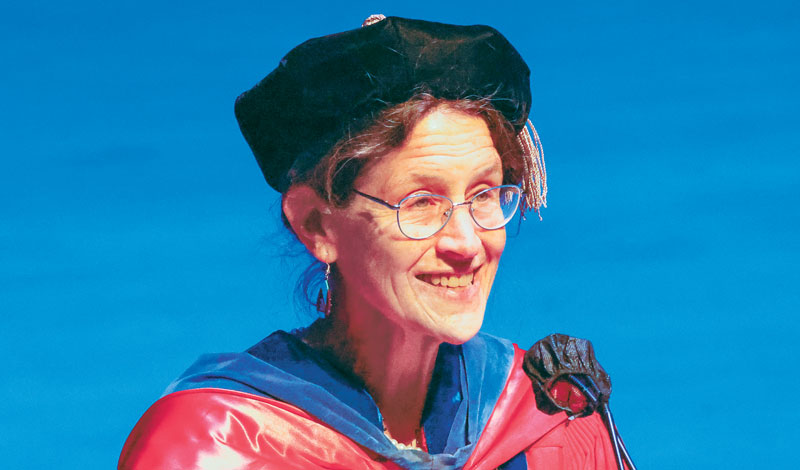
Scholar and author Sarah Ann Wider delivered the keynote address at the Soka University of America Class of 2026 commencement ceremony. In the following excerpt, Wider encourages graduates to inspire hope through imaginative empathy, heartfelt contribution and the shared work of building a world in which all can thrive.
by Sarah Ann Wider
I am so honored and delighted to be here and to celebrate you all. There is nothing like this day and all the days that came before it. I won’t take my hat off to you yet, but we will all toss them in the air later.
“Have you a thought in your heart?” Emerson asks.[1] I reply: So many. So many. Here I am in my mid-April thinking, thinking toward the here of mid-May. There are so many “heres”—so many presents—with us in any moment in time. I invite you into them all. In that “here” of mid-April, I am currently listening to the heartening structures of Baroque music, in this case a stately minuet played by harpsichord, flute and gamba. And now it is May 1, and I am revising steadily away looking out to a still chilly upstate New York spring, and yet, even with the dips back to winter temperatures, the leaves are unfurling their green lace. I am watching patterns of light—in the woods beyond my study window while also enjoying the patterns of light right here within my study, patterns created by a diamond-shaped, flower-filled prism my mother gave me years ago.
Here you can see that moment of which I have given us two iterations, the slight movement of air changing those patterns ever so slightly. I delight in watching these patterns, the moving structures, beautiful in their humanly imperfect symmetries. In fact, I am not looking for perfection but for what a dear friend and colleague calls gentle structures. Here they are, moving before my eyes. And now, here we are, celebrating all the patterns you have learned and entered into, embroidered upon and created in your years at SUA. I am also in yet another “here”—a comparable occasion 45 years ago, my own graduation from college.
I was not the first in my family to graduate from college, and yet that possibility was then still new enough that the occasion sparkled and shimmered with amazement, the unbelievable reality that people in our family were actually attending college, had been able, amazingly, to spend four years dedicated to study. As my mother would have said, “The Wonder of it All.” Then. Now. Here, together in the wonder of it all, this moment that holds so much.
I want to honor those who made our journeys into and through college possible. And of course, some of us never left college, continuing a lifelong journey in places where learning is centered. Who made, who has made, who is making your journey possible? Perhaps they are here with you today. Perhaps they cannot be, at least not in the way that so many of your family members are. Who do you wish could be here now? Invite them into this moment. For me, it’s my own dear parents, my grandmothers, my high school English teacher Genevieve Charron. How they each in their own ways would have loved being here for this occasion.
When I think about my own graduation from the University of New Mexico in 1981, I think also about how SUA existed then simply as an imagined possibility. The first entering class was 20 years in the future. But a thought experiment for a moment: Had your school been up and running then, how I would have loved being here, learning with you all in a place created with such deliberateness, such considered understanding for how thought comes to life—how we come to life by thinking together in surroundings that both affirm and challenge. How well you each know this care, each in your own ways.
That said, how grateful I am to have learned where I did. I share a few memories by way of invitation, so that you, dear graduates, can imagine your own comparable moments, remembering always how momentous such seemingly slight moments can be. …
“Take to heart”: a phrase I have long loved. What is it we take to heart, especially now in these oh so disheartening times. We know what disheartens us, perhaps all too well: in a word, cruelty, whether that is cruelty from one human being toward another or by one government toward those who differ from them or through actions that harm the very planet itself.
Yes, we know all too well what disheartens, as did many before us, as did Ralph Waldo Emerson, 175 years ago. Emerson writes: “It is cheap and easy to destroy. There is not a joyful boy or an innocent girl buoyant with fine purposes … but a cynic can chill and dishearten with a single word. Despondency comes readily enough to the best and most sanguine.”[2]
Many of us have experienced that ready despondency, that quick and cruel disheartening blow, whether in our own experience or seeing it play out for another; a person—and their ideas and their gifts and what they hoped to contribute—cut down by a single mean-spirited remark. In Emerson’s words, along comes a “witty malefactor” who diminishes and demeans “[our] little hope.” Yes, that diminishment and demeaning are easy, Emerson writes—all too easy and all too gaping a failure of imagination, of possibility, a misuse of human intellect. He concludes, “To help the young soul, to add energy, inspire hope and blow the coals into a useful flame; to redeem defeat by new thought and firm action, this, though not easy, is the work of divine men.”[3]
Emerson’s words resound across the years and speak directly to our time … Recently, we have seen far too much from so-called leaders who claim divinity for themselves. I turn away from that fatal folly and toward the guiding principles for global citizenship that Daisaku Ikeda laid out in his Teachers College address in 1996.[4] I would rewrite Emerson’s words this way, creating what you might call an Emerson-Ikeda collaboration: “To help all, to add energy, to inspire hope by new thought, by firm action, perceiving the interconnectedness of all life, recognizing the inherent equality and possibilities within all people: that is the work of imaginative empathy.” That is the work of heartening. …
This is not a world existing solely in our imaginations but one we bring into existence each day, acknowledging and celebrating all we have found, learned, envisioned—our profound interconnectedness in this shared world, joining together in this shared work—to be the hearteners of the world.
June 5, 2026 World Tribune, p. 9
References
- Ralph Waldo Emerson, The Letters of Ralph Waldo Emerson (New York: Columbia University Press, 1939), vol. 1, p. 95. ↩︎
- Ralph Waldo Emerson, The Journals and Miscellaneous Notebooks of Ralph Waldo Emerson (Cambridge, Massachusetts: Harvard University Press, 1977), vol. 13, p. 51. ↩︎
- Ralph Waldo Emerson, Success (Boston and New York: Houghton Mifflin Company, 1912), pp. 62–63. ↩︎
- See “Thoughts on Education for Global Citizenship,” My Dear Friends in America, fourth edition, pp. 447–57. ↩︎
You are reading {{ meterCount }} of {{ meterMax }} free premium articles