
by Teiki Guilloux-Chevalier
Henderson, Nev.
I was ready to leave it all behind—roofs, credit cards, beds and phones; roads and cars—the whole of society.
In 2017, the plan was simple: Go live in the Amazon, just me and my friend, Austin, forever. We knew none of the laws that stood in our way, and it wouldn’t have mattered if we had. Having thrived for weeks in Utah’s national forests in winter, we found the laws were the lesser part of the challenge.
I met Austin the year my family moved to Las Vegas, a place that shocked me as much as if we’d moved to the moon. The desert could not have felt more different from the ocean reefs and rainforests of our native Raiatea, in French Polynesia. From the day we met, we were best friends and kept as close to each other as our own shadows. We both became athletes—soccer, basketball, cross-country, boxing—and continually upped the challenge. We’d upped it and upped it and now, in our early 20s, the next proper challenge felt obvious: the Amazon.
Before leaving the country, we had to gather a few things—Austin’s gear from his parents’ home in Washington. But halfway through Northern California, in the dead of night, police pulled us over for speeding. Austin, who was always afraid of police, panicked and made a wrong move; the police opened fire.
Instantly, Austin was killed. Bullets rained all around. Stepping out with both hands up, I immediately crumbled to the ground. I’d been shot in the back but felt no pain at all. I stayed conscious all the way to the hospital. There, the doctor told me I’d never walk again. The bullet had severed my spine.
For days, the scene replayed in my head: Austin dead, the whistling of bullets flying by and the CT scan of the one that would remain, just behind my heart, inside my body. I should be dead, I thought. Mixed in with the grief and shock was wonder at the fact of my life. The only thing I felt for sure was that there was a reason I hadn’t died yet. Whatever that was, I had no clue. Figuring that out had been Austin’s last and greatest challenge to my body and spirit.
My family had a Christian background, but over time we’d become more spiritual than religious, per se, as we come from a deeply spiritual people. There’s an understanding of life among our culture that’s been handed down generation after generation. We believe that all things are connected, animated and endowed with mana—the fundamental life force of the universe.
The year after I was shot, my uncle visited Vegas and happened to drive past the local SGI Buddhist Center. Intrigued, he popped in and felt a profound connection with what he found there. When he returned to Tahiti, he was a practicing Buddhist—this was all that I knew. That and the fact that each time he visited Vegas, he seemed calmer, sharper and more fully himself. Before I ever heard the phrase Nam-myoho-renge-kyo, I saw that it worked for my uncle.
In the meantime, I did what worked for me—trained my body and mind. I did whatever I could to keep sharp, but often, I was distracted by doubt and regret. Quietly, I’d given up on certain ambitions, like starting a business or driving a car. This wasn’t like me at all, and yet, that’s how I’d become.
Everything changed last year, in summer, when I met a football recruiter at my cousin’s high school graduation. I was confused when he asked me if I played any sports. “No,” I said. “But I really want to.”
He told me about wheelchair football—football for disabled people. He recruited players for the Las Vegas Raiders wheelchair football team, which practiced at a local gym. Their next practice, I was there.
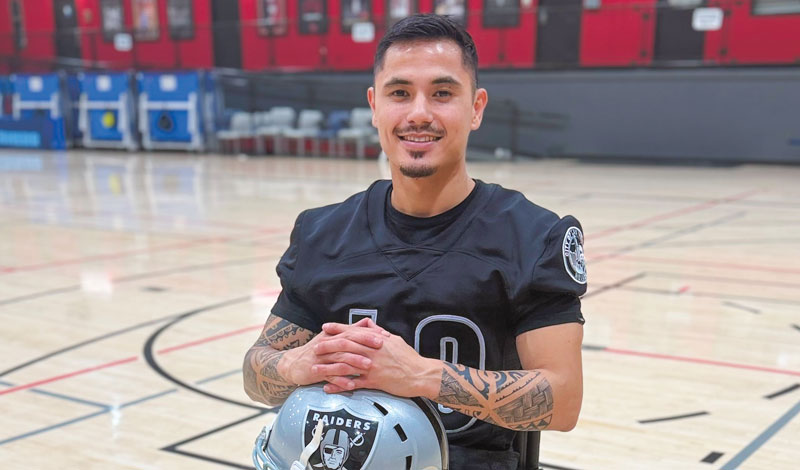
I’d never touched a sports chair before, and the one I was offered was made for someone 7 feet tall. As I climbed in, I felt like I was piloting a tank. Stiff and heavy and comically huge, still, in that thing, I flew. Apparently, though I’d been eight years without the use of my legs, I hadn’t lost a shred of my instincts. That day, I was brought on the team.
That first season, I finished as rookie of the year, playing wide receiver and defense. As the season ended, my uncle visited again, and this time, my father asked about Nam-myoho-renge-kyo. Intrigued, he went with my uncle one morning to chant. My brother and I went too.
Like my uncle, it was one and done for me—from my first chant, I knew it was for me. Its energy resonated deeply with me—and I found in this practice so much of what I already believed. After this, all of us began chanting—my brother, my dad and I. My mom later joined in as well, feeling energized, more present and focused.
My brother, when he went off to finish his senior year of college, brought with him the book, Discussions on Youth. A dialogue between Ikeda Sensei and high schoolers, it contained this passage my brother sent me at the start of this year’s football season.
Nothing is irredeemable in youth. Rather, the worst mistake you can make when young is to give up and not challenge yourselves for fear of failure. The past is the past and the future is the future. Keep moving forward with a steady eye on the future, telling yourselves: “I’ll start from today!” … This is the essence of Nichiren Buddhism. … This is the heart of chanting Nam-myoho-renge-kyo (new edition, p. 26).
Chanting, I’ve engraved this message deeply in my life: live today, in the moment. Instead of daydreaming or regretting the past, my prayers focused me on winning right now—a powerful truth my Buddhist friend, now my soul brother, has often impressed upon me as well. This year, on May 3, I received the Gohonzon, wanting to discover just how much I could evolve, how many people I could inspire.
Last month, we began the new football season, which kicked off with announcing team captains. Our coach named one—an absolute veteran, who’s been captaining the team for years. And then he turned to me and said my name. I looked to my soul brother in shock (he drove me that day), but he just smiled and nodded, as though to say: You deserve it. On the drive home, he said, “You’ve got to tell your mom.” I called her and told her and the first thing she said was, “Teiki, it’s the chanting!”
Maybe the best way to describe how I feel about this is to describe how I feel about something else. Soon after I received the Gohonzon, I received something else—a tailored sports chair of my own. All season long, I’d been piloting that cumbersome tank, and still, I’d been making it fly. With the new chair—the one made just for me—I discovered that I was a rocket. That’s how I feel about my Buddhist practice—with wings, the sky is the limit.
You are reading {{ meterCount }} of {{ meterMax }} free premium articles