
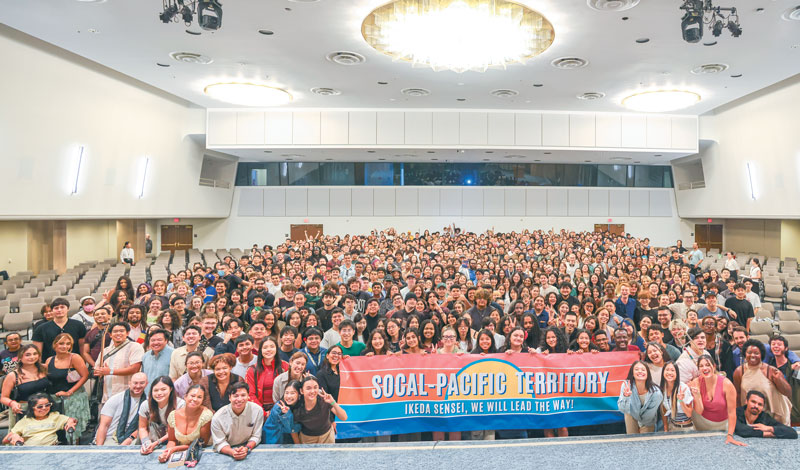
Thirty years after Ikeda Sensei’s 1996 visit to the United States, more than 800 young members and guests filled the SGI-USA World Culture Center in Santa Monica for a youth peace celebration on Aug. 30. Through music, personal stories and one-to-one dialogue, the event became a space for new friendships, fresh beginnings and affirming a shared commitment for a more peaceful future.
SANTA MONICA, Calif.—What started as a quiet, mildly warm Sunday morning quickly grew livelier as preparations for the SoCal-Pacific Territory “One Youth. Infinite Hope” Peace Celebration got underway. Arriving as early as 6 a.m., behind-the-scenes supporters gradually brought the SGI Plaza courtyard to life. Tables were arranged, signs went up and laptops were readied for check-in.
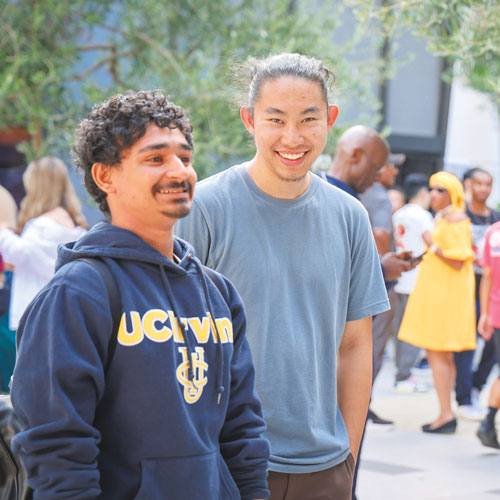
By 9:30, the first young attendees were arriving—some having awakened before dawn to make the journey from as far away as San Luis Obispo and San Diego in California, as well as Nevada, Utah and Arizona.
By 10:30, the courtyard of the SGI Plaza was buzzing. With music playing in the background, young people—members and guests—arrived in groups, individually or accompanied by those who had invited them. Friends who had met through SGI conferences and other activities spotted one another across the courtyard, exchanging smiles and hugs as they reconnected. The morning became a reunion for the men and women who had invited the young people too, as longtime friends caught up.
The gathering then shifted across the street to the SGI-USA World Culture Center. As the doors opened to the Ikeda Auditorium, a live band welcomed the steady stream of arrivals, and soon the room was filled with more than 800 young people.
Emcees Chris Yu and Sophie Hasuo invited participants to use a QR code to choose their afternoon breakout sessions on hope, career and mission, relationships or learning more about Buddhism. They then introduced a central idea of Nichiren Buddhism: Every person possesses Buddhability—the courage, wisdom and compassion to face any problem and create happiness.

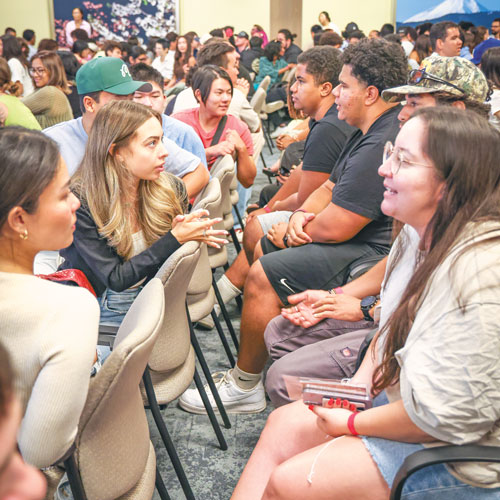
The program turned into a dialogue when Yu asked everyone to turn to someone they did not already know and answer a simple question: What brings you joy? Across the auditorium, rows of people pivoted toward one another. For two minutes, the vast meeting became a collection of one-to-one encounters.
SoCal-Pacific Territory youth leaders Manami Koizumi and Max Heine shared the historical context of this gathering, recalling Ikeda Sensei’s final visit to the United States, which began and ended in Los Angeles. Rather than simply commemorate his historic visit, the purpose of this event was to understand the vow behind his actions.
They recalled his Cold War-era dialogues with leaders of China and the Soviet Union as an example of how one person, committed to peace, could bridge divisions and create change. They connected this spirit to Sensei’s vision for Southern California as a blueprint for world peace—a place where individuals transforming their own lives could, in turn, transform their communities and society.
Alexandria Jones of San Diego shared how her Buddhist practice helped her leave a volatile relationship in 2018 and begin living “as the protagonist of my life, not its victim.” When her mother died unexpectedly in 2023, she challenged herself to create value amid her grief, resolving “to transform suffering into hope.”
A video carried that same resolve through the voices of youth members, who expressed how they apply Sensei’s guidance to dance, nursing, art, friendship and family. Their declarations varied, but returned to a common refrain: “I will create hope.”
Yu and Hasuo again turned the focus to the audience, this time asking participants to find someone they didn’t know and discuss who had made a positive impact on their lives. By alternating between the stage and personal interactions, spectators turned into true participants.
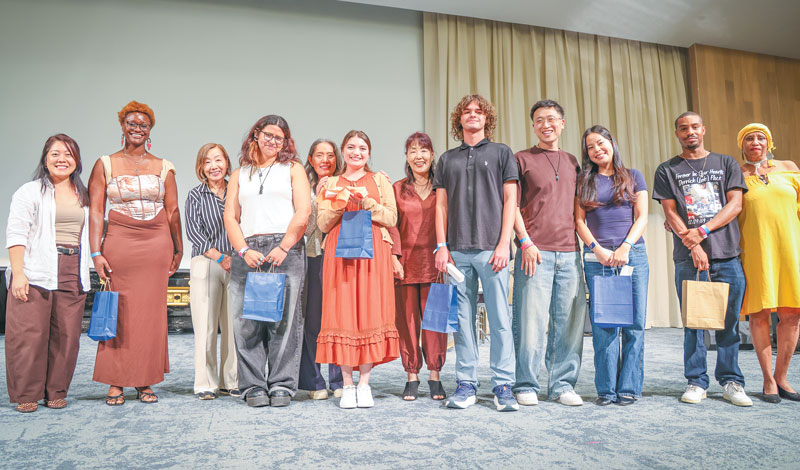
Six young people joined the SGI-USA, five of whom received the Gohonzon with their sponsors by their side, and joyful applause filling the venue.
After an introduction to Nichiren Buddhist practice, participants joined in chanting Nam-myoho-renge-kyo—the sound resounding through the hall.
In his closing words, Kenichi Hackman, SGI-USA’s young men’s leader, placed the 30th anniversary of Sensei’s visit within the history of the SGI’s development. Before 1991, he explained, the Soka Gakkai was associated with the Nichiren Shoshu priesthood, which increasingly sought to place clerical authority between people and their own Buddhahood.
When the priesthood excommunicated the Soka Gakkai in 1991, Hackman said, this break served as a spiritual liberation from clerical authoritarianism. Sensei repeatedly visited the United States before and after that time, teaching SGI-USA members correct faith, encouraging and raising capable young successors, and entrusting them with a profound sense of mission.
Now, Hackman said, that responsibility belongs to the young people gathered in the auditorium.
He acknowledged how easy it is to look at violence, injustice and the disregard for human life in society and conclude that individual actions do not matter. But that is precisely why young people must stand up. “Everyone could use some hope. Everyone could use another friend,” Hackman said. Peace begins in dialogue, and the next place to continue it would be the SGI’s neighborhood discussion meetings.
His conclusion gathered the entire morning into a single departure point: This anniversary was not the end of a 30-year chapter but the beginning of the next one. “The next 30 years starts now,” he said.
Then the auditorium transformed into a space for one-to-one dialogue as participants paired off and rotated to meet new partners, guided by discussions on hope and relationships. Others gathered at the Pacific Peace Center across the street for dialogues on career and mission or learning more about Buddhism.
The connections were immediate. One young woman emerged delighted by the person she had just met: “I love my dialogue partner.” Another young person who had been hesitant to return to SGI activities left energized and eager to learn more.
For Heather Angell, a student at Utah Tech University, the day was equally memorable. “I was able to make life-changing friendships and bond with members on a deeper level than before,” she said.
Thirty years after Sensei’s final U.S. visit, the gathering honored the past by looking ahead—forming new friendships, deepening connections and empowering young people to create a future of hope and a more peaceful world.
—Prepared by the World Tribune staff
You are reading {{ meterCount }} of {{ meterMax }} free premium articles