
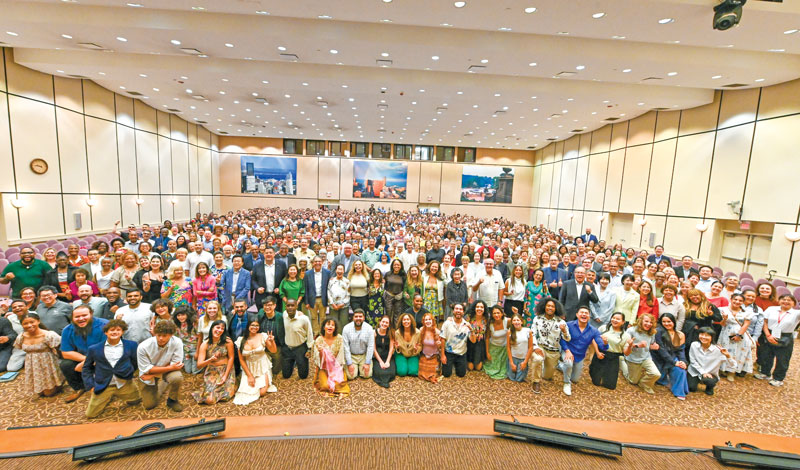
A delegation led by SGI General Director Yoshiki Tanigawa traveled to the U.S. from Sept. 30–Oct. 12 to take part in electrifying commemorative meetings held in New York, Florida, Denver and Los Angeles—the same cities that Ikeda Sensei visited during his 27th and final visit to the U.S. three decades before, in June 1996.
In New York and Florida, SGI Women’s Leader Masami Nasu took part in the general meetings there, led joyful encouragement meetings for women and young women, and visited local members. She was joined by Masami Shigeno, a Kayo-kai leader, and interpreter Cathy Rakuno.
Rounding out the SGI delegation were: Mitsuaki Asano, Executive Director for Americas, North and Latin America, and Oceania, and Mitsuhiro Kawahara, director of the SGI North America and Oceania Division.
New York, ‘a gathering of lions.’
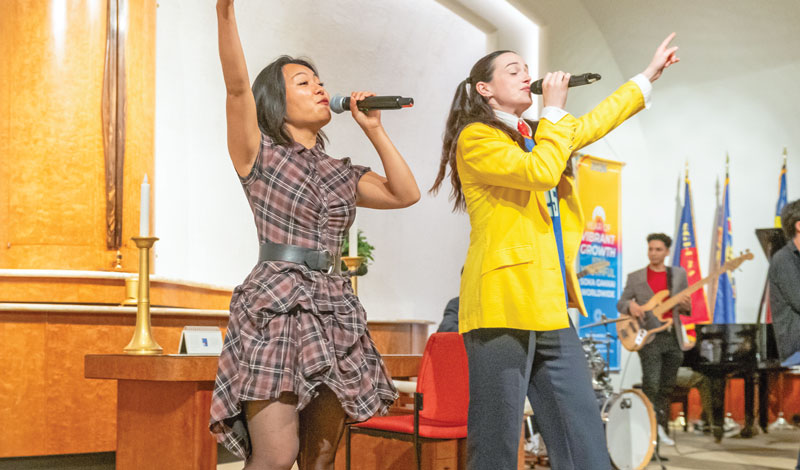
The Ikeda Youth Ensemble opened the Tristate General Meeting on Oct. 1 at a packed New York Culture Center with “Try Again City,” an original song inspired by Sensei’s September 1999 essay to the New York members, “Morning in New York.” Blending vocals, rap and a full live band, the performance sent a current through the crowd that carried through the entire meeting.
Goncalo Ruivo, of New York, shared his experience about converting his fears into action, uniting with the members in his local chapter and his wife, to share Buddhism with young people, securing his family’s future in the U.S. in the process (see p. 5).
Nasu introduced herself to the members (see pp. 10–11), sharing a deeply moving prime point with Sensei when she was a future division member. She then noted that the words “worldwide kosen-rufu” first appeared in the Seikyo Shimbun (the Soka Gakkai’s daily newspaper) in October 1960, when Sensei first set foot on American soil.
And while the members in Japan eagerly anticipated what kind of whirlwind of propagation he would create throughout the world, as a champion of propagation, Sensei did not simply call for expansion but listened to what people had to say. “Sensei would say: ‘What matters is that you become happy.’ ‘What matters is that you continue to uphold your faith.’ This was Sensei’s struggle to continue kindling the light of courage in the hearts of each person facing suffering.”
Tanigawa then relayed several key pieces of encouragement that Sensei gave to the members of New York, underscoring how spreading Buddhism here “is extremely important toward creating a model for freedom directly related to human happiness” (The New Human Revolution, vol. 7, revised edition, p. 160).
Given the turbulent changes the world has undergone in the past 30 years, Tanigawa said that New York’s mission has only grown in significance to transform a world of division and conflict into one of peace and security.
He encouraged the members to unite as lions, each capable of “standing against a thousand,” citing these words from founding Soka Gakkai President Tsunesaburo Makiguchi that Sensei had relayed during his final visit to New York: “It isn’t the number of people that matters. Even if we are small in number, we should continue to seek out true comrades.”
Sensei continued: “The Soka Gakkai’s founding president cherished true comrades, likening them to ‘gold unearthed from sand,’ ‘lotus flowers blooming in muddy water’ and ‘diamonds.’ I would therefore like the organization in New York to be a gathering of lions—each one a person of truly outstanding ability and caliber” (My Dear Friends in America, fourth edition, p. 469).
Kosen-rufu always begins with the person in front of you.
In each city ahead of the general meetings, Mr. Tanigawa led a wave of home visits, together with national and local leaders, kicking off the day with a brief Gosho lecture done in the spirit of the Osaka Campaign of 1956, when a young Daisaku Ikeda led the historic propagation campaign with morning Gosho lectures.
In his first such Gosho lecture in New York, he emphasized Gosho passages and Sensei’s encouragement based on the unity of “many in body, one in mind,” saying that if our unity falls apart, we won’t be able to accomplish anything.
“The deeper the darkness of division that pervades our world today, the more crucial it becomes for us to forge … the highest and strongest bonds of unity,” he said. “In doing so, we can directly change the destiny of humankind. With the deepest determination and the highest sense of pride, let’s forge ahead boldly in fulfilling this noble mission entrusted to us by Sensei.”
Florida, the land of kosen-rufu heart and heat.
Although the weather called for rain, the Many Treasures Group members of Florida Zone chanted many hours leading up to their general meeting, and on Oct. 4, the 870 members who converged on the Friendship Auditorium at the Florida Nature and Culture Center (FNCC) were indeed greeted by the bluest skies.
The site of the meeting held deep significance, as Sensei had opened the retreat center during his June 1996 visit as a place for members to gather for weekend conferences to refresh their faith and vow for kosen-rufu.
The Ikeda Youth Ensemble opened the meeting with Miami heart and heat, as singers and salsa dancers in perfect sync brought the house down with their rendition of Marc Anthony’s “Vivir Mi Vida.”
Viviann Larsen then shared a moving experience about how, drawing strength from her encounter with Sensei at FNCC 30 years before, she transformed her painful estrangement from her son into a fresh start for them both, introducing two young people to Buddhism in the process.
After Nasu introduced herself to the members of Florida, Tanigawa spoke about “The Hero of the World,” in which Nichiren Daishonin states: “Buddhism primarily concerns itself with victory or defeat, while secular authority is based on the principle of reward and punishment” (The Writings of Nichiren Daishonin, vol. 1, p. 835).
He then went on to share Sensei’s encouragement about how Buddhism and life are a struggle to be victorious: “Either we vanquish devilish functions and attain Buddhahood or we are defeated by them and lead lives of delusion. Ultimately, the purpose of our Buddhist practice is to realize victory in this crucial struggle.
“This ultimate way of living articulated by Nichiren Buddhism views all aspects of life as a series of struggles that must be fought and won. This is the true reality of existence. For those who earnestly take on this challenge, everything that happens in life, even events in society, become part of their Buddhist practice. In other words, for them, the teaching that ‘Buddhism is about winning’ applies to everything” (The Wisdom for Creating Happiness and Peace, part 2, revised edition, pp. 172–73).
Emphasizing the human revolution of each person, Tanigawa said: “Let us, the members striving here in the great land of Florida, remain steadfast in our faith no matter what circumstances we may face, winning and demonstrating lives of happiness and victory!”

Denver, a gold rush of capable people.
In the Mile High City, flanked by the iconic Rocky Mountains, some 300 members gathered at the new, state-of-the-art Denver Culture Center for a general meeting overflowing with camaraderie.
Thirty years ago, Sensei received an honorary doctorate from the University of Denver, his first from an educational institution of higher learning in the United States. To mark this occasion, university chancellor Jeremy Haefner sent a letter of recognition, which was dated Oct. 2, World Peace Day.
The Ikeda Youth Ensemble performed a heartfelt rendition of “Today” by The Smashing Pumpkins, making the song entirely its own. Apoorvee Sawhney, vice national and West Territory young women’s leader, shared a powerful experience about how she used her faith to persevere and become a professor and director in the Counseling Psychology Program at the University of Denver. Recently, she passed the national examination to become a licensed psychologist.
In his guidance to the meeting, Tanigawa said that the single-most decisive factor in advancing kosen-rufu and expanding our Soka community is the existence of capable people, and he shared the following words from Sensei’s visit to Denver: “Human beings are raised by human beings. Only people can help other people become happy. I hope that all of you, as outstanding humanistic educators, will also raise many fine individuals” (My Dear Friends in America, fourth edition, p. 443).
At each general meeting, Tanigawa opened the floor for Q&A. In Denver, a men’s leader asked whether there were any plans to erect a monument to Sensei in Japan or in the U.S.
“What’s the greatest monument Sensei offered to his mentor, second Soka Gakkai President Josei Toda?” Tanigawa asked. “It was the Osaka Campaign. For Sensei, President Toda was his mentor of kosen-rufu. The fact that he carried out this incredible campaign was the greatest monument.”
Los Angeles, breaking through a wall for the happiness of the people.
More than 800 members from throughout Southern California gathered at the World Culture Center in Santa Monica, California, for the SGI delegation’s final general meeting, which was broadcast nationwide to chapter through territory leaders joining at SGI-USA Buddhist centers.
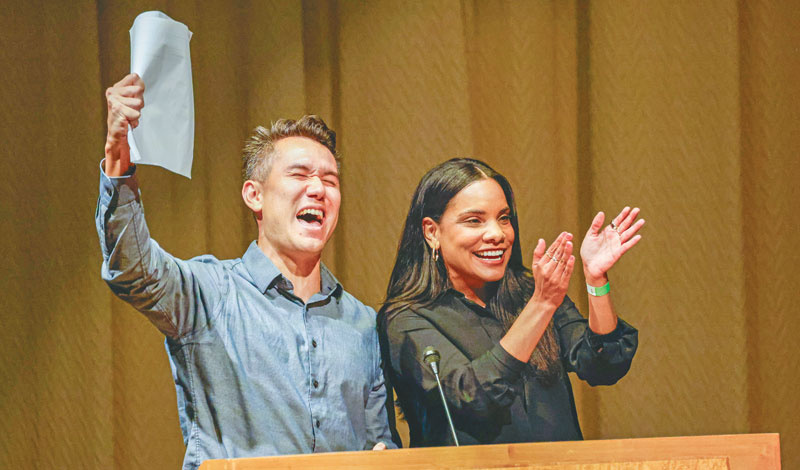
The meeting began with a heartfelt joint experience by two young women, Nimisha Kadan and Riya Relhan, about how Nimisha introduced Riya to Buddhism, and in return, Riya became a source of great support for her sponsor during a challenging time.
Channeling the crowd’s anticipation, the Ikeda Youth Ensemble dancers and live band launched into an electrifying performance of “Can’t Back Down,” an upbeat pop anthem whose lyrics pulsed with resolve: “We can’t back down / There’s too much at stake / This is serious / Don’t walk away.”
Tanigawa in his encouragement (see p. 8) called the expansion of kosen-rufu a continuous struggle against deadlock. “When we break through the wall of deadlock, we can greatly advance kosen-rufu to a new stage,” he said.
The first example of breaking through a wall was the pioneering efforts of Sensei during the February Campaign in 1952, where he led the efforts in Kamata Chapter to introduce 201 households in a single month, generating momentum for the entire country.
As division and conflict continue to deepen, Tanigawa said that whether we can transform the conditions of humanity and the world depends entirely on how kosen-rufu advances here in America. “It hinges on whether SGI-USA can expand happiness for ourselves and others and build bonds of solidarity overflowing with compassion, both within our organization and throughout society,” he said.
At the meeting’s end, all youth attendees were invited to the stage to lead “Forever Sensei.” To the delight and applause of the audience, the youth kept coming onto the stage in waves, until they were many rows deep, signifying that the future had arrived.
In each city, a special commemorative video created by the SGI was shown, featuring highlights of Sensei’s guidance and encounters over the years in various cities throughout the U.S. In Los Angeles, the video was broadcast nationwide.
Tanigawa, in introducing the video, said that Sensei had enveloped the U.S. with limitless compassion.
“Let us engrave in our lives Ikeda Sensei’s boundless compassion and expectations for America,” he said. “Starting today, let us surge forward toward expanding our youth membership by 10,000 and, together, make America—in both name and reality—the ‘center of the 21st century.’”
November 6, 2026 World Tribune, pp. 6–7
You are reading {{ meterCount }} of {{ meterMax }} free premium articles