
by Goncalo Ruivo
New York
“There are no guarantees,” said our lawyer. “Maybe it won’t happen to you.”
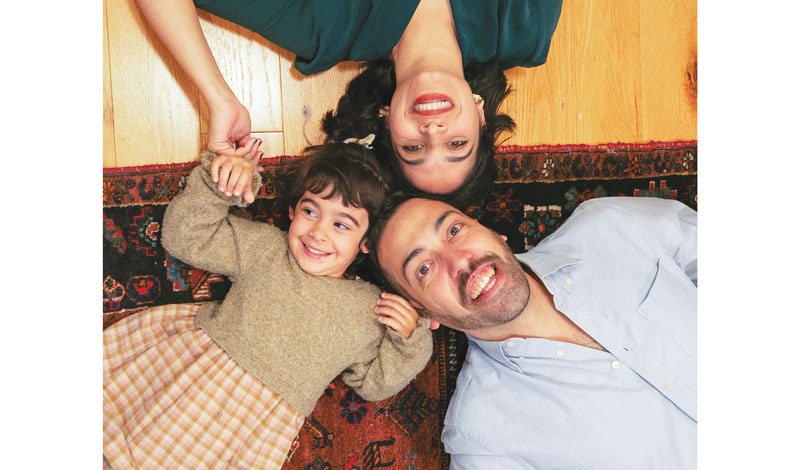
My wife, Serena, and I had asked point-blank whether I’d be deported at my upcoming visa renewal. The answer—hardly more than a shrug—was not the reassurance I needed. In fact, my anxiety was steamrollering me now—pushing me to the verge of a breakdown. It was Serena who put herself between me and my fear, looking me hard in the eye, saying, “Looks like we have a faith battle.”
We’d been waiting on our green cards since 2019, when we’d applied after years here working on visas. The process stalled for years, during which time Serena studied law and passed the bar exam, then signed on to my artist’s visa. This meant she could stay but not work. You can imagine the strain, financially speaking, of raising our baby girl in New York on my actor’s income. On top of these fears were those brought by the news—daily reports of immigrants, with or without status, handcuffed and hauled off from their visa interviews for expedited removal. Such an outcome began to feel inevitable: I’d be torn away, devastating my family. But Serena’s response reminded me that this was the moment to summon unshakable conviction. And yet, for me, conviction has never come easy—in fact, you could call it my No. 1 struggle.
I first heard about Nichiren Buddhism in Portugal in 2002 and wanted nothing to do with it. My family had pried itself away from the church, coming away with deep wounds and profound distrust. In place of religion, we Ruivos found meaning in work, rejecting prayer as a scam and wishful thinking. I already believed in humanistic ideals, in which case, why practice with the SGI?
It was only after I moved to New York, in 2010 for acting school, that I ran up against enough self-doubt and despair to engage with this practice in earnest. In the depths of depression, a young men’s division member came to my door. I didn’t answer at first, but he kept on coming, until one day it dawned on me that he genuinely cared. From then on, I developed my faith, seeing extraordinary actual proof. A notable benefit came in 2021, when I landed year-round, full-time acting work at the largest opera house on Earth. And yet, no matter what proof I saw, I struggled to develop conviction. I could believe in results, but in the time between them, I struggled deeply to believe in my prayer.
After our call with our lawyer, fear followed me everywhere. Even sleeping, I’d dream of being handcuffed at my green card interview. I called my men’s division leaders crying sometimes, until one gave me guidance that was so straightforward it was almost mundane. The only shocking thing, I saw right away, was that I hadn’t applied it yet:
“You must have conviction. Conviction in your daimoku.”
This was easier said than done, but from that moment, I made a deal with myself: If believing in my prayer felt out of reach, then I’d simply take action. I would read even one more line of Nichiren Daishonin’s writings, chant even one more daimoku. I’d try to live out even one sentence of Sensei’s guidance and meet with even one more person. I knew I couldn’t pray my way out of my head. What I could do was share Nam-myoho-renge-kyo, this treasure that we all have within us. My fears became my driving force—if I stopped moving, they’d swallow me whole.
At the start of that year, I’d accepted a chapter leadership position and realized our chapter had not one young person. Studying Ikeda Sensei’s accounts of his historic shakubuku campaigns, I found the similarity to my area in his descriptions of Bunkyo, where shakubuku had slowed way down. To break through the impasse, my team and I united in prayer, organizing activities to bring all the members together. Through this, we all began to naturally gain confidence, sharing Buddhism with our neighbors and friends.
Several of my neighbors are young people, some of whom had come to meetings in the past. In spring, while speaking with one such young man, his friend overheard. “Wow,” she said, “I need that!” The next time I came by, I brought my wife, Serena.
From here, a beautiful thing unfolded, teaching me something new. Every week, this young woman came over to connect with Serena, to chant, sometimes just to talk. Their conversations were rarely only about Buddhism—they talked about life and Serena listened deeply. She didn’t pretend to have her life all figured out but spoke with conviction about her practice. In just three months, our friend decided to receive the Gohonzon. Soon her friend did as well. Soon after, their mutual friend also joined, and soon our district was full of young people—friends bringing friends bringing friends.
Watching this, I realized that I’d been doing it wrong—I’d thought shakubuku involved making a pitch. But these young people, I saw, had no need of convincing—they needed to know we were people they could trust. Like me and my family, they distrusted organized anything.
So, I stopped trying to look like I had it all together. I started talking about my fears and my doubts. Speaking so openly, I realized for the first time that these struggles did not mean I wasn’t practicing Buddhism. They meant that I was human. Having a philosophy and practice that spurs me to battle my doubts—that is why I practice this Buddhism.
Years ago, I highlighted these words of Sensei’s, carrying a copy of them with me ever since.
To overlook no one; to judge no one; to abandon no one; to have complete faith in another person and reach out to them and awaken their Buddha nature—this is the humanistic spirit of Nichiren Buddhism. (April 1, 2011, World Tribune, p. 8)
In the past two years, Serena and I have helped eight young people receive the Gohonzon. Our chapter set a goal of 300 direct visits with members and last month we accomplished that goal. This year, we held casual hangouts to welcome neighbors, with games and food from the grill. In August, our chapter gathering drew 57, including 13 young people, our biggest turnout yet.
As the joy and momentum built up, so did my own conviction. It was a matter, I think, of setting down deep roots, becoming trusted in my community. Gradually, the nightmares stopped. Gradually, I decided: We would not leave our home, our city. Our mission for kosen-rufu was here. And I just kept taking action.
In May, we received our work authorization, meaning Serena could finally apply for jobs. Quickly, in July, she was hired as an attorney, with full benefits and wonderful co-workers. Then, faster than we could have imagined, without ever going in for an interview, our green cards arrived in September.
Even now, I struggle to believe in myself, but I’ve learned that it’s OK. The important thing is that I know my way to conviction—it comes, for me, from ceaseless action, reaching out in friendship, one person at a time.
You are reading {{ meterCount }} of {{ meterMax }} free premium articles