
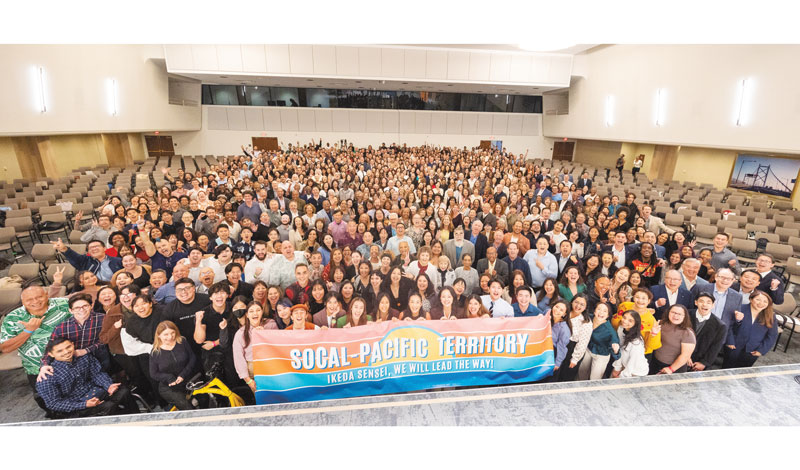
SGI General Director Yoshiki Tanigawa gave the following address at the SoCal-Pacific Territory General Meeting, commemorating the 30th anniversary of Ikeda Sensei’s 27th and final visit to the United States from June–July 1996. The meeting, held on Oct. 11, 2026, at the World Peace Ikeda Auditorium in Santa Monica, California, was broadcast to chapter through national leaders across the country.

Yoshiki Tanigawa
SGI General Director
Good afternoon, everyone!
First of all, to all those joining the live broadcast throughout the country as well as all of you here, I offer my heartfelt congratulations for successfully holding this SoCal-Pacific Territory General Meeting!
Kosen-rufu is a struggle to expand our movement. At the same time, it is a continuous struggle against deadlock. When we break through the wall of deadlock, we can greatly advance kosen-rufu to a new stage.
What was the first example of breaking through a wall of deadlock in our pioneering efforts to advance kosen-rufu? It was, as you all may know, the February Campaign of 1952, led by Ikeda Sensei.
The year before, on May 3, 1951, upon becoming the second Soka Gakkai president, Josei Toda declared his goal of introducing 750,000 households to Nichiren Buddhism. But the momentum was still far from what it needed to be to reach that goal. By the end of that year, 1951, the membership stood at only about 6,000 households.
At the start of 1952, President Toda said: “At this rate, we won’t achieve kosen-rufu even after tens of thousands of years. As of today, I am putting an end to our slow, single-file advance.” He then cried out, “Is there not one true disciple?”
He appointed Sensei, who had just turned 24, as advisor to Kamata Chapter, and he went on to break through and open a new level of shakubuku by welcoming 201 households in a single month.
This year marks the 70th anniversary of the Osaka Campaign of 1956, in which members achieved what had been thought impossible. And through the Yamaguchi Campaign (October 1956–January 1957), the membership there expanded tenfold in a brief period of time. Both campaigns were powered by disciples who worked in rhythm with their mentor, with members resolving: “I want to realize my mentor’s vision” and “I want to repay my debt of gratitude to my mentor through introducing others to Buddhism.”
In The New Human Revolution, Sensei writes:
Each day, I tell myself: “As a disciple of President Toda, I will respond to his aspirations! I will create a record of kosen-rufu that would make him proud!” By doing so, no matter what difficulty I may encounter, I can bring forth the courage to never become disheartened. …
We have a truly great mentor in President Toda. Those who, no matter where they are, always carry their mentor in their hearts are true disciples. That is the first step toward sharing the same commitment as our mentor. Having become disciples of President Toda, let’s embark on efforts to compassionately share Nichiren Buddhism with others and realize kosen-rufu, together with our mentor or, rather, in his stead! (The New Human Revolution, vol. 26, p. 360)
Sensei also teaches that, in our efforts to share Buddhism, everything begins with deep, earnest prayer:
President Toda often said with regard to propagation: “The key is to pray earnestly to the Gohonzon. There is no other way to spread this Buddhism!” We need to pray that the other person can sense our sincere desire for them to become happy. We have to pray: “Please enable me to fulfill my mission in this life as an emissary of the Buddha!” (The Wisdom of the Lotus Sutra, vol. 5, p. 257)
In The New Human Revolution, vol. 25, Sensei also explains that, in planting seeds of Buddhism, what matters above all is enabling others to hear the Law. He writes:
Even if the people you speak to don’t start practicing immediately, you have planted the seeds of Buddhahood in their hearts, so they will eventually accept this faith. Enabling people to hear about Buddhism is the basis of propagation. …
We may tend to feel disappointed and dispirited if, despite how earnestly we share Buddhism with others, they don’t take faith. But the benefits obtained through letting people hear the teaching and leading people to arouse faith in the teaching are the same. The important thing is to speak out and share the correct teachings of Buddhism.
You all know about Bodhisattva Never Disparaging. Our propagation efforts to plant the seeds of Buddhism are the modern-day equivalent of his practice. Isn’t that amazing? (NHR-25, 110)
Sensei continues:
Whether a person who has heard about Buddhism chooses to practice it or not is up to them. What matters is how many people we’re able to share Buddhism with, based on our genuine desire for their happiness. …
Try talking to one person. If it doesn’t go well, try talking to two more people. If that still doesn’t work out, try three, five, 10, and if 10 are unfruitful, then try 20. If 20 doesn’t work out, then try 30 and 40. The point is just to keep sharing Buddhism, with conviction and in high spirits. All those efforts will be transformed into benefit and good fortune, a force for transforming your karma. (NHR-25, 112–13)
With these words, he offers the highest praise and encouragement to all who challenge themselves to share Buddhism with others.
Sensei also cites the following words of President Toda to describe what can happen when we get caught up more with hitting the number of people we aim to introduce to Buddhism and lose sight of the heart to cherish and foster each person:
[President Toda said:] “I, as your president, march together with you, because I want to make all humankind happy. That is my one and only wish.” (The Human Revolution, p. 909)
Sensei goes on to write:
Toda feared that with the expansion of the Soka Gakkai, the leaders might lapse into bureaucracy. He, therefore, took this opportunity of warning them that the organization of the Mystic Law would collapse [unless it was based on helping people grow based on a foundation in faith]. (The Human Revolution, p. 909)
Mr. Toda also said:
No matter how many new families may join, we cannot do anything unless all the members deepen their knowledge of Nichiren Daishonin’s Buddhism and develop into people of capability. A lack of such endeavors would cause our organization to collapse. If numerical increase alone is the issue, a host of lice would easily surpass us. (The Human Revolution, p. 970)
Furthermore, regarding the numerical growth achieved through shakubuku, he also stressed the importance of leading each person to happiness, saying: “In the Soka Gakkai, numbers aren’t just statistics—each number represents happiness. The growth in our numbers reflects how many more people are becoming happy.”
As division and conflict continue to deepen, whether we can transform the society here in the U.S.—and, indeed, how we can transform the condition of humanity and the world—depends entirely on how kosen-rufu advances here in the United States. It hinges on whether SGI-USA can expand happiness for ourselves and others and build bonds of solidarity overflowing with compassion, both within our organization and throughout society.
Sensei consistently declared that “America will be the center of worldwide kosen-rufu in the 21st century.” In entrusting this mission to America, he expressed his unwavering expectation that it would play a central role in realizing his vision to transform humanity’s karma, moving from the war-torn 20th century and creating a 21st century that is a century of life and a century of peace.
In the afterword to volume 30 of The New Human Revolution, Sensei writes:
Human beings are the builders and shapers of the societies, nations and the world in which they live. Hatred and trust, disdain and respect, war and peace—all are the products of the human heart and mind. As a result, without human revolution, there can be no true personal happiness, social prosperity or lasting world peace. …
As long as suffering and misery exist anywhere on our planet, we must continue to weave with rich color and bold creativity the magnificent tapestry of human victory that is kosen-rufu. That is why our mentor-disciple journey to realize the great vow for kosen-rufu will continue forever. (NHR-30, 839–40)
Beginning with today’s general meeting, let’s deepen our resolve in faith, burn with even greater passion to fulfill our vow as disciples, and expand our propagation by powerfully breaking through each “wall” before us!
November 6, 2026 World Tribune, pp. 8–9
You are reading {{ meterCount }} of {{ meterMax }} free premium articles