

On Sept. 5, 2001, 41 SGI-USA youth representatives attended a headquarters leaders meeting in Tokyo with Ikeda Sensei, where he saluted the newly created SGI-USA youth division flag, calling on the youth of America to advance kosen-rufu together with him. Their experience became the foundation for the establishment of Sept. 5 as SGI-USA Youth Day two years later. The following are recollections of four individuals who attended that training course in their youth and their reflections on its enduring significance today.
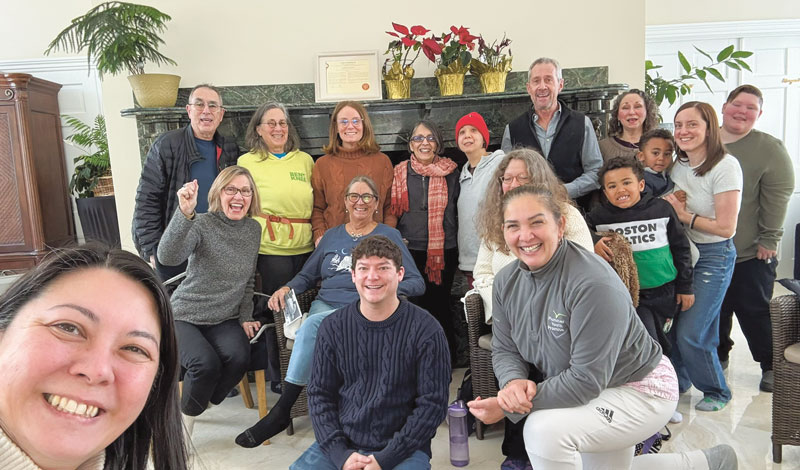
A Vow I Carry Every Day
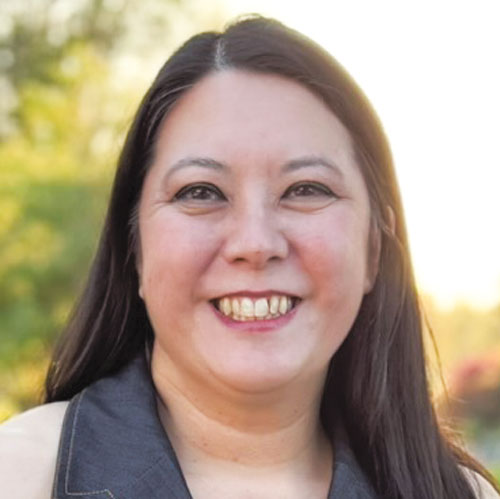
by Emi Gwin
Boston
I was born into a family that practices Nichiren Buddhism, so this practice has been a constant presence in my life. I joined the Fife and Drum Corps when I was 10 and learned from my parents the importance of developing strong faith. It wasn’t until the 2001 SGI youth training course in Japan, however, that I began to understand what it meant to make my own vow as a disciple of Ikeda Sensei.
When I think of that headquarters leaders meeting on Sept. 5, what I remember most is Sensei’s life force. We had gone to Japan wanting to express both our appreciation and our determination as youth to shoulder responsibility for kosen-rufu in America. What I came to realize was just how profoundly he trusted us in return. It was an exchange of mutual gratitude and shared commitment. I pinpoint that experience as the moment when I solidified my vow with my mentor, the significance of which became even clearer days later.
On Sept. 10, we attended a lecture on Nichiren Daishonin’s writing “On Establishing the Correct Teaching for the Peace of the Land.” The following day, we departed Japan, unaware of the events that were about to unfold.
On Sept. 11, terrorist attacks struck the United States.
Our flight was diverted to Canada, and, suddenly, we were preparing to return to a nation in turmoil. I couldn’t help but feel that Sensei had prepared us for that very moment. We had just studied about peace, and now we had to decide what it meant to become protagonists for peace, beacons of hope for our communities. Today, that mission is still the same for me.
During that training course, Sensei encouraged us to repay our debt of gratitude to our parents. I still have the memo I wrote to him in which I vowed that, no matter what, I would take care of my mother and father.
At the time, I was a young woman who could barely make ends meet. I had lost my job in the aftermath of Sept. 11 and eventually found work as an administrator. Through years of challenging myself, I steadily advanced within the company. Today, I am its chief executive officer and majority owner—a victory that has enabled me to fulfill the promise I made 25 years ago.
My mother is now 91, and I have been able to ensure that she receives 24-hour care at home. And before my father passed away, I provided for his needs and made sure the family was together with him during his final moments. For me, these things are actual proof that, when in your youth you make a vow with Sensei, you can create a life beyond what you can possibly imagine.
When I look at young people today, I think one of their greatest needs is friendship—deep, life-to-life connections. I was fortunate to develop such friendships through SGI youth activities. Some of my closest friends have been in my life for more than 45 years.
Many of those with whom I shared that Sept. 5 experience remain my close friends. I’m confident that, with our support, today’s youth will forge those same kinds of lasting bonds. One person can give another the hope, courage and confidence to stand up. Eventually, we learn to stand alone—but often it is because a friend first stood beside us.
Sensei named our 2001 training group the Ever-Victorious Group. To me, “ever-victorious” means continuing to respond to Sensei through the way I live. Twenty-five years later, the vow I made in Japan still guides me.
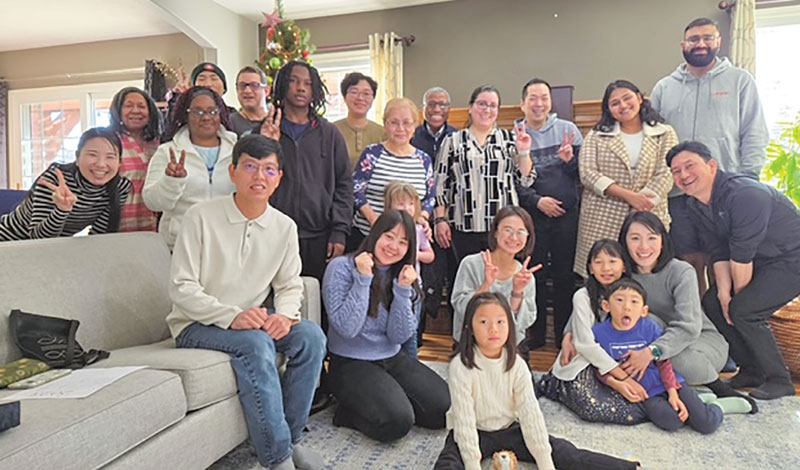
Turning a Crossroads Into a Mission
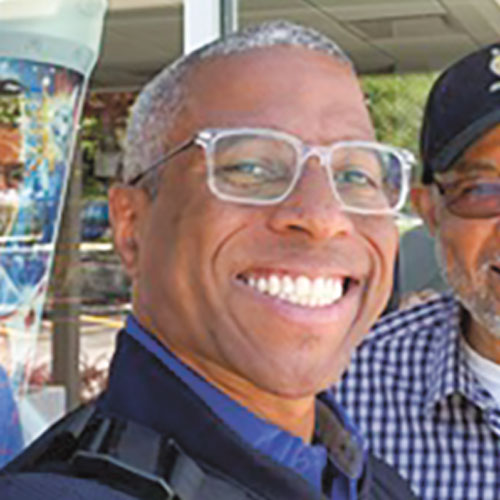
by Mark Woods-Hawkins
Chicago
In 2001, I was a young sheriff’s police officer in the Chicago area, facing a crossroads. My mother began practicing Buddhism when my twin brother, Mike, and I were 11, and through her practice, she introduced us to the SGI. We began attending youth activities and soon developed our own appreciation for Buddhism.
As we grew older, my brother and I were both drawn to law enforcement, partly because our paternal grandfather, the mayor of a small town outside Chicago, had been murdered when we were young. Around that time, I began chanting seriously about how, as a young Black man and a Buddhist, I could make an impact on society. But once I became a police officer, I struggled to reconcile my faith with my profession and began questioning whether this was what I wanted to do for the rest of my life.
A young men’s leader encouraged me to chant for clarity and to participate in the September training course in Japan. Financially, I was living paycheck to paycheck. Still, I knew I couldn’t pass up the opportunity.
I began chanting abundant daimoku every day and applied for several federal law enforcement positions, including one with the U.S. Department of State’s Diplomatic Security Service. The more I learned about its mission of supporting diplomacy, the more I saw it as a path that aligned with my Buddhist values.
Shortly before leaving for Japan, I interviewed for the position, but walked away convinced I had bombed it. But a fellow member encouraged to stay focused and not allow my disappointment over the interview to distract from the training course—to bet on faith and absorb everything I could from the experience. Then came Sept. 5, 2001, the headquarters leaders meeting in Tokyo.
As I sat in the auditorium, Ikeda Sensei encouraged us to not waste our youth and to make the causes necessary to become “ever-victorious.” By the conclusion of that meeting, everything I had been struggling with came into focus. It was OK to be at a crossroads. I was young. I didn’t need to have everything figured out. What mattered was transforming all my anxiety, frustration and confusion into determination.
On Sept. 11, when our flight was diverted to Canada because of the terrorist attacks, what followed felt like an extension of the training course. Local SGI members cared for us as we made our way from Canada through Seattle and eventually back to Los Angeles.
When I finally returned to Chicago, I found a manila envelope from the State Department. Inside was an offer of employment. The interview I was so certain I had bombed had actually been a success. The following summer, I moved to Washington, D.C., and began my career with the State Department. Years later, I returned to Chicago as director of the Diplomatic Security Service’s Chicago field office—the same office where I had once sat feeling intimidated during that 2001 interview. I retired there, too.
That training course transformed my faith and, ultimately, the course of my life. I stopped thinking of myself as a law enforcement officer who practiced Buddhism. I realized I am a Buddhist—a disciple of Sensei—who works in law enforcement.
When I meet young people who don’t know what they want to do, I tell them it’s OK if they don’t have all the answers. Youth is the time to pave your path and awaken to your mission. Being ever-victorious doesn’t mean never losing; it means not staying down when you do. Every struggle, setback and moment of uncertainty can enable us to forge our faith. That’s what the 2001 training course taught me—and today, I’m determined to help the next generation become ever-victorious in their own lives.
A Vow to Never Give Up

by Amelia Unione Contreras
El Paso, Texas
I was in my early 20s when I traveled to Japan for the 2001 youth training course. I had just graduated from college and started a new job. I had no money and, practically speaking, probably no business going on the trip. But I went.
When I left for Japan, I don’t think I truly understood the mentor-disciple relationship or what it meant for my own life. That changed during the training course.
Sept. 5 provided me with the trip’s defining moments. We joined youth from around the world for the headquarters leaders meeting in Tokyo with Ikeda Sensei. Sitting among people from so many countries, cultures and backgrounds, I felt the possibility of people coming together around a shared commitment. It felt like a microcosm of world peace. I remember thinking: This is possible. No matter how difficult things become, we can never give up on peace.
Then, when Sensei encouraged us to advance together with him for kosen-rufu, that vision became personal. I began to understand what the mentor-disciple relationship could mean in my own life. His call became, for me, a vow to work alongside my mentor for world peace. Only days later, that vow was tested.
In the wake of Sept. 11, the country we were returning to had been devasted. Amid the shock, a passage from Nichiren Daishonin’s writings came to mind: “Great evil portends the arrival of great good” (“The Kalpa of Decrease,” The Writings of Nichiren Daishonin, vol. 1, p. 1122). We had just learned about working for peace, and suddenly we had to put that into action—to find hope and meaning amid tragedy and decide how we would live from that point forward. I felt that our group needed to become a source of hope.
We later learned that Sensei had named us the Ever-Victorious Group. That experience has remained a source of encouragement throughout my life.
After returning home, I pursued graduate studies in biomedical science, earning a Ph.D., married and started a family. Then, in 2018, my family and I were involved in a devastating car accident in Mexico. My family was safe, but I suffered severe injuries and blood loss and had to be airlifted back to the United States.
On that flight, I felt myself fighting an internal battle. Part of me was saying: It’s too hard. I’m too broken. I’m not going to survive this. But another voice inside me said: You have to fight. You’re a disciple of Daisaku Ikeda. You made a vow. I thought about my husband and children. I thought about my mission. I knew I had to live to show actual proof of victory. So, I made up my mind to fight.
My recovery required surgeries and extensive therapy, but eventually, I regained my ability to walk and function independently. I ultimately made a complete recovery. Afterward, I decided to make another major change in my life. I entered pharmacy school and, in May 2026, completed my Doctor of Pharmacy degree. I am now working in postgraduate clinical pharmacy training at the Veterans Affairs health care system in El Paso.
When I look back, I feel that my determination to never give up—to remember that I made a vow and can use my Buddhist practice to overcome whatever is in front of me—began during that 2001 training course. That’s why today’s “One Youth. Infinite Hope” movement means so much to me.
Young people today can feel isolated and disconnected, even while constantly interacting through phones and social media. I believe friendship through one-to-one dialogue can break through that isolation. That kind of human connection still matters.
I feel that 25 years ago, the torch was passed to us. Today, I feel an even greater responsibility to carry it forward. The vow I made then is still my vow today—to never give up on world peace and to help the next generation discover the same power within their own lives.
Victory, One Person at a Time
by Jason Lions
Los Angeles
I was the youngest of the 41 SGI-USA youth selected to attend the training course. At the time, I was struggling with depression and anxiety, and I was surprised to even be invited.
But I understood the determination behind the trip: We wanted to show Ikeda Sensei he could entrust the future of kosen-rufu in America to us. I arrived in Japan seeking to understand what my own role was in this grand undertaking. The answer began to take shape at the headquarters leaders meeting. As I listened to Sensei, I was struck by how intensely he focused on fostering capable people who could carry kosen-rufu forward.
At that point, I wasn’t really thinking about raising anyone else. What became clear to me though, was that first I needed to become a capable person myself—someone who could take full responsibility to contribute and respond to Sensei’s expectations. When Sensei said, “Together, you and me, let’s accomplish kosen-rufu,” I didn’t take those words lightly. I heard them as his absolute trust in us—and a call to stand up and establish the correct teaching for the peace of the land.
On Sept. 11, when our plane was diverted to Canada, members there gave us food and clothing as we couldn’t take any of our luggage with us for security reasons. When we reached Seattle by bus in the middle of the night, members were waiting for us holding a huge “Welcome Home” banner bearing all our names. It felt as though the training course had never ended.
When Sensei named us the Ever-Victorious Group, I wrote to him asking: What does it truly mean to be ever-victorious? A month later, I opened the World Tribune to find an essay by Sensei titled, “Being Victorious Each and Every Day.” One passage became a guiding principle for my life: “Being ever-victorious means winning resolutely in the present. It means winning today” (republished in the May 13, 2016, World Tribune, p. 3).
Sensei described how, as a young man, he threw himself wholeheartedly into encouraging each individual—through visit after visit, always determined that there was time to engage even one more person. It struck me deeply that his great victories weren’t created through abstract strategies. Instead, they were constructed step by step through his life-to-life encounters.
Over the past 25 years, I’ve deepened my understanding of this through my own experience. Sensei’s accomplishments are a history of making the impossible possible. But when you examine how he created change, it always came down to joyfully encouraging each person. Now I ask myself everyday: How many people can I encourage? Who can I support? Did I actually advance kosen-rufu today? That is how I’m resolved to carry on my mentor’s legacy.
Young people are living in a very different time. I believe many look at what is happening in society and wonder what they can possibly do to change the world. Sensei has said that there are periods in the advancement of kosen-rufu when great numbers of capable people suddenly burst onto the scene, like a starburst (see Oct. 31, 2014, World Tribune, p. 4). I feel we are entering another great “starburst.” And I’m convinced that giving everything we have to supporting one youth—the person in front of us—is the greatest cause we can make to change the world.
Today, I’m regularly talking with 14 young friends about Buddhism and over the past three years, my wife and I have helped eight youth receive the Gohonzon and begin their Buddhist practice.
At the 2001 training course, I made my goal to become a capable person. Today, I understand that becoming capable isn’t the end goal though. We become capable so that we can help others become capable. Ultimately, I learned from Sensei that faith in Buddhism means believing in the unlimited potential of one person—especially one youth—and dedicating our lives to bringing forth that potential, just as my mentor did for me.
September 4, 2026 World Tribune, pp. 6–8
You are reading {{ meterCount }} of {{ meterMax }} free premium articles