
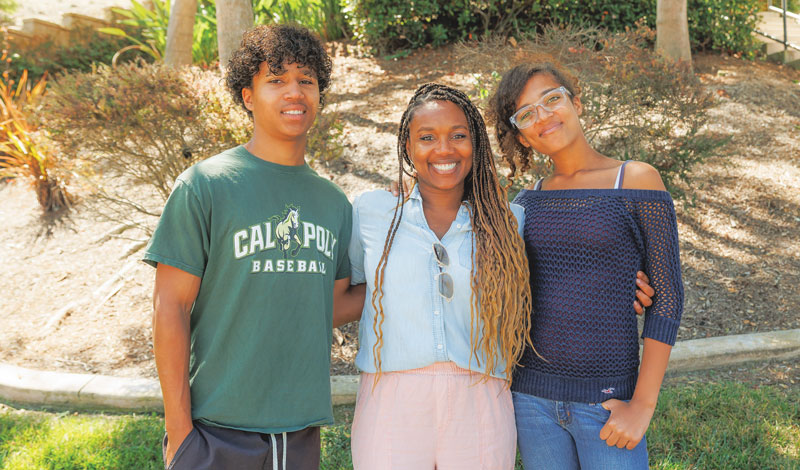
by Tochi Izegbu
San Diego
“Wait, Tochi, wait,” my friend butted in, and I was surprised to hear tears in her voice. “This isn’t you. You don’t talk like this, like someone about to give up.”
It was hard to hear her over the phone, over the miserable sounds of the emergency room. My doctor had just told me, fighting back tears, that she did not know what could be done.
“Tochi,” I heard my friend say again, as though from the end of a tunnel. “No matter how hard you get hit, you always get up—you always fight your way through.”
But I was tired of fighting, I heard myself say, of always having to be so tough.
I’m the eldest of seven, born to a father who’d lived through the Nigerian Civil War and a mother who’d lived through Jim Crow. My parents never received the safety they needed, inside or outside the home. That trauma was passed down to me and my siblings, who were raised in total chaos. The nine of us moved constantly, crammed into home rentals or studio apartments—once, into a huge station wagon. At times, we were out on the streets. Wherever we were, I made sure that we ate, panhandling if that’s what it took. The abuses I suffered back then were encountered later in life—in work, in love, in friendship. I was full-grown before I’d carved out a safe place in the world, carved it out with my own bare hands.
At 22, I left home for good, a betrayal in the eyes of my parents. When they turned their backs on me, I began putting to use the gifts they’d left me: rage, grit and a relentless drive to succeed. And these took me further than I could have ever imagined, yet wherever that was, I couldn’t find happiness.
By 2018, I’d landed my dream job in New York at a leading investment firm. Even divorced, with two little kids, I pressed on for their sake and mine. And when, just months into that job, I fell sick with a rare autoimmune disorder, I proved I could outwork all limitations, even those of my own body. Often, friends praised how effortless I made it look. But then, they didn’t see me sob myself to sleep most nights, begging for the pain to let up.
Little by little, my autoimmune condition deteriorated, steep dips followed by mild improvements. Most patients with this condition become wheelchair-bound or bedridden; many do not survive. By the start of this year, my symptoms were dismal—sleeping, breathing and swallowing were painfully difficult. For the first time, I felt I couldn’t press on. In March, I resigned from my job.
Colleagues reached out in the following days, expressing their concern and sympathies. One, however, was genuinely impressed. She wanted to know how I’d managed at a job like mine, with this condition, raising two kids.
“You’re a Buddhist and just don’t know it yet,” she said, and I was reminded that she was one herself. She put me in touch with friends of hers who lived right down the block from me.
A few weeks later, preparing to meet them, I got a call, literally minutes before leaving the house. It was my doctor, urging me to go to the ER. My numbers from that month’s bloodwork were in. They suggested imminent organ failure.
I stood there a moment, sinking into the floor, then texted my Buddhist neighbor, explaining I had to cancel and why. To my surprise, she texted back right away, asking if she could stop by.
“I’m in the area,” she wrote, “I’d like to chant for you.”
For some reason, I agreed, and within minutes she sat across from me in the living room. Mindful of the time, she wasted none in recounting how chanting Nam-myoho-renge-kyo had helped her through the direst circumstances. Before she left, she handed me some prayer beads and books and asked me to try chanting for 90 days. I agreed, but soon after checking into the ER, I understood I might not have that much time.
There were no open rooms, so I was parked on a gurney, thin curtains between me and my neighbors. Poked and prodded day and night, surrounded by cries of pain, I felt my will ebbing hour by hour. Out of sheer obligation, I remembered to chant.
Every day, my Buddhist neighbor texted saying that she and others were chanting for my victory. But every day’s bloodwork showed catastrophic results, and every day, I chanted through sobs. But when, on day three, my bloodwork came back, I felt myself grow suddenly furious. I could not remain on this gurney forever, surrounded by pain and despair. The parting words of my Buddhist neighbor flashed through my mind—words I hadn’t thought of until then.
“When you pray,” she’d said, “don’t beg, OK? Command the change you want.” I began chanting, not loudly, but not quietly, either, channeling the anger within. It felt completely different from my earlier prayers, and different also from the anger that fueled me all my life. The rage I felt—it felt like sacred rage, which I was using to align the power of the universe with my own.
Show me the change!—it was this kind of prayer, coming from the depths of my life.
The following morning, my bloodwork came back—my levels had dropped 2,000 points. “This kind of drop takes months,” said my doctor, shocked. “Clinically, this is not something we see.” My numbers kept dropping, as though in free fall, until I was cleared to go home.
Continuing to chant, I began to feel strong in a way I hadn’t before. Without white-knuckling or gritting my teeth, strength flowed forth from my life while chanting.
Even when my relationship ended in April, just weeks after coming home from the hospital, I chanted daimoku, transforming pain into determination and hope.
The following month, my son said to me, “You know, mom, the house feels lighter.” He began chanting with me and soon my daughter did too, the three of us chanting together.
In July, I received the Gohonzon, and that month was deemed in remission. In the eight years that I’ve been living with this condition, I’ve never come close to this. I’ve returned to the activities that I enjoy most—walking in nature, dancing and yoga.
Recently, during my morning prayers, I began crying out of the blue. I wasn’t sad; I was humbled to have known such profound transformation, humbled by this community that has rallied around me to help me achieve true wholeness. That morning, I made a solemn vow to the Gohonzon that I would continue this practice for life. With daimoku as my fuel and the Gohonzon as my vehicle, I know I can take action toward absolute happiness, commanding the change that I want.
You are reading {{ meterCount }} of {{ meterMax }} free premium articles