
In his 1996 lecture at Columbia University’s Teachers College, Ikeda Sensei said of his mentor, second Soka Gakkai President Josei Toda: “Ninety-eight percent of what I am today I learned from him.”
On another occasion, he wrote: “By following the path of mentor and disciple, we can develop and improve ourselves. It holds the key to realizing our fullest human potential.”[1]
Sensei frequently reflected on the profound relationship he had with his mentor, speaking of the lessons learned and the struggles they faced together. They were united in their commitment to widely spread the principles of Nichiren Buddhism to create a peaceful world and to bring happiness to all people. Through meeting Toda, Sensei discovered his lifelong mission.
Why does Buddhism place immense importance on such a relationship? What does “the oneness of mentor and disciple” mean for us today?
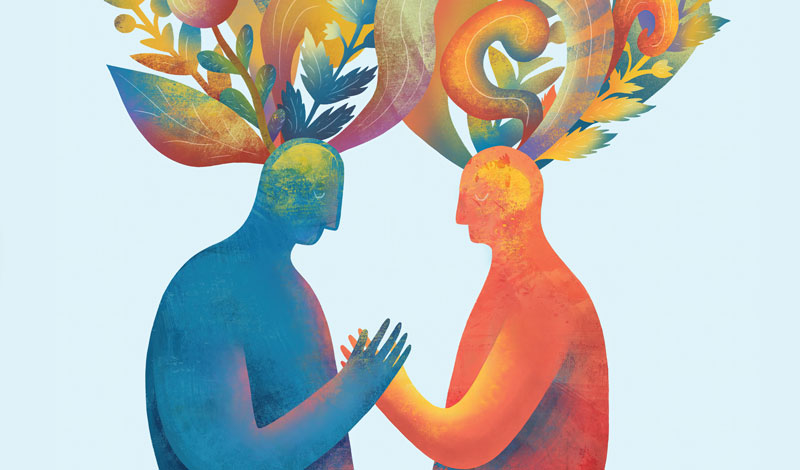
At its core, this relationship is about a shared vow. A mentor demonstrates the limitless potential of a human being through their own life and actions. Inspired, the disciple stands up with a parallel determination: I, too, will reveal my highest potential and work for the happiness of others. Through this living transmission from one person to another, Buddhism is passed on across generations.
A Living Transmission Person to Person
From its very beginnings, Buddhism has been transmitted through human bonds.
When Shakyamuni Buddha awakened to the truth that everyone possesses the potential for enlightenment, his journey didn’t end. His goal was “to make all persons equal to me, without any distinction between us.”[2] He spent the rest of his life traveling and talking with people, helping them achieve the same state of profound happiness he had attained. A community of practitioners formed around him—disciples who learned, practiced together and shared the teachings with others.
Buddhism was never meant to be abstract theory. It lives and breathes when people learn from a teacher and put those lessons into practice. As Sensei explains:
Elevating the life state of disciples to the same level of the Buddha—this is the fundamental aim of Buddhism. … Precisely because it is grounded in the spirit of mentor and disciple, Nichiren Buddhism is a humanistic teaching, one in which ordinary people take the lead.[3]
He adds that the relationship between the Buddha and ordinary people is not like that between a god and human beings but rather between teacher and student, between mentor and disciple.
The Lotus Sutra illustrates this point when the Buddha entrusts his disciples, the Bodhisattvas of the Earth, with the mission to spread the Law, the sutra’s essence, for the happiness of all people. As this demonstrates, genuine disciples don’t just parrot their mentor’s words; they share the mentor’s purpose and actively carry it forward.
Making a Great Vow
Centuries after Shakyamuni, Nichiren Daishonin embodied this exact spirit. In his youth, he studied Buddhism under his teacher Dozen-bo and then at major Buddhist temples throughout Japan. In the process, he concluded that the Lotus Sutra was Shakyamuni’s highest teaching. With that conviction, he dedicated his life to helping ordinary people reveal their inner Buddha nature. He established the chanting of Nam-myoho-renge-kyo as the means to do so.
Nichiren never forgot his gratitude to those who had taught him, and he strove to repay their kindness throughout his life.
He also showed extraordinary care for his followers. He wrote to people facing hardship—illness, financial hardship and grief—and empathized with their pain. He offered detailed advice and encouraged them to summon courage and fight for their own and others’ happiness.
To his young disciple Nanjo Tokimitsu, Nichiren wrote: “My wish is that all my disciples make a great vow.”[4]
That great vow refers to the Buddha’s original promise: to relieve all people of suffering.
This is the key to understanding “oneness.” It doesn’t mean becoming a subordinate or some clone. It means standing side by side with the mentor, uniting in purpose to help all people become happy.
The Founding Spirit of the Soka Gakkai
The Soka Gakkai (“Value-Creation Society”) was built on this shared commitment. Its founding president, Tsunesaburo Makiguchi, was an educator, and he believed that the purpose of education and life was to create value and happiness. A young educator named Josei Toda chose him as his mentor. When Makiguchi took up faith in Nichiren Buddhism, Toda, too, embraced the faith as his own. Together they founded the Soka Gakkai.
During World War II, Japan’s militarist government imprisoned both men as “thought criminals” for refusing to compromise their Buddhist beliefs. President Makiguchi died in prison on November 18, 1944.
While imprisoned, Toda awakened to the essence of the Lotus Sutra—the vow of the Buddha—which his mentor Makiguchi embodied until the end. Upon Toda’s release, he resolved to rebuild the Soka Gakkai and prove his mentor’s greatness by accomplishing their shared mission.
On August 14, 1947, a 19-year-old Daisaku Ikeda met Josei Toda. Seeking a philosophy that could offer genuine hope in a country decimated by war, the young Ikeda Sensei found a mentor whose actions perfectly matched his convictions.
From that day on, Sensei dedicated himself to supporting Toda. When his mentor’s businesses struggled, he stood by him. When Toda set seemingly impossible goals for the advancement of kosen-rufu, Sensei took responsibility for achieving them. He studied under his mentor, who rigorously tutored him in Buddhism and many other subjects, and exerted himself to respond to Toda’s vision and expectations for the decade they strove together.
Sensei was, first and foremost, a model of a genuine disciple. Rather than simply declare his admiration for Toda, he became his disciple through action—by asking himself what his mentor wanted to accomplish. He showed what it means to be a true disciple—not just admiring the mentor but taking action to make his vision a reality.
After Toda’s passing, Sensei cherished that vision and expanded the Soka movement globally for 65 years, developing the worldwide network we know today by putting his entire being into encouraging the person right in front of him.
Sensei wrote, “By making the same great vow as our mentor to spread the Law of Nam-myoho-renge-kyo, we can tap infinite power.”[5]
Sensei’s life is proof of what one person can do when they fully embrace their mentor’s vow.
What Does ‘Oneness’ Really Mean?
It’s easy to misunderstand the mentor-disciple relationship if we view it through the lens of power or hierarchy. In Buddhism, the mentor isn’t a superior individual lording over inferior disciples. And this relationship doesn’t require giving up one’s individuality or copying someone else’s personality.
The mentor’s goal is to point out the greatness within you—to awaken your courage, wisdom and compassion, helping you become stronger than you ever imagined. As Sensei notes:
If we view our mentor as existing apart from us, as someone beyond our reach, then the mentor’s conduct and teachings cannot serve as an internal guide. … Then we can neither deepen our faith nor carry out our human revolution.[6]
Two people might live in different eras or under different circumstances or have completely different personalities. Yet, when both dedicate themselves to the happiness of humanity, respect for life and world peace, the spirit of mentor and disciple is alive. That is true oneness.
Becoming a Disciple Through Action
What does this mean for us today, especially if we consider Ikeda Sensei our mentor but have never personally met him? The path is open to everyone. We can connect with his heart through his writings, learn how he lived from his convictions and actions, and embody his spirit in our daily lives.
Lawrence E. Carter Sr., founding dean of Morehouse College’s Martin Luther King Jr. International Chapel, said:
The key to ensuring that Dr. Ikeda is deeply and profoundly appreciated as a teacher… is living beyond belief and beyond faith in Dr. Ikeda—[it is] living with his strength and his activism, until we are strong enough to line his belief with our strength and activism.[7]
In his novel series The New Human Revolution, Sensei left us a roadmap. It chronicles his lifelong effort to go to the people, listen to them and help them transform their karma. Reading it helps us understand his heart so we can help others do the same.
In The Record of the Orally Transmitted Teachings, Nichiren highlights the significance of a phrase that opens the Lotus Sutra and other sutras, “This is what I heard.” He says this phrase affirms that the person transcribing the text is correctly conveying the Buddha’s words.
Sensei comments that “This is what I heard” means the disciples have listened to the Buddha’s words with their entire beings, taken them to heart and put them thoroughly into practice.
When we study Sensei’s writings and strive to put what we learn into action, we are saying, “This is what I heard, this is what I did, and this is how my life changed.”
The best way to develop the spirit of the oneness of mentor and disciple is to take action for the happiness of others. Just as Sensei continuously encouraged the person right in front of him, we can do the same. It might mean listening to a struggling friend, supporting a new member or transforming our family situation or workplace with patience and courage. In doing so, in a world where so many need help—including ourselves—we become the ones to provide it.
Developing Genuine Humanity
The goal of Buddhist practice is human revolution—transforming our lives from the inside out so we can bring hope to others and to the world.
The oneness of mentor and disciple isn’t just a lofty concept; it is a practical path of personal growth. Embodying the heart of the Buddha, the mentor believes in the disciple’s potential more than anyone else, as expressed in Sensei words to his disciples:
Even if you think you’re hopeless and incapable, I know you’re not. I have not the slightest doubt that each of you has a mission. Though others may disparage you, please know that I respect you, I believe in you. No matter what circumstances you now face, I have absolute confidence that a wonderful future awaits you.[8]
We might start our Buddhist practice feeling insecure or overwhelmed by our problems. But through chanting, studying Buddhism and helping others, our lives expand. We learn to encourage people even when we ourselves are struggling. We learn to see possibilities where we once saw dead ends.
The greatest way to repay our gratitude to our mentor is to become strong, happy people who embody courage and compassion in our own unique way. The oneness of mentor and disciple isn’t found in the distance; it comes alive the moment we stand up right where we are to find hope and give hope to others.
As Sensei explains in The New Human Revolution:
The relationship between mentor and disciple can be likened to that between needle and thread. The mentor is the needle and the disciple is the thread. When sewing, the needle leads the way through the cloth, but in the end it is unnecessary. It is the thread that remains and holds everything together. I am the needle. You are the ones who will remain on the stage of kosen-rufu after I am gone.[9]
This continuous thread of awakened, empowered people—the emergence of genuine disciples—is the living heartbeat of Buddhism and kosen-rufu.
It Starts With Me!

Tina Menil / Sacramento, California
Living Buddhism: Hi Tina. How did you begin practicing Buddhism?
Tina Menil: I started practicing in 2023, when I was 20. My sister Whisper introduced me to Buddhism when I was in middle school, but because we grew up Catholic, I thought, She’s allowed to practice Buddhism, but I’m too young to make that choice.
When I was 20, she moved back home and began taking me to SGI meetings. I felt like I was finally ready, and I received the Gohonzon that September.
At first, I was drawn to the goal of world peace. But I was also really lost and looking for a path that could help me feel more capable in my own life. I started meeting young women in the SGI and thinking, Wow, they seem like they really have it together. I want that for myself.
How did your understanding of Ikeda Sensei develop?
Tina: It definitely didn’t happen all at once.
When I was about 15 or 16, before I started practicing Buddhism, I visited my sister in San Diego. She told me I could write a letter to Sensei, and I remember thinking, I don’t even know this guy! But I wrote something like, “I’m not Buddhist, but I think what you’re doing is cool.”
That attitude stayed with me even after I began practicing. I admired Sensei, but I didn’t understand what it meant for him to be my mentor.
Reading A Youthful Diary[10] began to change that. Sensei became more human to me. I read about how he fought for kosen-rufu while dealing with his own health, financial and family struggles. And seeing Sensei actually live for kosen-rufu made me realize, I can do kosen-rufu, too.
Still, I remember thinking, that maybe he was my mentor, but I didn’t know if I could call him “Sensei” yet.
What changed?
Tina: I recently went on an SGI Youth Training Course in Japan (see pp. 22–28 of this issue for a full report).
One of the experiences that left a deep impression on me was seeing an exhibit about World War II. There were drawings and images by people who had experienced the horrors of war and the atomic bomb.
It was really difficult to look at. But I learned about Sensei’s efforts to preserve people’s experiences of war so future generations could understand how terrible it is and why peace is so important.
Only someone who is incredibly strong could face suffering like this and help people see that their experiences matter. This was Sensei’s heart.
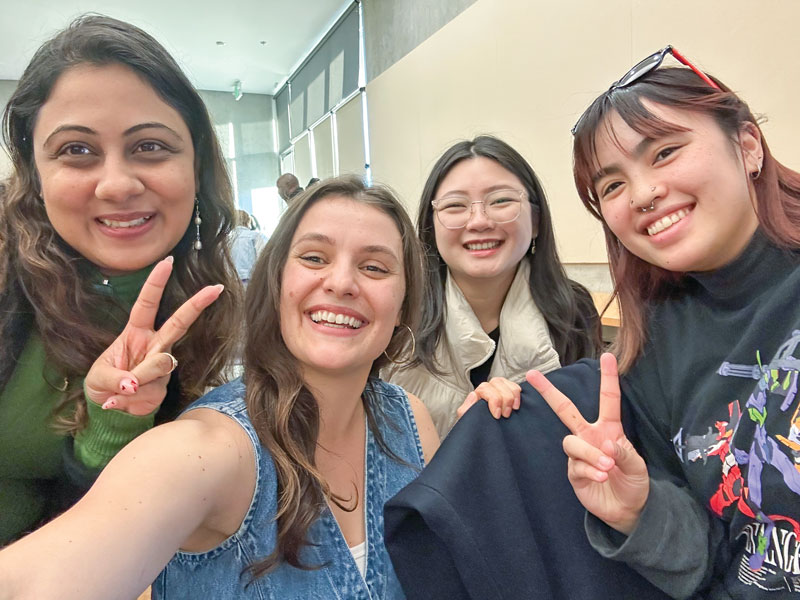
I realized I had begun developing my own relationship with Sensei. I wasn’t only appreciating what he had done. I was beginning to understand his dream and how I, as a disciple, could help carry it forward.
What does having a mentor mean to you now?
Tina: Sensei is an example of the potential that exists in every person’s life, especially when we base our lives on kosen-rufu.
Before, I felt like I had the bow and arrow but didn’t know where to aim them. Having Sensei in my life has given me direction. He’s shown me the importance of having a teacher that I know believes in me.
He has also helped me develop conviction in myself and become stronger. For people in my generation, sometimes it can feel embarrassing to be passionate or to say you’re deeply committed to something, because there’s always the fear of failure or judgment.
But when I turn to Sensei’s guidance, I feel more confident thinking: Let people say what they’re going to say. I know what I’m fighting for.
How has studying Sensei’s guidance helped you through difficulties?
Tina: This past year was really hard. I injured my back, was sick for a couple of months and had serious conflict with my family. During part of that time, I wasn’t even chanting.
But then a women’s division member shared with me this guidance from Sensei about tackling life’s problems:
Life is a struggle with ourselves. It is a tug-of-war between moving forward and regressing, between happiness and unhappiness. Those short on willpower or self-motivation should chant Nam-myoho-renge-kyo with conviction to become people of strong will, who can tackle any problem with real seriousness and determination. (Discussions on Youth, new edition, p. 98)
At that time, I felt like Sensei knew exactly what I was going through.
I’d been feeling powerless, directionless and unmotivated. But that guidance helped me return to the Gohonzon and become the protagonist of my life again.
What would you say to someone who feels they can’t connect with Sensei because they never met him?
Tina: Something I heard during the training course really struck me: Daisaku Ikeda, Josei Toda and Tsunesaburo Makiguchi never met Nichiren Daishonin, but through studying his writings and striving to embody his teachings, they developed a profound relationship with him.
I also think it’s OK to take time developing your own relationship with Sensei. For a long time, I had questions. I think asking those questions is part of having a seeking spirit. Seeking to understand this relationship will help you derive greater benefit from it.
What is your determination now?
Tina: For a long time, I didn’t understand what it meant to “respond to Sensei.”
I started practicing only a couple of months before Sensei passed away. Looking back, I feel that he entrusted the future to young people like me.
So now I want to respond to Sensei with my life and show through my own actions that kosen-rufu will happen.
My determination is that it’s going to start with me.
A Lantern In the Dark
Brandon Poythress / Chicago
Living Buddhism: Hi Brandon. Thank you for speaking with us about the oneness of mentor and disciple. To begin, can you share how you started practicing Buddhism?
Brandon Poythress: I came from a family that practices Buddhism starting from my great grandmother and grandmother on my mom’s side.
Some of my earliest memories were going to the local Buddhist center in Dallas and spending time with friends I made there. I didn’t chant then, but I always felt positive about the practice.
In high school, I struggled with feelings of loneliness. I felt that I had to be someone different than myself to become happy. Remembering how I would feel when I went to the Buddhist center, I joined the SGI-USA brass band and began developing a consistent Buddhist practice. This helped me challenge the negativity I felt about myself.
What was your journey in learning about Ikeda Sensei?
Brandon: Growing up in the SGI, I naturally had developed respect for Sensei and the founding presidents of the Soka Gakkai. Members shared their experiences and the appreciation they had for Sensei. However, my understanding was still quite limited until I began reading more of his work.
At a time when I felt like I couldn’t open up to anyone, Sensei’s words touched my life. I felt that even though I’d never met this man I can trust him. One quote that pierced my heart is: “Even if you think you’re hopeless and incapable, I know you’re not. I have not the slightest doubt that each of you has a mission. Though others may disparage you, please know that I respect you, I believe in you” (Discussions on Youth, new edition, p. 27).
The next evolution of that came at the beginning of the COVID-19 pandemic, when I determined to read all volumes of The New Human Revolution available in English. From there, my Buddhist practice began to shift. I went from being passive and waiting to be told what to do, to having strong conviction to take initiative. I learned about Sensei’s heart and intent in everything he did to construct the fabric of the SGI and empower everyday people.
Sensei became a stronger presence in how I went about my own life. I intuitively began asking myself, “Would Sensei do this?” Or, “What would he do in this situation?”
What does it mean to you to call Sensei your mentor? How has it benefitted you?
Brandon: Having a mentor is like having a lantern in the dark—someone who lights the path. As a disciple I strive to live with the same positive spirit as Sensei and to walk that same path.
In a lot of ways, it’s my greatest fortune to call him my mentor. He’s consistently helped me persevere and push through any self-limitations or negativity I’ve felt about myself.
Reading about Sensei as a disciple of second Soka Gakkai President Josei Toda, I see how much he broke through his own self limitations—battling through tuberculosis and poverty. Seeing him as a disciple and what he was able to overcome has shown me what a person can achieve when they have a great mentor.
What would you say to someone who feels like they can’t connect with Sensei because they never met him?
Brandon: Just because you’ve never met someone doesn’t mean they can’t make a lasting impression on you. A senior in faith once shared with me how many members have never met or seen Sensei. However, through reading his encouragement, they’ve developed an incredible seeking spirit and bond with him.
I’ve personally never met Sensei—I’ve only seen him in videos. However, time and time again in crucial moments his encouragement has felt as if he were speaking directly to me.
For someone struggling to connect with Sensei, I would encourage them to read his written works with an open heart and see what sticks. That doesn’t mean they have to agree with everything he says. In the preface of Discussions on Youth he even says, “You may not agree with everything I have to say. That’s perfectly all right. I would be happy if, however, from this discussion, you could glean something, however small, that might help you and be of benefit to your growth” (Discussions on Youth, new edition, p. 4).
Just having the attitude to learn about Sensei and how he thinks opens you up to understanding his heart, which is really what the mentor-disciple relationship is about.
What is your personal determination?
Brandon: For the last several years, I have been working in information technology, and I’m ready to move on from that and start a new journey of going back to school. Through that endeavor, I want to understand what it means to fulfill my mission in my work as a disciple of Daisaku Ikeda.
From the November 2026 Living Buddhism
References
- The Wisdom for Creating Happiness and Peace, part 3, revised edition, p. 277. ↩︎
- The Lotus Sutra and Its Opening and Closing Sutras, p. 70. ↩︎
- For Our Wonderful New Members, p. 5. ↩︎
- “The Dragon Gate,” The Writings of Nichiren Daishonin, vol. 1, p. 1003. ↩︎
- The Wisdom for Creating Happiness and Peace, part 3, revised edition, p. 331. ↩︎
- The Wisdom for Creating Happiness and Peace, part 3, revised edition, p. 238. ↩︎
- November 2024 Living Buddhism, p. 17. ↩︎
- Discussions on Youth, new edition, p. 27. ↩︎
- The New Human Revolution, vol. 9, revised edition, p. 123. ↩︎
- A Youthful Diary is a collection of personal diary entries written by Ikeda Sensei from 1949 to 1960. It begins when he was 21 years old. ↩︎
You are reading {{ meterCount }} of {{ meterMax }} free premium articles