
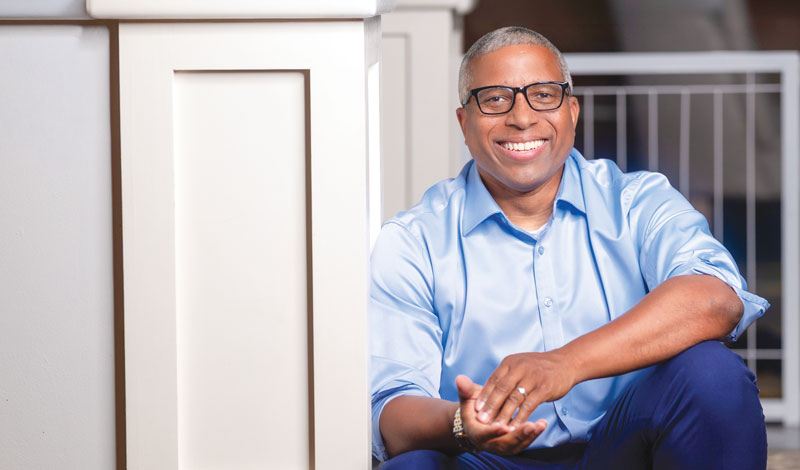
Living Buddhism: Thank you, Michael, for talking with us. Last summer, after a 28-year career in federal law enforcement—including 23 years with the U.S. Marshals—you filed for retirement as one of Chicago’s highest-ranking federal officers. But your exit would not be so easy.
Michael Woods-Hawkins: On paper, it was time to go—I filed for retirement as soon I was eligible, when I turned 50 that May. And none too soon, it seemed to me—the workload was set to double. Early that year, mass firings swept the federal government—hundreds of jobs cut nationwide—and these were just beginning to be felt on the ground, by field offices like mine. The cuts, followed by a hiring freeze, ensured that we who remained would inherit that work, much of which we’d never been trained for. I did not envy whoever would manage all this, but I was glad it wouldn’t be me.
I’d venture that feeling didn’t last very long.
Michael: It barely outlasted the week. Right after I filed, I was shocked to discover that the hiring freeze affected me, if indirectly. It was causing protracted delays in personnel actions, including promotions and retirements. It dawned on me that I was strapped to this train, and I’d need to steer it without any new help. This began to hurt at the start of summer, when an entire federal division was abruptly and permanently shut down. Rolling up our sleeves, we did our best to keep up, learning roles we had never been trained for. I too assumed a second role when our administration officer was let go. Patiently, he walked me through how to do the job, for which I reminded myself to be eternally grateful.
But honestly, day-to-day, I was furious; my gut reaction: I need to get out. I called a senior leader for guidance, who kept it plain and simple. Resolve to retire victoriously—this was the central point. Also, make sure, amid all the chaos, to not lose my head or forget to rest. I knew he had my hot temper in mind when he pointed me toward Nichiren Daishonin’s letters to Shijo Kingo. A devoted disciple, Kingo was a samurai too, and as famous for his temper as he was for his devotion.
Your face bears definite signs of a hot temper. But you should know that the heavenly gods will not protect a short-tempered person, however important they may think he or she is. If you should be killed, even though you might attain Buddhahood, your enemies would be delighted, but we would feel only grief. (“The Three Kinds of Treasure,” The Writings of Nichiren Daishonin, vol. 1, p. 849)
In any case, the storm that I thought I was weathering would soon prove to be no more than spring breezes. The real thing came down at the end of summer, when a massive federal immigration enforcement operation moved into the Chicago area. The tension in the city exploded.
My officers were out on those same streets, focused on doing their jobs. Our focus was on what it had always been on—apprehending violent fugitives, drug smugglers and child traffickers—on reuniting missing children with their parents. Now, much of our manpower was channeled toward protecting federal judges, whose safety was at constant risk.
Because every federal agency gets issued the same gear, my marshals were constantly mistaken for these other agents. Crowds would form. Angry calls poured in about “the marshals” at addresses we’d never been near. I couldn’t send my people anywhere without first sorting out who was actually operating there. Meanwhile, the job itself began to feel different—more about reporting desired benchmarks up the chain and less about the thing I’d been told mattered the most, the thing I’d entered the force to do: keep people safe.
That pressure built up in all my people, one of whom came to my office one afternoon. For four years, he’d run our missing-children recovery unit, an office he’d assumed after his wife, a schoolteacher, passed away. Protecting children, he’d decided, would be how he would honor her.
He came in furious and worn down: headquarters seemed no longer interested in recoveries—the dozens of children pulled out of horrific situations—unless the case had a specific angle that could be reported up the chain.
“When,” he asked, “is this job going to be about keeping people safe again?”
In our line of work, a person needs a compass. Mine has always been my Buddhist practice. I closed the door and we spoke about this, a conversation that stayed with me the rest of the year.
The work sounds profoundly demanding. What was the most trying moment for you?
Michael: Mine came in September, by which time my office had recovered 67 missing and trafficked children from circumstances no child should ever experience. That month, we got a tip on a girl whom we recovered and brought to the hospital, where we learned that she was pregnant. We called in her parents, whose faces, etched with worry, filled, the moment they saw us, with fear. They were undocumented—we understood this immediately; they saw our uniforms and fled.
We stripped off our vests and chased them down. In the parking lot, we caught up, showed them our credentials and conveyed to them that the only thing we wanted was to reunite them with their daughter.
On my way to a local SGI gathering that night, I thought of the terror in their eyes. I too have a daughter, and it broke my heart—I couldn’t imagine what they were feeling. The fear that I saw on their faces was the kind of fear I’d entered the force to transform. It was the same fear and suspicion I’d once felt myself for all police and law enforcement.
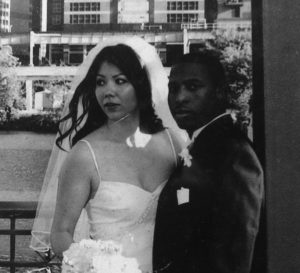
Twenty-eight years is a long time on the force—you would have been young when you entered the field. Why did you decide on this path?
Michael: I may have decided when I was a child—maybe when I was just 4. That’s how old we were—my twin brother and I—when our grandfather was shot on his doorstep. My grandfather, the mayor of a small town here in Illinois, had reported corruption among his own police. Following this, he’d begun receiving death threats and then…
His murder shattered my father and more—it shattered our family, which had been hanging on by a thread. When my parents divorced, there seemed no way we would heal; not until my mother began practicing Buddhism. I saw her transform her anger into compassion and become stronger than anyone I’d ever known. I had a ringside seat to her human revolution and watched her knit our family back together. I could not deny what I saw—it really was possible to turn poison into medicine. This was something I knew I had to more deeply understand and so dove into SGI activities. This Buddhist community and practice became my fuel to turn poison into medicine, spurring me toward the field of law enforcement.
Is there a prime point in faith you return to when the going gets rough?
Michael: There is—it’s a vow that I made to my mentor, Ikeda Sensei. In 2002, at 27 years old, I flew with other American youth to attend a training course in Japan. To us, Sensei gave electrifying encouragement, which I engraved that day in my heart. I vowed to stand up against injustice and dedicate my life to protecting ordinary people. Passing by, he gave me a fist bump—a single contact in which I tried to convey everything in my heart. Whenever I’ve felt myself on the edge, I remember the vow that I made. And at no time in my life did I need to lean on it more than I did the winter of last year.
Things reached a fever pitch last autumn when immigration agents deployed tear gas at a community event, very nearly provoking a riot. A federal judge responded by sanctioning the leader of that operation, and I was assigned to personally ensure the judge’s orders were followed. What this meant for me was “supervising” this man during his court appearances. Every appearance drew angry crowds, which he had a habit of stoking. This went on for weeks, until one day, I snapped and found myself shouting him down in the courthouse lobby, surrounded by media cameras.
In that moment, I remembered all the letters I’d read from the Daishonin to Shijo Kingo. If I met provocation and injustice by exploding in anger, how could I show proof of my Buddhist practice? How could I keep everyone safe? Calming myself, I began to chant in my heart and was able to carry out my duty with firm professionalism. This worked—and it taught me more about my practice than almost anything else that year.
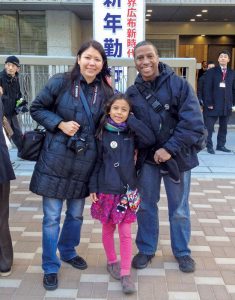
What next?
Michael: Well, soon after, the government shut down, and for 97 days my people and I worked without paychecks. Amid this tension, I watched as nearly all my old colleagues one by one, left the field—fired, forced out or worn down into resigning. It hit home at a face-to-face meeting in December, when the only person I recognized in the room was the police superintendent. I remember the pit I felt in my stomach, thinking: Where did everybody go?
But my resolve had changed completely from the start of the year—I no longer yearned to leap off this runaway train. What example would that set for all the deputies I’d sworn in, whose families I’d promised, eye-to-eye, to look out for? I gritted my teeth, trusted my practice and kept showing up. My Buddhist practice would not allow me to burn out.
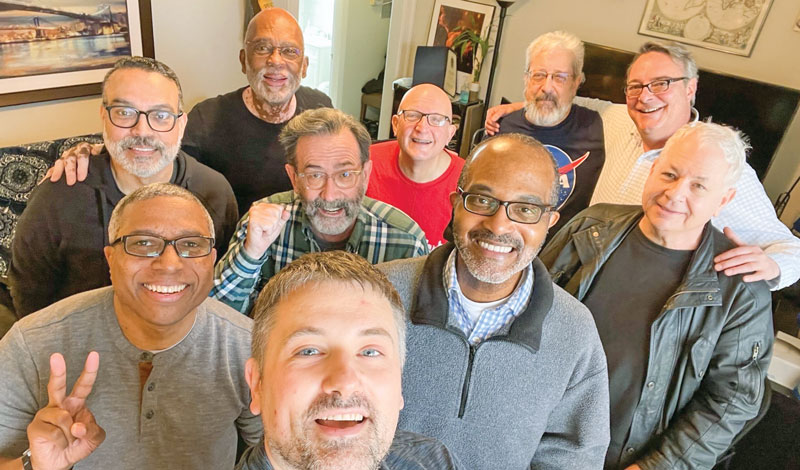
Was there a moment you remember in particular, in which you relied on your faith to break through?
Michael: I remember one discussion meeting in particular—the evening after we’d reunited the girl I mentioned with her parents. Their fear wore on my spirit more than anything else I’d seen that year, and I was trying to think of something encouraging to share. But when I arrived, weighed down by these thoughts, an older woman began to speak about her illness. She had terminal cancer, she said, but was not at all defeated—she was using this as her opportunity to demonstrate the greatness of Buddhism, sharing it even with her doctor.
Listening to her, I thought to myself, What I’m going through is peanuts compared to terminal illness. It gave me perspective and it gave me conviction. Her spirit stoked a flame in my heart.
All my hardships, I decided, were part of my vow. I left feeling: I chose this to show the greatness of Buddhism! To establish the correct teaching for the peace of the land! In particular, I began to chant about the pledge I had made—to inspire one young person to begin practicing Buddhism.

Your daughter stood up in faith, isn’t that so?
Michael: That’s right. She was watching me closely.
This summer, she decided, with my wife’s steady support, to receive the Gohonzon. When we moved her into her college dorm, the first thing she did was set up her altar. I knew, when she called me later that year, shaken but undefeated by something difficult that had happened, that I really had nothing to worry about. She had chanted, she told me, through the difficulty and now felt that everything would be OK. In fact, by the end, she was encouraging me, saying, “Dad, you know you’re doing great.”
By this time, I really believed that too—winter was turning to spring. At work, I had raised a successor, a woman with all my strengths and none of my faults. I chose her for her character—the most important thing, without which you can’t build anything. On top of character, though, you can build anything—capability without any limit. When I retired this year, I looked around at my team—staffed with extraordinary people who’d weathered the storm or parachuted courageously into it.
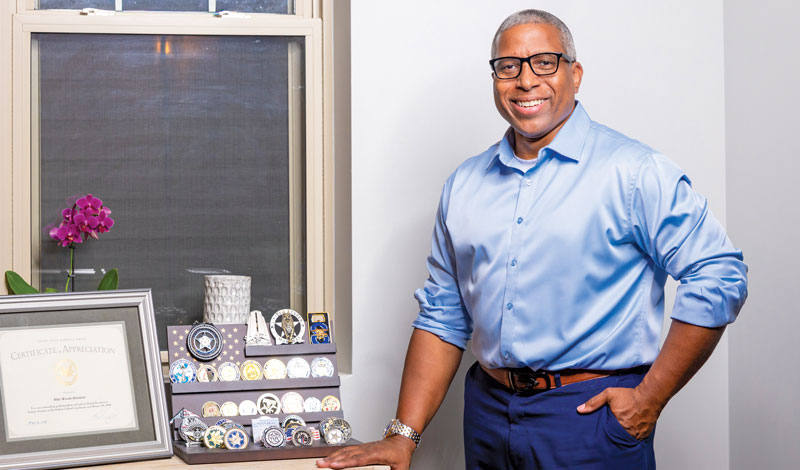
Congratulations. You must be proud. This summer, you retired. What’s next?
Michael: Right! Well, I was hired for a regional position at a wonderful company which, two weeks before the start date, chose to give me a global role instead. This has been a whirlwind for me, which I’m taking one day at a time.
One wonderful thing has been supporting this program, an antiviolence nonprofit my friend asked me to support. Actually, when she first asked me, I said no right away—I couldn’t imagine one more thing on my plate. But then my wife encouraged me to hear her out, and I learned what the work was about. The organization works with over 4,000 at-risk youth across Chicago; volunteering would mean speaking to groups of 30 or 40 kids and their families once a month, talking about my life, how my family overcame violence and how I found my way into law enforcement. My friend encouraged me to share my Buddhist practice as well.
My daughter was the one who connected the dots: “Dad, this is exactly what you’ve been chanting for.” She meant about my prayer to inspire youth to practice Buddhism. I realized, of course, she was right.
I started meeting with those kids and their families, speaking from the heart about how this practice has changed my life. They come prepared with real questions—some that genuinely stump me—and many of them ask more about Buddhism than anything else.
Looking back on this year, I see how fortunate I’ve been. I wouldn’t trade my last year on the force for anything on earth—it was a once-in-a-lifetime opportunity to do some massive human revolution. My practice, as ever, was my corner man: patching me up and sending me back out. Every moment challenged me to rise with something deeper than anger—with a vow to protect and inspire hope in the people.
You are reading {{ meterCount }} of {{ meterMax }} free premium articles