

Sometimes it may seem impossible to keep up with everything we need to do in our lives when our attention is divided among different priorities every day. With the the school year in full swing, managing relationships, classes, work and club activities can feel overwhelming—like a big wave ready to pull us under. What can we do to remain unswayed when we feel overwhelmed by all the things we need to do?
To master time, we must strive to master our mind, which we do through deepening our faith. Sensei writes: “Faith causes the sun of wisdom—which enables us to clearly see what we need to do in order to win—to rise in our hearts” (The Heart of the Lotus Sutra, p. 119).
Now let’s dispel some myths about time management and learn ways to master our time with faith.
Myth 1: I’m so busy. I don’t have time to study AND chant AND do SGI activities.
Reality: Chanting and challenging ourselves in SGI activities helps us build the life force to fulfill all our responsibilities and dreams joyfully!
When things get busy, our initial reaction is to start canceling plans. But when we make our Buddhist practice the foundation of our lives, we can pull forth the wisdom to do what needs to be done and take a step forward every day. Chanting Nam-myoho-renge-kyo is the key to transforming the anxiety of a busy schedule into an expansive life state that can break through our perceived limitations. We can then expand our capacity to do what’s best for our happiness. Just like our body needs food for fuel, our life needs chanting Nam-myoho-renge-kyo to fuel our life force.
We don’t have to compromise or limit ourselves. The Gohonzon is a reflection of our limitless potential, so our prayer should reflect that boundless determination. In Discussions on Youth, Sensei states:
Reciting the sutra is a daily activity in which we purify and prime our hearts and minds. In the morning, it is starting the engine for our day. …
Some people have powerful engines, and some have weak engines. The strength of the engine dramatically affects what we accomplish throughout the course of our lives. The difference can be enormous.
Diligently applying ourselves in our daily practice of the sutra recitation boosts the power of our engine. (new edition, p. 215)
Winning in the morning with vigorous gongyo and daimoku is key to having a fulfilling and meaningful day; it all starts with our determination. When we are grounded in our daily Buddhist practice, we can approach everything with a high life condition and expand our capacity to accomplish what we set out to do that day.
Myth 2: I can put things off and wait until the last moment to get things done.
Reality: We can exercise wisdom and make consistent daily efforts based on chanting Nam-myoho-renge-kyo.
It is easy to fall into the mindset of putting off our responsibilities until the very last moment. We’ve all pulled all-nighters to finish up projects that we should have started weeks ago, but doing so is not exercising our Buddhist wisdom. That’s why it is important to make consistent efforts.
To maximize our time we should strive to make consistent efforts toward our goals. By deepening our faith day after day, we can create dynamic progress for our life.
Sensei writes in volume 22 of The New Human Revolution:
Speed is the key in any struggle, and it is the secret for victory. Being slow to act or failing to take action when action is called for is an invitation for defeat. The great victory of kosen-rufu comes about when each person takes swift action, focuses on each day’s objectives and resolves the tasks at hand fully and completely. (p. 22)
Myth 3: It’s too late for me—I’m cooked.
Reality: As we chant, we tap the boundless life force of our Buddhahood and draw forth powerful resolve and wisdom to take decisive actions that move us toward total victory.
When deadlines have already passed and the tasks pile up, a rational conclusion might be to give up. But it is never too late! What matters is how we make use of the time now, giving our 100% in each moment.
Sensei states:
The future exists right now. How we act and live in this moment—and in each passing day—determines the future.
A sutra says, “If you want to understand what results will be manifested in the future, look at the causes that exist in the present” (“The Opening of the Eyes,” The Writings of Nichiren Daishonin, vol. 1, p. 279).
It’s now or never! Don’t let this precious moment slip by! (The New Human Revolution, vol. 30, p. 3)
At any moment we can decide to change the direction of our life. We can’t change the past. What is important is challenging our current obstacles with courage and wisdom.
By beginning our day with chanting Nam-myoho-renge-kyo, making consistent efforts every day and taking action with a fresh determination in each moment, we can live a life in which we can maximize our time to create the most value.
—Prepared by the SGI-USA student division
A Current of Support

Name: Hao Yang //
City: College Station, Texas
School: Texas A&M University
Living Buddhism: Hi Hao! Thank you for speaking with us. How did you start your Buddhist practice?
Hao Yang: I was born in Taiwan into a family that practices Buddhism with the SGI. Growing up, my brother and I often participated in future division activities. In 2020, he and I moved to the United States for school. Initially, maintaining my Buddhist practice was a challenge. At the time, the COVID-19 pandemic made it difficult to connect to the local SGI community.
In 2022 I transferred to Purdue University, where I studied for three years. In my second year there I struggled with academics and my confidence as a student. Overall, my life condition was quite low too. In my third year I began to chant consistently again and attend my local discussion meetings, where I could hear other members share their experiences and how they were using Buddhism to tackle everyday problems. Gradually, chanting helped me build back my confidence, and I saw both my grades and my ability to socialize with others improve.
What are other some other benefits you’ve had from practicing Buddhism?
Hao: At the beginning of this year, I started a master’s degree program in electrical engineering at Texas A&M University. After my first semester, I was searching for a research lab to work at over the summer—a process that typically requires a lot of time.
Mystically, the topic I studied for a final project in one of my classes was the same as one of my professor’s research topics. She asked if I would join her lab. This was something that seemed impossible since I had no prior experience in research. That showed me the power of having a determination and chanting Nam-myoho-renge-kyo toward it.
That’s amazing! Right now, you are leading the campus club at Texas A&M. Can you share about your club activities?
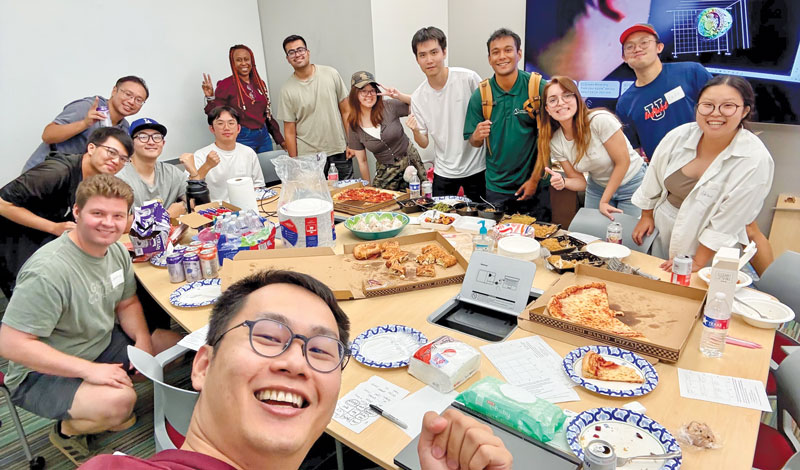
Hao: Yes. I just became the leader of the campus club in August, so I’m still quite new to everything. For our club meetings we gather once a month and work toward inviting friends to join us. In our first one, we came together, played board games, ate food and presented a short introduction to Buddhism. At the following meeting we had more friends join, and we centered our discussion on that month’s Ikeda Wisdom Academy video.
This worked well, so going forward we want to continue centering our discussion on the Ikeda Wisdom Academy videos and study topics. I believe activities like this help to expose more people to Buddhism and the friends they can make in the SGI.
What are some challenges you’ve experienced as a campus club leader?
Hao: One struggle I had was inviting students to join our gatherings. I would think about what words to use so that the campus club meetings would sound attractive to others. I really had to be courageous when I invited friends.
I speak quite slowly and honestly, which I thought was not such a great thing. However, I discovered this to be one of my strengths—finding that just speaking honestly with others is the best way to communicate and keep people coming back.
Why do you believe campus clubs are important for students?
Hao: I think it’s important to introduce many people to the philosophy of SGI Nichiren Buddhism and for them to know that a gathering of good people exists. When I was at Purdue University and didn’t participate in activities my first two years, I felt like I was struggling alone. I believe campus clubs are a place where students can come to support one another or at least be exposed to a space where they can be supported.
They’re great for promoting dialogue as well. One of my friends who I invited is a part of a Christian group on campus. He came to our campus club meeting, and I asked him to invite me to his Christian group’s gathering too. Having the club created the opportunity to have an exchange based on our respective faiths. I was happy my friend could learn about Buddhism and the SGI.
What are your determinations moving forward?
Hao: For one I’m determined to grow the campus club and to introduce more people to this Buddhism. I have received great benefit from practicing Buddhism, so I want to sincerely share my experience with more people. I will follow Ikeda Sensei’s guidance and improve my speaking skills so that more people can learn about Nichiren Buddhism and the SGI. For my personal dream, I want to stay here in the U.S. and either continue my education by pursuing a Ph.D. or find work in electrical engineering.
You are reading {{ meterCount }} of {{ meterMax }} free premium articles