
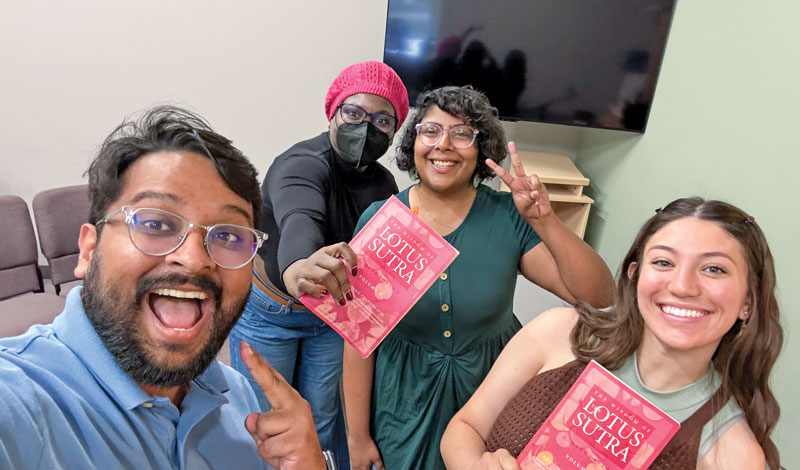
Ikeda Wisdom Academy members:
• are group through national youth leaders and all student division members.
• should have their own copy of The Wisdom of the Lotus Sutra, vol. 6.
• are encouraged to read the assigned material before each meeting.
November Syllabus: The Wisdom of the Lotus Sutra, vol. 6, pp. 3–35
Part One: “Former Affairs of the Bodhisattva Medicine King” Chapter
1: “True Health Can Be Found in the Bodhisattva Practice”
Supplementary Material:
• The Lotus Sutra and Its Opening and Closing Sutras, pp. 321–30
• The Writings of Nichiren Daishonin, vol. 1, pp. 372–74
• The Record of the Orally Transmitted Teachings, pp. 172–75
VOLUME 6 SYNPOSIS
The Final Six Chapters of the Lotus Sutra
This month, we begin volume 6 of The Wisdom of the Lotus Sutra, the final book in this study series. It opens with the “Former Affairs of the Bodhisattva Medicine King,” the Lotus Sutra’s 23rd chapter.
The Lotus Sutra begins with Buddhas, bodhisattvas and other beings gathering on Eagle Peak to hear Shakyamuni Buddha preach. Then, in chapter 11, “The Emergence of the Treasure Tower,” the Ceremony in the Air begins as the Buddha elevates the entire gathering into the sky. This central ceremony, in which the propagation of the sutra is entrusted to the Buddha’s disciples, concludes with the 22nd chapter, “Entrustment,” after which the assembly returns to Eagle Peak.
These events are known as the “three assemblies in two places”: the gathering at Eagle Peak (sutra chapters 1–10), the Ceremony in the Air (chapters 11–22) and the return to Eagle Peak (chapters 23–28).
Some view the last six chapters as an addendum. But Nichiren Daishonin compares them to “gleaning,” the collection of grain left after the main harvest. Though the central teaching has already been revealed, these final chapters present essential points, expressing Shakyamuni’s wish to spread the sutra’s teaching after his death so all people can attain enlightenment.
In our daily Buddhist practice, the first assembly can be likened to getting ready to chant. The Ceremony in the Air corresponds to chanting to the Gohonzon and aligning our lives with the Mystic Law. The return to Eagle Peak represents bringing forth our Buddha nature in daily life.
We experience this dynamic rhythm as we engage in our practice morning and evening and in the realities of life. As Ikeda Sensei explains:
Through this cycle of practicing faith and taking action in society, we can realize boundless growth in our lives and limitlessly advance kosen-rufu. I think this is the practical standpoint of these six chapters, which make up the second assembly at Eagle Peak. (The Wisdom of the Lotus Sutra, vol. 6, p. 11)
—Prepared by the SGI-USA Study Department
Chapter Overview
True Health Can Be Found in the Bodhisattva Way
“Former Affairs of the Bodhisattva Medicine King,” the Lotus Sutra’s 23rd chapter, focuses on Medicine King, who represents a life of true health, a life thoroughly dedicated to spreading the Mystic Law to help all people attain Buddhahood.
In striving to uphold this same dedication, we can cultivate compassion for others while remaining steadfast in faith no matter our circumstances. Ikeda Sensei says:
It is impossible… that we who practice the Mystic Law cannot expand the universe of our heart. Mystic, or myo, means “to open.” We practice faith in order to open the vast treasures in our hearts, to establish a state of life through which we can enjoy all that life brings. (WLS-6, 4)
The purpose of faith is to elevate our life state so that we can live a full and enriching existence. A well-known passage from this chapter says that anyone who hears this sutra “will know neither aging nor death” (The Lotus Sutra and Its Opening and Closing Sutras, p. 330).
While this doesn’t mean we will remain forever young or become immortal, it means that, through faith, we can enjoy health in body and mind. “Even should illness overtake us,” Sensei says, “we will continue chanting daimoku and telling others about the Mystic Law. It means living fully for our mission throughout eternity. To have such faith is to possess a state of life free from aging and death” (WLS-6, 6).
—Prepared by the SGI-USA Study Department
Ikeda Sensei’s Guidance
A Mission Transcending Life and Death
Ikeda Sensei: What is health? In conclusion, it is the life of the bodhisattva. I think that true health is the spirit to continue struggling for the sake of others. To just eat health food, aiming to lead a peaceful and secure existence while thinking only about oneself—this is not the image of health.
Bodhisattva Medicine King, who symbolizes health, gave his life for his convictions. A life of struggle is a healthy life.
Dr. René Dubos, a world renowned physician whom I had the privilege of meeting, remarked, “While it may be comforting to imagine a life free of stresses and strains in a carefree world, this will remain an idle dream.” He continued: “The earth is not a resting place. Man has elected to fight, not necessarily for himself, but for a process of emotional, intellectual, and ethical growth that goes on forever. To grow in the midst of dangers is the fate of the human race, because it is the law of the spirit.”[1]
Turning stress and worries into life force—this is the principle of changing poison into medicine. We need to realize a state of life that allows us to live with great joy. Toward that end, struggle is required. (WLS-6, 33).
Digging Deep
November Study Guide
Please use these questions to guide your study of The Wisdom of the Lotus Sutra, vol. 6, pp. 3–35.
1) Briefly explain the story of Bodhisattva Medicine King, who dedicated his life to repaying his gratitude to his mentor. How does this illustrate the concept of “giving one’s life for the sake of the Law”? (WLS-6, 12–17)
2) How did Josei Toda explain applying the Lotus Sutra using Bodhisattva Medicine King’s example? (WLS-6, 21–24)
3) In the context of the bodhisattva way of life, how does Sensei explain what true health is? (WLS-6, 33–34)
From the November 2026 Living Buddhism
References
- René Dubos, Mirage of Health: Utopias, Progress, and Biological Change (New York: Doubleday & Company, Inc., 1959), p. 230. ↩︎
You are reading {{ meterCount }} of {{ meterMax }} free premium articles