
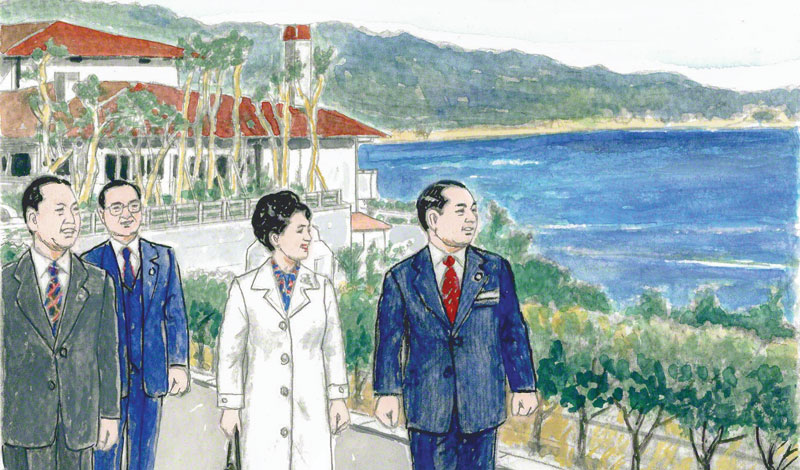
Ikeda Sensei’s serialized novel The New Human Revolution chronicles the history of the Soka Gakkai following his inauguration in 1960 as its third president. It carries practical guidance on how to expand our movement for kosen-rufu and hundreds of experiences of inner transformation. Sensei appears in the novel as Shin’ichi Yamamoto. The following takes place in 1978.
Installment 1
It was a crisp, bright autumn day.
The clear blue sky stretching overhead seemed to mirror the spirit of Soka Gakkai members, who sweep away the dark clouds and advance with indomitable dignity.
On the afternoon of November 18, 1978, a Soka Gakkai headquarters leaders meeting commemorating the organization’s 48th anniversary, also serving as the annual general meeting, was held at the Arakawa Culture Center in Tokyo. With this gathering, the organization set a powerful course for 1979, which had been designated as the “Year of Fostering Capable People.”
At the meeting, Shin’ichi Yamamoto noted that the Seven Bells—seven consecutive seven-year periods marking the advance of the Soka Gakkai—would end the following year, and he announced that the organization would establish new five-year milestones from 1980 until 2000, aiming toward the 21st century.
He also said that to commemorate November 18, Soka Gakkai Foundation Day, he would present a proposal focused on environmental issues, which had become a global concern, as well as on such topics as greater regional autonomy in Japan.
Shin’ichi’s proposal appeared on pages 4 and 5 of the Seikyo Shimbun the next day, November 19.
He began by discussing the background behind emerging calls in Japan for an “era of localism.”
Japan’s modern industry, linked closely to a centralized political system, had prioritized efficiency and generated immense wealth, he observed. But it had also fostered a consumer culture and an urban-centric society, leading to overcrowded cities, rural depopulation and environmental destruction. Traditional local cultures became subordinate to a superficial and homogenized central culture, eroding regional lifestyles and cultural diversity.
Shin’ichi shared his view that these growing calls for an era of localism had arisen from people’s wish to reclaim places where they could enjoy a vibrant way of life—one that was both rooted in tradition and that served to revitalize it. Since the Soka Gakkai’s movement is grounded in the daily lives of ordinary people, he added, it must continue to move forward in harmony with these wishes.
Buddhism and the Soka Gakkai’s mission are put into action in society. Only by responding to people’s hopes and desires can we fulfill the true mission of religion to create a better world.
Installment 2
Shin’ichi further discussed the Soka Gakkai’s role in an era of localism.
As long as we live in society, he stressed, “each of us must be determined to lay down solid roots in our communities and earn the trust of those around us, to forge genuine heart-to-heart connections with them and share in their joys and hardships. Only through such steady, grassroots efforts to connect with others’ hearts can we advance kosen-rufu and revitalize local communities in a meaningful sense.”
Even in the most remote regions of the country, he noted, Soka Gakkai members strove for kosen-rufu with great joy and passion. “We speak of treasuring each individual, but in concrete terms, this means actively taking the initiative to meet and talk with those living in such unsung and less prosperous areas. This is our most important responsibility as leaders of kosen-rufu. Such efforts are what pave the way to an era of localism. That is also the most natural path for us in light of Nichiren Buddhism’s fundamental commitment to enable all people to become happy.”
Turning to the environment, Shin’ichi observed that while large-scale industries had no doubt caused serious pollution, it was war, both past and present, that caused the greatest environmental destruction.
He went on to argue that just as wars begin in the hearts of human beings, “external environmental destruction” has always been fundamentally inseparable from the destruction of the inner realm of the human heart. He pointed out that much of modern scientific progress—particularly as it developed in the West—has been rooted in the justification of human self-interest, manifested as the desire to dominate and subjugate nature.
Shin’ichi was of course well aware that this attitude had also served as a positive force giving rise to perseverance, effort and a spirit of challenge, and that modern science had made significant contributions to overcoming hunger and disease. But as long as our science- and technology-driven world is fueled by egoism—a state of inner disharmony and imbalance that could be described as “inner environmental destruction”—that very energy will inevitably be channeled in a distorted direction.
Installment 3
Shin’ichi said that while modern civilization’s justification of self-interest had powered scientific progress, this anthropocentric mindset had already reached its limits, as evidenced by the spread of pollution and other negative consequences. A fundamental solution to environmental problems, he argued, cannot be achieved without shifting to a worldview that promotes harmony and coexistence with nature, ideas rooted in Eastern thought.
The Eastern philosophy of Buddhism recognizes the innate preciousness of all living things. It also teaches that human life cannot exist apart from the natural environment. This principle—the oneness of life and its environment—teaches that living beings and their environment are distinct yet inseparable.
According to this principle, a transformation in our inner state of mind inevitably influences how we interact with our natural environment, our external environment, enabling a transformation therein. It is a profound philosophy of harmony and coexistence, where internal and external change are deeply interconnected.
“Only with this worldview as our foundation,” Shin’ichi asserted, “can we transform the existing one-way relationship between humanity and nature—characterized by control and subjugation—into a reciprocal connection where communication flows both ways. This shift will enable human beings to listen to the messages of nature and, through such interactions, foster a culture and spirit rich in sensitivity.
“Based on this perspective, I believe we can move away from a mindset of conquering and subjugating nature toward a philosophy of harmonious coexistence and, ultimately, of true oneness with nature.”
Shin’ichi was resolved to overcome each of the grave issues threatening humanity’s very survival—war, nuclear arms, environmental damage, poverty and hunger. To that end, he made it his personal challenge to spread the supreme wisdom of Nichiren Buddhism throughout the world. Every day, as he sensed the dark clouds of destruction looming over humanity, he reminded himself: “There is no time to lose.”
Installment 4
Shin’ichi reached the crux of his proposal. Because we live in an increasingly globalized world, he warned, the destruction of nature and the environment would have devastating repercussions for not just a single nation or region but the planet as a whole. All nations should therefore pool their wisdom to explore, discuss and formulate concrete solutions for humanity’s survival on a global scale. He further proposed the establishment of an “Environmental United Nations” as a consultative and decision-
making body for that purpose.
Shin’ichi also discussed the North-South divide—the disparity between the developed nations, which enjoyed economic prosperity through advancements in modern science and technology, and the developing nations, which enjoyed no such progress and continued to struggle with hunger and poverty. He asserted that to promote harmony, coexistence and prosperity among the world’s nations, the developed nations—which had historically built much of their wealth at the expense of developing nations and peoples—bore a moral responsibility to undertake difficult challenges to rectify such disparity.
He further argued that ever-expanding human greed had led to the rise of the mass consumer society responsible for so much environmental destruction. The most pressing task, therefore, was to control and curb that greed.
“To that end,” Shin’ichi wrote, “I wish to emphasize the vital importance of a philosophy—particularly, a religious philosophy—that cultivates such wisdom.
“Now more than ever the world needs to shift from a focus on material wealth to spiritual wealth, from materialism to respect for the dignity of life—a value system embodied in these words of Nichiren Daishonin: ‘More valuable than treasures in a storehouse are the treasures of the body, and the treasures of the heart are the most valuable of all’ (“The Three Kinds of Treasure,” The Writings of Nichiren Daishonin, vol. 1, p. 851).
“I am confident that when this value system becomes firmly established in people’s hearts, we will find a way to unravel and resolve humanity’s greatest challenges, no matter how daunting. If inner destruction leads to external destruction, then it is only natural that inner harmony will, in turn, bring about external harmony.”
Shin’ichi’s heartfelt cry reflected the perspective of Nichiren Buddhism.
Humanity will be able to open new creative paths to resolve even its most complex and difficult problems when people return to the fundamental Law of life taught in Buddhism.
Installment 5
Lastly, Shin’ichi discussed the Renaissance, the period of cultural and artistic rebirth in Europe from the 14th to 16th centuries.
The Renaissance, he said, was a transformational era in which God, viewed as absolute and reining over all from above, was brought down to the realm of the individual. This led to a rejection of a Church-centered worldview and to calls for liberating the human spirit. What followed, however, was not respect for individual dignity but rather the rise of new forms of external authority. This trend continued for several centuries, with people putting their faith in progress, in institutions, in capital, in science and even in nuclear power. But the value systems built upon such externals had reached a breaking point and were rapidly crumbling, leaving a profound emptiness in people’s lives.
“I believe that the guiding principles for the future must emerge from a religion deeply rooted in people’s hearts. The time has come for us to prioritize inner personal transformation over absolute faith in external authority. Though it may be a modest approach, I see such a ‘second Renaissance’ as a necessary trend of the times. Ordinary people will play the key role in achieving this, and their struggle must begin with changing their own lives.”
Shin’ichi concluded by affirming that the teachings of Nichiren Buddhism offered the means to make this possible.
He was resolute in his determination to bring the profound principles of Buddhism to society and the world and open a new way forward for humanity in the 21st century.
In his treatise “On Establishing the Correct Teaching for the Peace of the Land,” Nichiren Daishonin writes, “If you care anything about your personal security, you should first of all pray for order and tranquillity throughout the four quarters of the land, should you not?” (WND-1, 24). “Order and tranquillity throughout the four quarters of the land” means the peace and prosperity of society and the world.
If religious practitioners shut their eyes to humanity’s most pressing challenges and turn their backs on society, they abandon the fundamental mission of religion—to help people attain happiness. Genuine Nichiren Buddhists throw themselves into our troubled and chaotic world and strive to free people from suffering.
Installment 6
Taking the initiative to meet and talk with those in unsung and less prosperous areas is what it means to value each individual, Shin’ichi had asserted in his proposal. Such efforts, he said, pave the way to an era of localism.
Shin’ichi put his own words into action.
On November 21, just two days after the proposal appeared in the Seikyo Shimbun, he attended a Totsuka leaders meeting celebrating the Soka Gakkai’s 48th anniversary, at the Totsuka Culture Center in Kanagawa Prefecture. The following day, six gongyo sessions were held at the same venue to mark the center’s one-year anniversary. Wishing wholeheartedly for Kanagawa’s great progress and victory, Shin’ichi poured his entire being into offering guidance at each one. It commenced a new charge ahead.
That same day, November 22, at a leaders meeting in Gunma Prefecture, the prefecture song “The Bell of Kosen-rufu,” lyrics by Shin’ichi, debuted.
About 10 days earlier, Gunma leaders had asked Shin’ichi to write a song to mark the prefecture’s fresh start. Given that Shin’ichi already had a guidance trip to Kansai scheduled and was preparing for the Soka Gakkai’s 48th anniversary commemorative events, they assumed it would be quite some time before he could begin working on it.
But at the headquarters leaders meeting in Tokyo on November 18, the completed lyrics were delivered to the Gunma Prefecture leader.
Shin’ichi had used every spare moment to work on the lyrics, despite his intense schedule in Kansai. He made further revisions and finalized the song on the day of the leaders meeting.
He was determined to respond to the members’ request, and that earnest resolve gave him strength and doubled his energy.
Shin’ichi’s swift response deeply moved the Gunma members. And their joy was all the greater having received the lyrics on the anniversary of the Soka Gakkai’s founding.
Installment 7
Shin’ichi had also sent a message with the lyrics: “I’ll arrange for a composer as well. As soon as the music is ready, I’ll let you know.”
The Gunma members waited eagerly.
On the evening of November 21, prefecture leaders gathered at the Gunma Center (present-day Takasaki Peace Center) to discuss activities for December.
Suddenly, a phone call came in from a leader accompanying Shin’ichi.
“The music for the Gunma song is ready,” he said. “I’ll play a recording over the phone.”
“Please wait a moment,” the leader who answered replied. “We’d like to record it.”
Before long, lyrics and music flowed through the receiver—it was a powerful song, brimming with hope.
The winds that blow down from Mount Akagi,
as it watches over and protects us,
are to us the workings of the Mystic Law
bringing the fragrance of happiness to beautiful Gunma.
Joining arm in arm, arise, my friends!
In this land of Jomo,[1]where culture abounds,
we now again strive to create a realm of peace and joy,
the wondrous dream of kosen-rufu come true.
Come, let’s build it now—sound the bell!
Brimming with a rich and storied history,
Gunma’s legacy shines bright.
Above us, in the sky, a rainbow gleams.
Ah, we will never forget our vow—
ever one with the Tone River and Mount Haruna.
It was a song of departure as Gunma set out anew toward the 21st century.
In the leaders’ minds, the lyrics evoked one image after another of their picturesque homeland. They could feel Shin’ichi’s warm concern as they worked for kosen-rufu in their communities.
The song brought tears to everyone’s eyes.
Installment 8
A group of chorus members happened to be at the center for a rehearsal. One of them quickly transcribed the music by ear from the recording. They began practicing the song immediately.
Soon after, a message from Shin’ichi arrived: “Songs have the power to change the times. I’m looking forward to seeing the Gunma members achieve wonderful growth and build a new age as they proudly sing this song together.”
At the Gunma leaders meeting the following day, November 22, a joyous rendition of the new song filled the hall.
With the composition of “The Bell of Kosen-rufu,” Shin’ichi had now written a song for every prefecture in the Kanto region.
On November 23, he attended the first Kanto Region chapter leaders meeting, held in the Kosen-rufu Hall of the Soka Culture Center in Shinanomachi, Tokyo.
Before the meeting, chapter leaders from each prefecture sang their respective song in what felt like a friendly and spirited contest—the men singing with pride, their heads held high, the women swaying gently to the rhythm, singing with grace and joy. Their voices rang with determination to scale the summit of the 21st century.
In his speech, Shin’ichi expressed his heartfelt gratitude and admiration for the chapter leaders, who shoulder the weighty responsibility of kosen-rufu as central figures entrusted with the well-being of their members, the children of the Buddha.
“Each of you is dealing with your own struggles—with work, family or other personal challenges. Yet you continue to give your all for your fellow members and for Buddhism. I’m sure at times things feel especially difficult or overwhelming. Please know that I truly understand what you are going through.
“When I was racing around trying to get Mr. Toda’s businesses back on track, I not only held leadership responsibilities in the young men’s division but also served as a district leader, a chapter adviser and an acting chapter leader. It was an enormous struggle just to find time to attend meetings.
“But I am firmly convinced that thanks to those challenges, I could build a strong foundation in faith, which became the cornerstone of my life. I was able to develop my abilities as a leader of our Buddhist movement and accumulate boundless good fortune. Hardships are truly a treasure.”
Installment 9
Shin’ichi continued: “Most people are so busy just trying to survive that they have little time to think about others.
“You, on the other hand, even while grappling with your own struggles and challenges, encourage fellow members, pray for people’s happiness and strive earnestly for kosen-rufu. This is the noblest way a person can live.
“Each of you will overcome your problems and hardships. Why? Because our mission as Bodhisattvas of the Earth is to demonstrate the great power of Nichiren Buddhism by triumphing over suffering through Buddhist practice.
“Life may bring many stormy days. But that is why, when we courageously face and surmount our challenges, we can experience deep fulfillment and exhilaration. Buddhist practice means winning over ourselves and advancing kosen-rufu in the real world.
“The first men’s and women’s chapter leaders in the early days made immense contributions. Even today, many members speak admiringly of their efforts.
“Now you are the chapter leaders pioneering this second phase of kosen-rufu. I hope each of you will create a personal history so inspiring that future generations will say: ‘How sincerely they dedicated themselves to others’ happiness!’ ‘How passionately they took action!’ ‘I learned the true meaning of faith from them!’
“Once you decide to take on a new challenge, I hope you’ll press forward with unwavering courage and passion!
“As we confront and break through our limitations for the sake of kosen-rufu, our life state will expand tremendously. That will spark fresh energy and momentum in our movement. True growth comes only when we push beyond our limits—that’s when we become more capable. On the other hand, though we may have great potential, if we don’t make full use of it, our ability will fade away.”
The German poet Goethe wrote:
We will strive unceasingly
to shed the habit of half measures
and live resolutely
in wholeness, goodness, and beauty[2]
Installment 10
Shin’ichi went on to describe the role of leaders and specify points they should bear in mind in their activities.
“I would like you to establish a chapter tradition of reading the Daishonin’s writings as part of your daily activities. The more each person strengthens their faith, the more they will want to understand the teachings. That’s because deepening faith and continuing to practice require a foundation in Buddhist study.
“What matters is that everyone reads the Daishonin’s writings together—even just a line or two.
“Next, I ask that men’s leaders at the chapter and other levels show utmost consideration to the families of our women’s division members. Some women are raising small children; others are caring for elderly relatives. Please be mindful of each person’s situation and consider ways to support them, such as ending meetings early.
“Also, I want to emphasize that the planning meeting is the main venue for organizing chapter activities. A chapter leader must never make decisions arbitrarily without consulting others. That goes against the spirit of democracy. Without genuine agreement among leaders, they won’t be able to give their all, unite or create joyful activities. It is also crucial that chapter leaders avoid making plans only with those they personally like or deciding things based only on reports and information they receive from them.
“Whether at the chapter or district level, what’s essential when carrying out activities is always prioritizing open discussion, doing everything in a democratic spirit and ensuring that everyone can practice faith with full understanding and agreement.
“Leaders must also be careful not to burden the members. For example, if a leader takes for granted even something as simple as accepting a ride from a member, they are unfit for leadership. If you find yourself having to accept such help, you should offer your heartfelt thanks. Please understand that Buddhist practice and human revolution involve mastering ourselves.”
Installment 11
Small things matter. Major accidents often result from failing to notice minor details. There are many instances where a lack of simple consideration has eroded trust among members, causing a local organization to stagnate.
That’s why, at this fresh start for the Kanto men’s and women’s chapter leaders, Shin’ichi spoke in detail about what he wanted them to keep in mind—even if he might sound nitpicky.
“Everyone has a right to privacy,” he continued. “No matter how close your relationship, always give utmost respect to people’s privacy and don’t share their personal matters. Leaders have a duty to maintain confidentiality, and being strict about this is only natural.
“Nichiren Daishonin writes, ‘Misfortune comes from one’s mouth and ruins one’ (“A Comparison of the Lotus and Other Sutras,” WND-1, 1137). I urge you to use wisdom to avoid causing members distress through careless remarks.
“Also, leaders must refrain from using any form of coercive language or behavior with members. Your role is to support and encourage them so they can practice with peace of mind and move forward confidently in their lives.
“Some individuals may try to exploit the members’ faith or the organization. I urge you to remain vigilant and take firm action to protect your fellow members when necessary. We must not turn a blind eye to those who stray from the path of a genuine Soka Gakkai member, disrupt our organization of children of the Buddha striving for kosen-rufu or create problems in society.
“As I’ve emphasized many times, please strictly observe the rule of ending meetings by 8:30 p.m. Overexerting ourselves is simply unsustainable. I hope our elderly members in particular take care to get sufficient rest and avoid fatigue.
“Speaking of time, I’d also like to request that phone calls for reporting and communication be kept brief and to the point so that everyone can use their time meaningfully. And leaders shouldn’t stay at members’ homes late into the night. Every family needs time to rest and unwind. Please be mindful of this and maintain clear boundaries.”
Installment 12
Accidents happen when we become careless and neglect the basics. Kosen-rufu is a battle against negative forces, and if we let our guard down, those forces will find a way to take advantage. That’s why Shin’ichi urged the chapter leaders to stay vigilant, firmly grounded in their principles.
The chapter is the linchpin of the Soka Gakkai. Shin’ichi hoped that chapter leaders would fully demonstrate their abilities and lead the kosen-rufu movement with vitality. “If you ever encounter some problem or dilemma in carrying out activities,” he said to them, “please consult other leaders, like those on the headquarters level. And if ever you genuinely can’t accept a leader’s guidance, don’t hesitate to bring it up with the top leadership.
“I would like to reaffirm the importance of valuing discussion and respecting everyone’s opinions so that all chapter members can contribute freely and fully. Please conduct activities with everyone’s agreement—the chapter leaders and vice leaders and the youth division. This will lead to the most steady and sustainable development.
“If your discussions come to an impasse and you can’t reach a consensus, try chanting together. It’s also important to study the Daishonin’s writings and return to the basics of faith. What matters most is having a faith-driven resolve to align your hearts and unite for kosen-rufu.
“Your leadership teams include people of varying ages and perspectives. Naturally, opinions will differ. But by overcoming those differences, aligning your hearts, and uniting, you can set an example of human harmony for your communities and society.”
Lastly, Shin’ichi said: “Please take the best care of your precious, precious members. Please support them on my behalf. I would like to express my sincere appreciation and gratitude to you all.”
If chapter leaders are truly determined, their entire chapter will transform. When the chapter changes, its members will savor true joy and benefit, and a triumphant song of kosen-rufu will ring out.
Installment 13
On November 25, Shin’ichi Yamamoto attended a Chiba Prefecture chapter leaders meeting at the Kosen-rufu Hall of the Soka Culture Center in Tokyo. On the 26th, he visited Hachioji to encourage those taking the Study Department introductory-level promotional examination as well as those administering and marking the exams. On the 27th and 28th, he held discussions with student division representatives.
He did his utmost to make time to meet with members he hadn’t yet been able to.
Amid all this, he continued writing lyrics for Soka Gakkai songs. He presented the members in Shizuoka Prefecture with “Champions of Shizuoka.” A chorus group performed it for the first time on the evening of November 29 at a prefecture leaders meeting held in Shizuoka.
Ah, the honor of gazing upon
our beloved Mount Fuji morning and evening.
May we, as Bodhisattvas of the Earth, be like Fuji!
Champions of Shizuoka, now is the time to rise, now is the time to rise!
The morning sun shines on this land where friends from around the world gather.
Rise boldly here to build a realm of peace and happiness!
Champions of Shizuoka, now is the time,
this is the place!
Our proud, spirited advance of kosen-rufu in this land causes
unprecedented benefit to emerge without end.
We inherit the spirit of the three martyrs![3]
Champions of Shizuoka, now is the time to joyfully leap forth!
Champions of Shizuoka, now is the time to joyfully leap forth!
In referencing Mount Fuji in the first verse, Shin’ichi expressed his hopes for the Shizuoka members: “Be people of unwavering conviction, dignified and undaunted like Mount Fuji, even in the fiercest storm!” “Be people of noble character, as lofty as Mount Fuji!” “Be people who possess an expansive life state that compassionately embraces all like Mount Fuji!”
Thirty years later, in November 2008, Shin’ichi revised the lyrics to commemorate the 1st New Era Shizuoka Youth Division General Meeting and congratulate the young champions of Shizuoka on their fresh start. He changed “friends from around the world” in the second verse to “comrades of truth and justice,” “unprecedented benefit” in the third verse to “waves of disciples, one with their mentor,” and “now is the time to joyfully leap forth!” in the last line to “now is the time to triumph!”
References
- Jomo is an old name for the area now known as Gunma Prefecture. ↩︎
- Translated from German. Johann Wolfgang von Goethe, “Generalbeichte” (General Confession), in Goethe’s Werke (Goethe’s Works), vol. 1 (Stuttgart und Luebigen: J. G. Cotta’sche Buchhandlung, 1827), p. 140. ↩︎
- The three martyrs: Refers to the three martyrs of Atsuhara (located in present-day central Shizuoka). They were among a group of Nichiren Daishonin’s farmer disciples arrested during the Atsuhara Persecution. All three refused to recant their faith and were ultimately beheaded. ↩︎
You are reading {{ meterCount }} of {{ meterMax }} free premium articles