
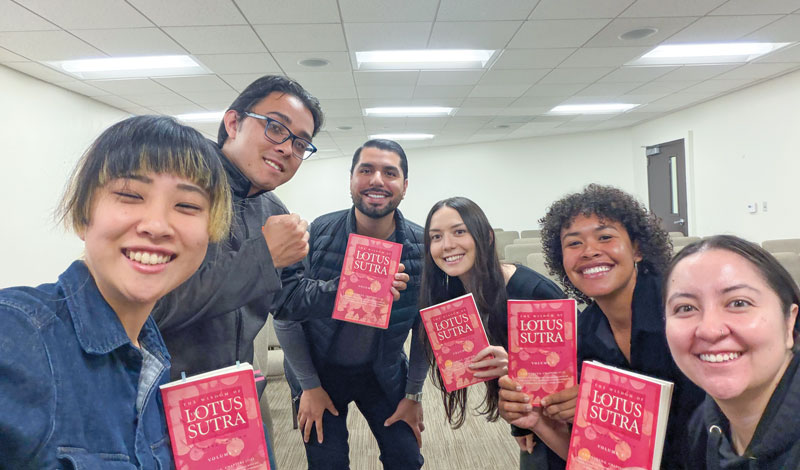
Ikeda Wisdom Academy members:
• are group through national youth leaders and all student division members.
• should have their own copy of The Wisdom of the Lotus Sutra, vol. 5.
• are encouraged to read the assigned material before each meeting.
October Syllabus: The Wisdom of the Lotus Sutra, vol. 5, pp. 237–62
Part Six: “Entrustment” Chapter
9: “Completing the Ceremony of Transmission”
Supplementary Material:
• The Lotus Sutra and Its Opening and Closing Sutras, pp. 319–20
• The Record of the Orally Transmitted Teachings, pp. 171–72
• “An Outline of the ‘Entrustment’ and Other Chapters,” The Writings of Nichiren Daishonin, vol. 1, p. 911
Chapter Overview
‘Entrustment’: Transmission From Mentor to Disciple
This last chapter in volume 5 of The Wisdom of the Lotus Sutra covers “Entrustment,” the Lotus Sutra’s 22nd chapter. In this chapter, Shakyamuni Buddha entrusts all bodhisattvas (not only those of the essential teaching) with the mission of spreading the Law after his passing to help all people become happy. He says:
For immeasurable hundreds, thousands, ten thousands, millions of asamkhya kalpas I have practiced this hard-to-attain Law of supreme perfect enlightenment. Now I entrust it to you. You must single-mindedly propagate this Law abroad, causing its benefits to spread far and wide. (The Lotus Sutra and Its Opening and Closing Sutras, p. 319)
Hearing the Buddha’s wish, the bodhisattvas assure him, repeating three times in unison:
We will respectfully carry out all these things just as the world-honored one has commanded. Therefore we beg the world-honored one to have no concern on this account!” (LSOC, 320)
This chapter teaches that we repay “the debt of gratitude that [we] owe to the buddhas” (see LSOC, 320) by spreading the teaching. Of the two Chinese characters that make up the term entrustment, the first means “to commit or leave something to someone with confidence,” while the second implies a difficult task (see WLS-5, 237–38). No matter the difficulties, these bodhisattvas vow to uphold and spread the teachings of the Lotus Sutra, with the same spirit as the Buddha, their mentor.
Those who strive in accord with their mentor’s intent also form powerful bonds with the mentor. Ikeda Sensei expands on this point:
The bond of mentor and disciple comes down to the awareness of the disciple. It’s not about formality. Meeting the mentor on numerous occasions or spending time at the mentor’s side or being entrusted with a leadership position—these are all form [rather than essence]. Even if people are physically far from the mentor or have never spoken directly with the mentor, if they are aware of their role as disciples and strive to put the mentor’s words into practice, then the mentor-disciple relationship is alive and intact. (WLS-5, 251–52)
How do we respond when something precious is entrusted to us? In “Entrustment,” the bodhisattvas demonstrate that gratitude is expressed through action—by encouraging others and helping them reveal their potential.
—Prepared by the SGI-USA Study Department
Ikeda Sensei’s Guidance
Courage and Compassion—Two Sides of the Same Coin
Ikeda Sensei: [First Soka Gakkai President Tsunesaburo Makiguchi] says that we should spread the teaching with the compassion of a parent—that is shakubuku. This makes it very easy to understand. It’s not a matter of increasing numbers or promoting our name, nor is it simply engaging in theoretical debate.
Always warmly, sometimes strictly, sometimes soothingly—this is how we should guide the other person. When sharing Buddhism with others, if we allow ourselves to be pulled into an emotional confrontation, then we are no longer behaving as an emissary of the Buddha. We need to firmly gird ourselves in the “armor of perseverance” (LSOC, 233). On the other hand, asking someone to “please just give it a try,” as if begging, amounts to degrading the Law.
[Josei] Toda said, “Shakubuku means helping the other person overcome the evil in their minds and enabling them to live according to the good in their minds.” Parents cannot look on in silence and watch their children enter a mistaken path that will lead to misery. There are times when a parent is firm. Such compassion is shakubuku.
In short, it is an act of the greatest justice and courage. It is not easy for people to exhibit compassion. Many people who claim to have compassion are actually hypocrites. That is why courage is a more apt word than compassion. To courageously speak about what is right is tantamount to compassion. Courage and compassion are like two sides of the same coin. (WLS-5, 247–48)
Digging Deep
October Study Guide
Please use these questions to guide your study of The Wisdom of the Lotus Sutra, vol. 5, pp. 237–62.
1) The Lotus Sutra states: “The Thus Come One has great pity and compassion. He is in no way stingy or begrudging, nor has he any fear. He is able to bestow on living beings the wisdom of the Buddha, the wisdom of the Thus Come One, the wisdom that comes of itself. The Thus Come One is a great giver of gifts to all living beings” (LSOC, 319).
This passage includes the phrase “nor has he any fear” (LSOC, 319). Explain the relationship between compassion and courage when engaging in shakubuku. (WLS-5, 244–48)
2) The “Entrustment” chapter says that those who spread the teaching “will have repaid the debt of gratitude that [they] owe to the Buddhas” (LSOC, 320). How are spreading the teachings and expressing gratitude related? (WLS-5, 251–52)
3) How does the Lotus Sutra’s overall framework, centered on the Ceremony in the Air, reflect the “rhythm of human revolution”? What “two actions” does this rhythm alternate between? And in light of the character nam (Skt namas), what does “return to” and “based on” indicate in our Buddhist practice? (WLS-5, 255–57)
Looking Forward: November Syllabus
The Wisdom of the Lotus Sutra, vol. 6, pp. 3–35
Part One: “Former Affairs of the Bodhisattva Medicine King” Chapter
1: “True Health Can Be Found in the Bodhisattva Practice”
You are reading {{ meterCount }} of {{ meterMax }} free premium articles