

College is a time when we enter a new phase of our lives. It is a time of meeting new people and experiencing lots of new things, including living on our own for the first time. It may all sound exciting, but it can also be a time when we confront new challenges and feelings such as loneliness.
When we are feeling lonely, our first instinct might be to seek more social interactions. But loneliness is a feeling that is not determined by how many people we interact with. Some people can feel lonely with many people around them, while others feel just fine being alone.
Buddhism teaches that we can transform our state of life, which in turn changes how we experience the world around us. So what are some steps we can take to overcome feelings of loneliness?
First, we can chant Nam-myoho-renge-kyo. Chanting allows us to reconnect with and activate the life state of Buddhahood within our own lives and overcome the delusion that clouds it. We can awaken to the reality of our lives, that we possess unlimited compassion, wisdom and courage and the ability to overcome our sufferings.
Sensei writes:
When you’re suffering, when you’re sad, when you’re hurting, just chant Nam-myoho-renge-kyo with an open heart. Keep chanting just as you are, as if sharing your feelings with a caring parent. In this way, you transform your problems into prayers.
Most important, as you chant, you will experience courage surging up from within, filling you with the conviction that you can triumph over what’s troubling you. Even if the problem isn’t resolved immediately, the time will come when “the sufferings of hell will vanish instantly” (“Lessening One’s Karmic Retribution,” The Writings of Nichiren Daishonin, vol. 1, p. 199). When you look back, you’ll find that the difficulty that was causing you so much heartache became an opportunity to dynamically expand your life state. (For Our Wonderful New Members, p. 44)
Second, we can do something for others. When we are feeling lonely, we tend to focus on ourselves and how much we are struggling. But we can break out of that cycle by doing something for another person.
Sensei says:
When beset by some misfortune, people tend to think that no one could possibly be as unhappy or unlucky as they are. …
As long as we are wrapped up in ourselves, there is no happiness. When we courageously take action for others, the wellspring of our own life is replenished.
When we look after and care for others—that is, help others draw forth their life force—our own life force increases. When we help people expand their state of life, our state of life also expands. (The Wisdom for Creating Happiness and Peace, part 1, revised edition, pp. 229–30)
By chanting and supporting others, for example, sending a quick text to a friend or checking in on a family member, we can transform our life state, the first step to transforming loneliness.
Finally, we can reach out to a Buddhist friend or local Buddhist community. The SGI is all about building friendship and community. Wherever we are, we can find someone in the SGI who will listen to our worries and warmly encourage us. We can also meet others who may be going through similar challenges. As SGI-USA campus clubs continue to expand across the U.S., we might even discover one on campus!
The important thing is to know that we are not alone in feeling lonely. By chanting Nam-myoho-renge-kyo, supporting another person and reaching out to a Buddhist friend, we can transform our feelings into a source of value for our own and others’ lives.
—Prepared by the SGI-USA student division
Centering Everything on Prayer

Name: Miwa Oizumi // City: Davis, Calif.
School: University of California, Davis
Living Buddhism: Hi Miwa! How did you start practicing Buddhism?
Miwa Oizumi: I was born into a family that practices Nichiren Buddhism. Growing up, I spent many weekends at my local Buddhist center and the practice came very naturally to me. During the COVID-19 pandemic, I began to set chanting goals and helped with future division activities. By taking initiative to expand my Buddhist practice I changed into a person who tries to see the good in all people—no matter the circumstance.
How did you end up at the University of California, Davis (UC Davis)?
Miwa: Since I was young, I’ve been passionate about protecting the environment. In high school, I took an environmental science course and realized it was something I wanted to pursue. Since UC Davis is known for its agricultural and environmental science program, I was dead set on going there.
What are benefits you’ve experienced through practicing Buddhism?
Miwa: Last academic year, I started the fall quarter with a low GPA and became quite discouraged. Through chanting Nam-myoho-renge-kyo, my mindset shifted to
understand that grades are important, but getting experience in the field is also important.
I focused my prayer toward doing my best in school and finding a job or paid internship related to my major to gain that experience. Though I was initially discouraged by the straight rejections I received, I engraved in my heart the quote, “Winter always turns to spring” (“Winter Always Turns to Spring,” The Writings of Nichiren Daishonin, vol. 1, p. 536). Through prayer and action, I eventually received both a full-time summer job in a lab and an internship related to the sustainability of dairy economics.
Congratulations! You’re also leading the campus club at UC Davis. Can you share about that?
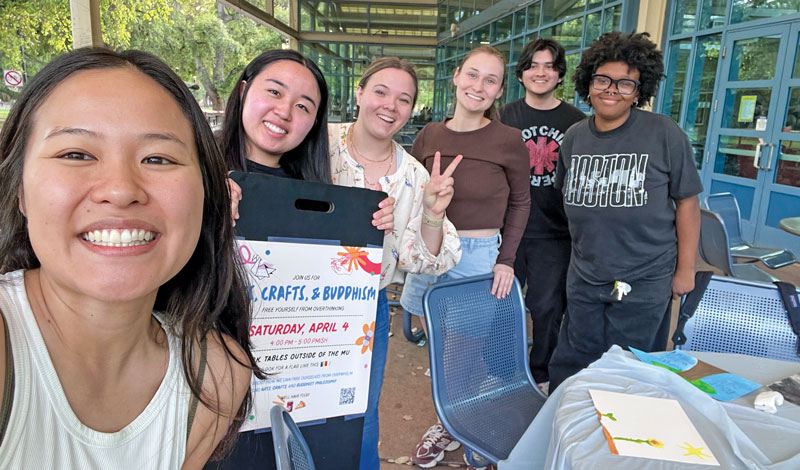
Miwa: Yes. Recently, I and fellow student division members on campus got together to start up the club again.
We held an activity last spring quarter which was joyful and gave us the confidence to keep the momentum going this academic year. Now, since we have a solid group of five student division members on campus, we will make the campus club official this year.
What challenges have you experienced leading the campus club? And what did you learn from those challenges?
Miwa: One big challenge was lacking confidence in my own ability to take initiative to lead the club. Because I am a perfectionist, I have a mindset that if something can’t be done perfectly it’s not worth doing. Receiving encouragement from a senior in faith made me see that making the effort, no matter how big or small, is what matters in the end.
Deciding to make the campus club a reality and centering it all on prayer has given me that confidence. Because of that I’ve expanded my mental capacity to juggle life, and I chant more about the people around me. I truly feel that sharing Buddhism with others brings me joy, and I want to do it more.
Why do you feel like campus clubs are important for students today?
Miwa: Campus clubs offer a space for students to be themselves. A guest who attended the meeting we held in the spring quarter came seeking Buddhism. From her, I learned that it’s important to have campus clubs as a space for people who are seeking a grounding life philosophy. I believe this is how we can achieve kosen-rufu, one step at a time.
What is your determination?
Miwa: For the campus club, I’m determined that we will have consistent monthly meetings to maintain momentum in our activities. In my personal life, I am determined to solidify what I want to do in environmental science since it’s such a broad major. This year, I’m hoping to have a solid vision for my future in the next 5 to 10 years.
Any closing thoughts?
Miwa: Through practicing Buddhism, I learned to never put a limit on my dreams and capability. I hope other students can realize their own unlimited potential to bring about their own happiness and the happiness of those around them.
You are reading {{ meterCount }} of {{ meterMax }} free premium articles