
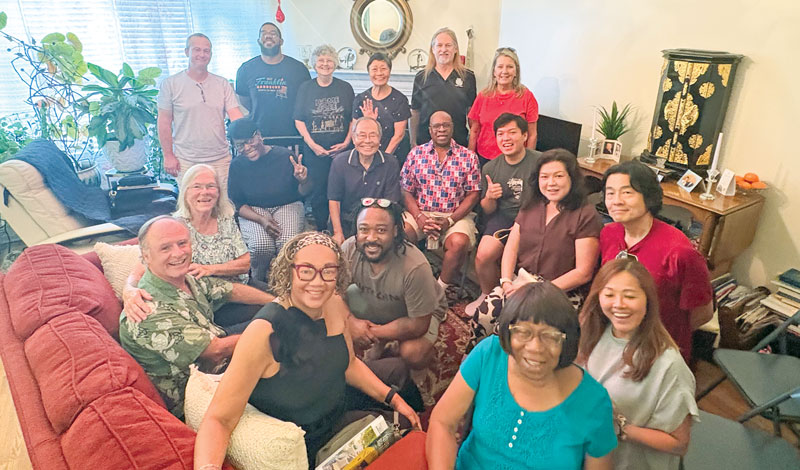
Please present the 3-Minute Gosho (pp. 50–51) at your discussion meetings. For the main study portion of the meeting, you can choose to expand on the 3-Minute Gosho or choose from one of the following:
1) What Do You Think? (pp. 52–53)
2) Material from any recent issue of the World Tribune or Living Buddhism.
3 Minutes Gosho
This series serves as the basis for a brief study presentation at monthly discussion meetings, to be given by future, student or youth division members (or by other members if youth are not available). Those presenting can simply read the material or get creative!
The Time Is Now!
Passage
When it comes to studying the teachings of Buddhism, one must first learn to understand the time.—“The Selection of the Time,” The Writings of Nichiren Daishonin, vol. 1, p. 538
Background
Nichiren Daishonin wrote “The Selection of the Time” in 1275 while living at Mount Minobu. The year before, Mongol forces attacked Japan, just as Nichiren had warned in his 1260 writing “On Establishing the Correct Teaching for the Peace of the Land.” Many people feared another invasion.
Nichiren explains in this letter that he stood up during a troubled age to spread and protect his teaching of Nam-myoho-renge-kyo. He encouraged his disciples to continue this effort. The “time” in the title points to the Latter Day of the Law, the most crucial time to spread Nichiren Buddhism and lead people to absolute happiness.
From Ikeda Sensei’s The New Human Revolution
Ikeda Sensei begins New Year’s Day in 1972, keeping in mind a passage from “The Selection of the Time.”
The golden opportunity has come! The decisive moment is now! Our goal is near!
Shin’ichi Yamamoto greeted New Year’s Day of 1972 with a powerful fighting spirit burning in his heart. That morning, as he chanted Nam-myoho-renge-kyo together with his family before the Gohonzon in their home, he contemplated the opening passage of Nichiren Daishonin’s writing “The Selection of the Time”: “When it comes to studying the teachings of Buddhism, one must first learn to understand the time” (WND-1, 538).
If we allow the crucial moment to pass, we cannot accomplish anything, and all our earlier efforts and struggles will be for naught. As Nichiren says: “Now, when the true and the provisional teachings are utterly confused, it would be equally unnatural for one to seclude oneself in the mountain forests and carry out the peaceful practice of shoju[1] without refuting the enemies of the Lotus Sutra. One would lose the chance to practice the Lotus Sutra” (“On Practicing the Buddha’s Teaching,” WND-1, 394).
The Daishonin declares that it is disgraceful for practitioners of the Lotus Sutra to lack the courage to correct people’s mistaken beliefs in an age when the teachings are completely confused. If we fail to stand up when we should and fail to fight when we need to fight, we sacrifice both our chance to attain Buddhahood in this lifetime and to achieve kosen-rufu. Shin’ichi keenly felt that the crucial moment for all Soka Gakkai members to rise up and take action had finally arrived.
The great Russian author Leo Tolstoy wrote that “time is infinite progression without a moment’s pause.” Indeed, time passes with relentless speed. (The New Human Revolution, vol. 16, pp. 1–2)
Presenting this month’s 3-minute Gosho? Click here for a brief tutorial video.

What Do You Think?
How Can We Keep Our Seeking Spirit Alive?
We all crave comfort—and so do our brains! Studies show that we prefer familiar thoughts and feelings, often resisting advice.[2] Yet research also reveals that staying open to input accelerates our growth.[3]
These tendencies highlight the importance of continually deepening our understanding of Buddhism, which helps us break free from our assumptions about life, ourselves and the limitless potential of our Buddhist practice.
Nichiren Daishonin often praised his disciples’ seeking spirit—the drive to learn, improve and keep moving forward—writing for instance:
For you to inquire about the Lotus Sutra and ask its meaning is a rare source of good fortune.[4]
• • •
If you do not question and resolve your doubts, you cannot dispel the dark clouds of illusion, any more than you could travel a thousand miles without legs.[5]
In other words, working to resolve our questions and doubts fuels our development. Asking for guidance in faith isn’t weakness; it’s an exercise of strength.
Even seasoned members turn to leaders who may have practiced Buddhism for fewer years. Why? Because earnest dialogue awakens something profound: the inner Buddhahood in both individuals. It’s not just the words but the heart-to-heart connection that leaves both people refreshed and ready to chant and take on life with greater resolve.
‘Questions Lead to Progress’
Throughout Soka Gakkai history, this spirit of seeking guidance and encouraging one another has driven the growth of our global movement.
Ikeda Sensei reminds us: “Questions lead to progress. When doubts are cleared away, a refreshing certainty is established.”[6]
Nichiren wrote countless letters responding with care to his followers’ questions—letters that continue to inspire millions today. In Nichiren Buddhism, the more questions, the better! They open the door to joyful, heartfelt exchanges that transform people’s lives.
Josei Toda, the second Soka Gakkai president, spent hours each day talking with members struggling with financial, health and family problems. His warm words, grounded in faith and conviction, often transformed despair into hope.
For instance, he once encouraged someone: “Don’t worry. If you practice this Buddhism, you cannot fail to become happy. Please be a champion of the spirit. Live out your life fully and proudly as a praiseworthy member of the Soka Gakkai.”[7]
People left sessions with him smiling—not because their circumstances suddenly changed but because their hearts did.
Ikeda Sensei carried on this tradition. Once, while visiting Brazil, he spoke in detail with a farmer facing crop failure, saying:
“Prayer in Nichiren Buddhism means to chant based on a pledge or vow. At its very core, this vow is to attain kosen-rufu. It means chanting resolutely with the determination: ‘I will realize kosen-rufu in Brazil. Therefore, I will show magnificent actual proof in my work. Please enable me to somehow bring forth my greatest potential.’ This is what our prayer should be like.”[8]
That guidance transformed the farmer’s hopelessness into resolve—and led to his remarkable success.
For SGI leaders, the key is to pray, listen deeply, empathize and share encouragement rooted in Nichiren’s teachings rather than personal opinion, enabling each person to tap their inner strength and rise up with hope.
The Spirit to Improve Limitlessly
Mr. Toda once wrote:
Faith in Nam-myoho-renge-kyo means self-improvement—unlimited self-improvement. … The Mystic Law enables us to improve ourselves even more, even further.[9]
By striving to resolve our doubts and questions, maintaining a seeking spirit and remaining open to encouragement, we can transform every challenge into an opportunity to grow, deepen our sense of mission and continue developing limitlessly throughout our lives.
—Prepared by the SGI-USA Study Department. Revised from an article originally published in the January 16, 2026, World Tribune.
From the October 2026 Living Buddhism
References
- Shoju: A method of expounding Buddhism in which one gradually leads another to the correct teaching according to that person’s capacity and without refuting his or her attachment to mistaken views. The term is used in contrast to shakubuku, or directly awakening another to the correct teaching by refuting that person’s mistaken beliefs. ↩︎
- See https://pmc.ncbi.nlm.nih.gov/articles/PMC4288123/ <accessed on August 25, 2026>. ↩︎
- See Adam Grant, Give and Take: A Revolutionary Approach to Success (New York: Viking, Penguin Group, 2013), pp. 148–52. ↩︎
- “The One Essential Phrase,” The Writings of Nichiren Daishonin, vol. 1, p. 922. ↩︎
- “Letter to Niike,” WND-1, 1031. ↩︎
- The Teachings for Victory, vol. 5, p. 45. ↩︎
- The Wisdom for Creating Happiness and Peace, part 3, revised edition, p. 93. ↩︎
- The New Human Revolution, vol. 1, revised edition, p. 269. ↩︎
- February 16, 2018, World Tribune, p. 2. ↩︎
You are reading {{ meterCount }} of {{ meterMax }} free premium articles