
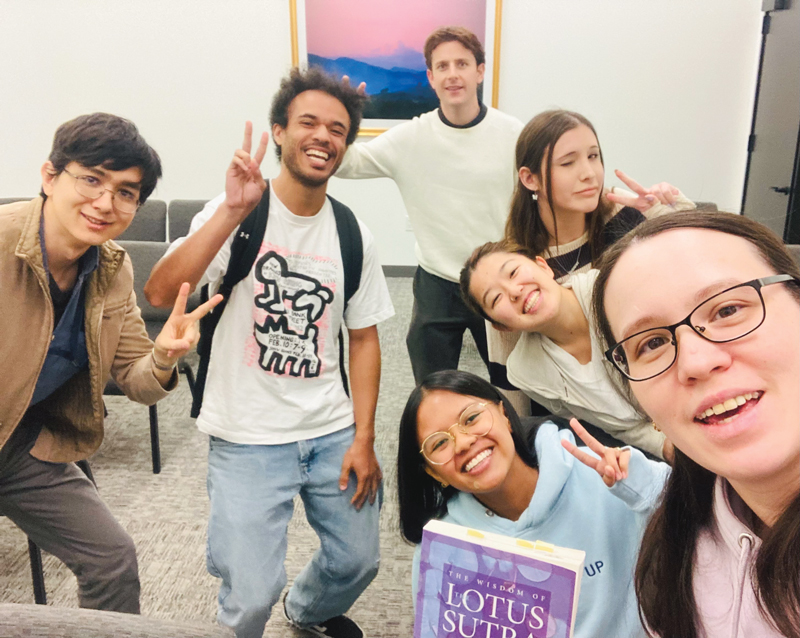
Ikeda Wisdom Academy members:
• are group through national youth leaders and all student division members.
• should have their own copy of The Wisdom of the Lotus Sutra, vol. 5.
• are encouraged to read the assigned material before each meeting.
February Syllabus: The Wisdom of the Lotus Sutra, vol. 5, pp. 3–25
Part One: “Distinctions in Benefits” Chapter
1: “Those Who Spread the Mystic Law Accumulate Great Life Force”
Supplementary Material:
• The Lotus Sutra and Its Opening and Closing Sutras, pp. 274–85
• “Letter to Horen,” The Writings of Nichiren Daishonin, vol. 1, p. 516
• The Record of the Orally Transmitted Teachings, pp. 144–45; 147–48; 234
Chapter Overview
Revealing the Life Force of Buddhahood Is Our Greatest Benefit
This month, we begin our study of The Wisdom of the Lotus Sutra, volume 5, which covers the 17th through 22nd chapters of the Lotus Sutra. Over the next three months, we will focus on studying chapters 17 through 20, where Shakyamuni Buddha explains the various benefits of spreading Buddhism.
Chapter 17, “Distinctions in Benefits,” describes the boundless benefit of believing in the preceding “Life Span” chapter, which reveals the cause for bringing forth our Buddhahood—faith in the Mystic Law.
Nichiren comments on this chapter, stating:
As to the benefits, the distinction is here made clear that earthly desires associated with the three poisons of greed, anger, and foolishness that are a part of each and every one of the living beings of the Ten Worlds will now, just as they are, become the benefits of the Wonderful Law. (OTT, p. 234)
In other words, faith in the Mystic Law enables us to transform everything in our lives into benefit.
Upon hearing Shakyamuni preach the “Life Span” chapter, the assembly “gained a great many rich benefits” (LSOC, 274). These benefits included the ability to:
• “abide in the stage of no regression” (always advancing);
• “acquire dharanis” (correctly remembering and applying the mentor’s teachings);
• “speak pleasingly and without hindrance” (freely explaining the Law);
• “retain ten thousand, a million repetitions of the teachings” (diligently, vigorously challenging negativity and bringing about great good); and
• “turn the unregressing wheel of the Law” and “turn the pure wheel of the Law” (carrying out unceasing, dynamic faith to spread Buddhism far and wide).[1]
Because everyone has unique abilities, goals and karma, each person’s human revolution and benefits will be different. But all of us, just as we are, can attain enlightenment. Ikeda Sensei explains:
While the manner in which benefit manifests differs for each person depending on his or her faith, life condition and karma, as long as we persevere in faith, in the end we are sure to attain the state in which all wishes are fulfilled. This is the profound meaning of “distinctions in benefits.” (WLS-5, 19)
We often experience positive changes in our life and environment—concrete proof of our faith and practice. But the real benefit is not something external; it’s much deeper. Our faith in the Gohonzon and the Mystic Law unleashes the great life force of Buddhahood within us—the fearless, fighting spirit to overcome all obstacles, “wiping out evil and bringing about good.”[2] To live with this spirit is the supreme benefit of chanting Nam-myoho-renge-kyo.
—Prepared by the SGI-USA Study Department
Ikeda Sensei’s Guidance
Buddhist Optimism Is a Fighting Optimism
Ikeda Sensei: Buddhist optimism is not the escapist optimism of those who throw up their hands and say, “Somehow or other things will work out.” Rather it means clearly recognizing evil as evil and suffering as suffering and resolutely fighting to overcome it. It means believing in one’s ability and strength to struggle against any evil or any obstacle. It is to possess a fighting optimism.
Speaking of optimism, I remember the smiling face of Dr. Norman Cousins, who was known as the “conscience of America.” Although he did not practice Buddhism, in his belief in the power of the human being he was no different from a Buddhist. Dr. Cousins once wrote:
No one need fear death. We need fear only that we may die without having known our greatest power—the power of his free will to give his life for others. If something comes to life in others because of us, then we have made an approach to immortality.[3]
When we devote ourselves to the happiness of others, when, of our own free will, we undertake the struggle of a bodhisattva, the immense force of life without beginning or end wells up in our being. The eternal life of the Buddha permeates our being like a rising tide. Then, there is no way that we cannot dramatically change our lives for the better.
In that sense, chanting Nam-myoho-renge-kyo, spreading Nichiren Buddhism and working for kosen-rufu in themselves are the greatest benefits. Nichiren states, “There is no true happiness for human beings other than chanting Nam-myoho-renge-kyo” (“Happiness in This World,” WND-1, 681). This plainly indicates that a life dedicated to kosen-rufu is most noble and lofty. The “Distinctions in Benefits” chapter imparts the wisdom to recognize this. (WLS-5, 23–24)
Digging Deep
February Study Guide
Please use these questions to guide your study of The Wisdom of the Lotus Sutra, vol. 5, pp. 3–25.
1) What is considered “supreme benefit” in Buddhism? What is the relationship between benefit and “getting rid of evil in one’s life and bringing forth good”? (WLS-5, 4–6)
2) What is the meaning of “distinctions in benefit”? (WLS-5, 19–20)
3) What is the meaning of “Buddhist optimism”? (WLS-5, 23–24)
Looking Forward: March Syllabus
The Wisdom of the Lotus Sutra, vol. 5, pp. 29–52
Part Two: “The Benefits of Responding with Joy” Chapter 2: “Joyfully Spreading the Mystic Law”
From the February Living Buddhism
References
- See The Wisdom of the Lotus Sutra, vol. 5, pp. 10–14. ↩︎
- Nichiren Daishonin says the following about benefit (Jpn kudoku) in Buddhism: “The element ku in the word kudoku means good fortune or happiness. It also refers to the merit achieved by wiping out evil, while the element toku or doku refers to the virtue one acquires by bringing about good” (The Record of the Orally Transmitted Teachings, p. 148). ↩︎
- Norman Cousins, Human Options (New York: W.W. Norton and Company, 1981), p. 45. ↩︎
You are reading {{ meterCount }} of {{ meterMax }} free premium articles