
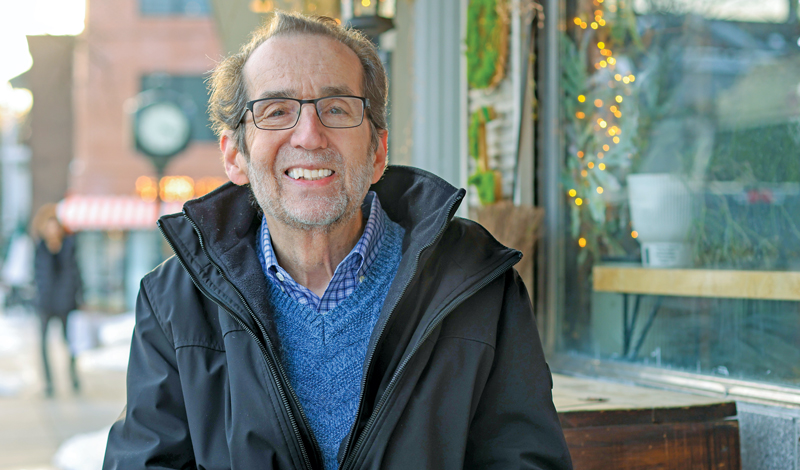
Living Buddhism: Thank you for talking with us, Mike. You began your Buddhist practice in Los Angeles, in January 1978, but not on the recommendation of Buddhists. Tell us what led you to commit to the practice you’ve maintained now for decades.
Mike Levine: Well, right, that’s true. I did have Buddhist friends who suggested
I chant Nam-myoho-renge-kyo, all of whom had become more confident, direct and capable people, virtues translating directly to their success. But as you say, despite this observable proof, I remained critical and aloof. An avowed Marxist, I was unconvinced by a philosophy that stressed the revolution of people’s hearts and minds over a revolution in “the system.” However impressed I was with the changes I’d seen in my friends, I didn’t see how these had a bearing on transforming the world. So I had continued, two years after college, to do as I had while in school—philosophize, criticize and generally make myself known for deflating rooms with long-winded critiques. Perhaps it was only natural that the decisive nudge toward Buddhism was not an invitation, but a criticism.
You were away on vacation at the time.
Mike: Yes, in Seattle, miles away from any of the Buddhists I knew. I was there with an entourage of college friends, one of whom was getting married. We’d all put up in one of their homes and were planning an all-day hike before the wedding.
I was in the middle of one my famous critiques, when one of them interrupted. Don’t you think it’s time, he said, to move out of your parents’ house?
The following day, everyone left to take advantage of the perfect weather in the great outdoors, except for me. Making some excuse, I stayed behind, pacing the empty house. I brooded ‘til about noon, when I realized why my friend’s question had stung as much as it had. Because I agreed. I knew my life had gone stale and was overdue for a change. I knew—consciously or not—that the reason I argued so much was that I was afraid. I was afraid of people, of showing them who I was, because honestly, I didn’t know. But that day spent pacing that empty house, I decided it was time I found out. Returning home to Los Angeles, I began chanting every day, twice a day, morning and evening.
You followed through and have kept it up since. What did you notice at the start?
Mike: In my case, huge, immediate changes. On my first day back in LA, I decided to move out of my parents’ house. On day two, I found a great spot—a beautiful, rent-controlled two-bedroom just blocks from the bluffs over the beach in Santa Monica. On day three, I attended an internship fair and came back with two offers from the best internships they had. I chose one and kept at it until it paid—not much, but enough for rent, groceries and gas. Every day I got up and applied myself—first and foremost in front of the Gohonzon, chanting to develop my capacity as a human being.
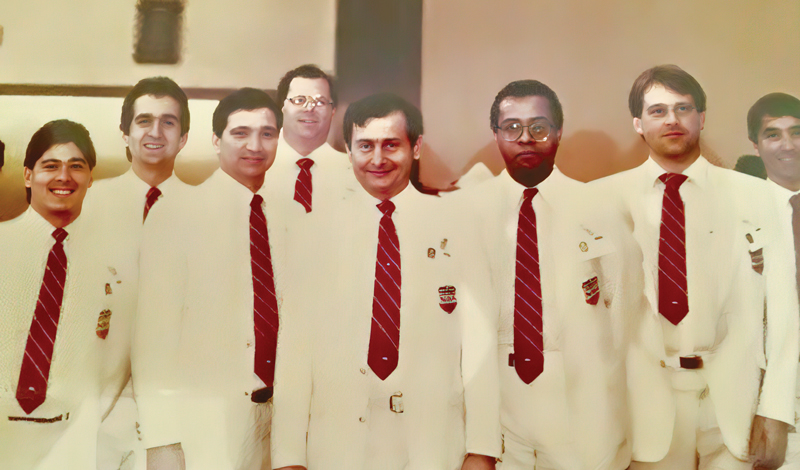
Eventually, you landed a job in federal government and worked your way to positions of responsibility—among them a deputy directorship. For someone with no background in management, how did you end up there?
Mike: Honestly, that’s a great question. And what it came down to was seriously chanting Nam-myoho-renge-kyo and applying the guidance of mentor, Ikeda Sensei. My career path is too winding to recount for you here—too many pitfalls, switchbacks and dead-ends. An important note, I think, was that I never felt fully ready for the opportunities given and often kicked myself for my mistakes. My mind, you might say, is wired to hunt and air out all the flaws—others’ as well as my own.
For years, I’d wake in the middle of the night, anxious I’d done something, said something wrong—that I’d rubbed someone the wrong way. The thoughts often came crashing down in the morning, first thing when I opened my eyes. Chanting was what helped me process and make sense of these negative thoughts, bringing my mission into view. I’d ask, How would Sensei respond to a worry like mine? And there was no question: he’d reflect, adjust and move on. I mean, if you’re determined to bring happiness to humanity, can you really afford to be paralyzed by the fear of a simple misunderstanding. Sensei once wrote, “I have my mission, which is mine alone / You too / have a mission, which only you can fulfill” (The Sun of Youth, p. 6). If I were to fulfill my unique potential, then what choice would I have but to face the day and challenge my fears?
And here’s the kicker: My Buddhist practice actually empowered my critical mind, by which I mean it enabled me to make practical use of it. I still had an eye for gaps and flaws but directed it toward systems as opposed to people. Polishing my mind, I saw that people, like me, were just doing their best, and I began to give all of us the benefit of the doubt. Criticism, whether taken or given, became something I embraced for what it truly was—an opportunity to reflect, adjust and grow. In this way, I advanced, making tangible contributions to the systems in place that benefited the lives of others. In time, I became a trusted leader at work—one who empowered people to lead and connect with others of diverse positions, perspectives and personalities.
You have mentioned appreciation—how centering it transformed your approach to others and their approach to you. Can you talk about appreciation as it relates to financial offerings, with our May Commemorative Contribution activity just around the corner.
Mike: Absolutely. And you’re right—the spirit of appreciation is at the heart of my human revolution and the key to the many benefits that have followed—be it my career, my marriage and my physical and mental well-being. That said, I must say that this particular kind of contribution—namely, financial contribution—is one that took me years to feel truly excited about. Only in recent years have I come to truly appreciate the function that it has played in the course of my 47 years of Buddhist practice.
Floor’s all yours.
Mike: On a practical level, it’s exciting, of course, to see my contributions put to work renovating our centers and building new ones across the U.S.—especially, in recent years, in Silicon Valley, the Caribbean and Guam. And seeing us jumpstart whole new initiatives like the Buddhability podcast that’s reaching a new generation of youth—I could go on. But the deeper purpose of contribution for me is that it creates a framework for my entire life; that framework is appreciation. May Contribution offers a way of concretely deciding to live with appreciation—for myself, for others and for the Buddhist practice that has made me who I am today.
And in a sentence, who is that?
Mike: One sentence, huh? Well, I’d say a person who can see what needs work and has the courage to take the action that will make a difference—namely uniting with others toward a lasting solution.
Wonderful. And it ties in with our next question about shakubuku. Would you talk about your recent efforts to share Buddhism?
Mike: When I read Sensei’s call at the end of 2019, to fight all-out alongside him in the coming decade, toward our movement’s centennial in 2030, I immediately vowed that I would.
The coming decade will be decisive for both humanity and the SGI, he said. And I believed him. And I believed that the problems anticipated could be fundamentally overcome in one way and one way only—by widely sharing the principles of Buddhism. I made an ambitious daily daimoku goal and decided to share the practice with at least three people each day. Since then, I’ve planted countless “seeds” of the Mystic Law. This year, I added a third goal of dramatically increasing my visits to friends in faith, including virtually with friends from afar.
When, the young people of the SGI-USA pledged to introduce 10,000 youth to our movement by 2028, I vowed again to fight alongside them. In 2023, I introduced three friends of mine to the practice, one of them a young woman I met in a coaching class I take online. In 2024, I introduced two others, both young men, one of whom has taken on leadership. This young man, Daniel, has begun introducing his friends and supporting the young men in our district.
There was a time when I believed that to shakubuku (introduce them to Buddhism) someone meant to convince them. This was perhaps the natural assumption for me, a fluent and chronic pontificator. It’s only in the past five years that I’ve truly digested the message Sensei stressed years ago—especially on his trips to the States in 1990 and on—that sharing Buddhism is entirely about friendship. Daniel, for instance, is someone I visit four times a week. We chant together, study together and generally encourage one another with our most recent efforts to break through in our own lives and help others do the same.

Tell us about the woman you met at the market—how you introduced her to Nam-myoho-renge-kyo.
Mike: It was the day before our discussion meeting, and I was determined to invite someone to come. At the self-checkout, a woman, just shopping like me, offered to scan my things. It moved me, and I said so and offered a Nam-myoho-renge-kyo card as a token of my appreciation. “I think I’ve chanted this, years ago,” she said, “back when I was living in New York.” And she went on, saying she could really use something like this at this particular time. On my invitation, she came to our next discussion meeting. She practices another religion, she told me, and said after her first meeting, “This was so wonderful and just what I need.”
And tell us about that friend you pocket-dialed.
Mike: Well, not that—but I did mistake his name for someone else! After 14 years of no-contact, he picked up. He wanted to know how I knew he needed a friendship call, and we talked for 90 minutes about his life and his hopes for the future. Though he’s living two hours away in a rural area, I found him a discussion meeting near his home, which he attended and enjoyed. After a long call the following day, he agreed to challenge chanting twice a day.
Both of these recent experiences reminded me that the people we meet we do so for a reason—we’re connected in ways we can’t fathom. You never know what a simple phone call, or a few words of praise, may do, especially backed up with a strong prayer for that person’s happiness and the peace of the land.
As Sensei says:
The problem isn’t that there are no capable people; it’s simply that we cannot “see” them. The solution is to offer earnest prayer. We also need to be determined to take full responsibility without anyone’s help. Such resolve will without a doubt bring forth people able and willing to work for the same cause. (The Wisdom of the Lotus Sutra, vol. 5, p. 68)
These are wonderful examples of people who warmed to you right away. But what about the ones who give the cold shoulder? When the going gets tough, how do you persist in sharing Buddhism?
Mike: Now and again, that does happen. What I do is chant to believe that my life—and the lives of everyone I meet—is Nam-myoho-renge-kyo. Though that’s written in The Writings of Nichiren Daishonin and I hear it all the time, it is hard to actually believe. But when I chant to believe in this deeply, shakubuku becomes natural. I can see the unlimited potential in each person I meet and strive to connect my Buddhahood with theirs. I get friendly responses and often names and phone numbers.
But to your question, it is something I work on—not being swayed by how someone responds. That person does not exist to validate my efforts—they exist to be happy. My role is to give them every possible chance to do so.
When my doubts or distractedness show up, I chant to win over myself and inspire others.
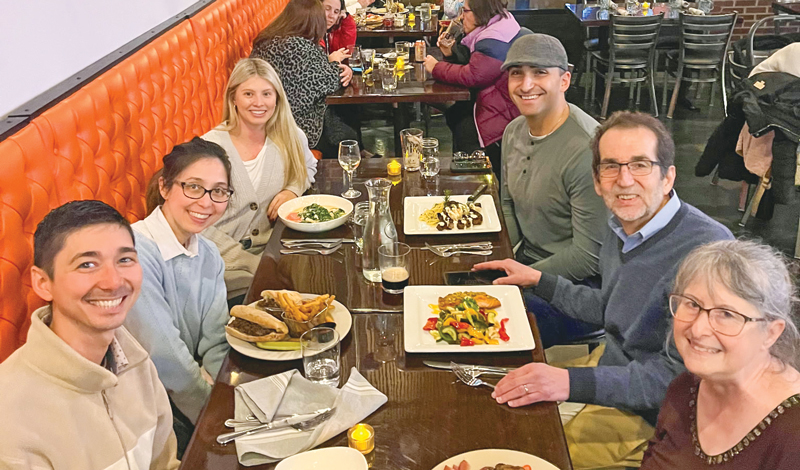
Beautiful. Any parting thoughts?
Mike: I’d like to share something I read recently in The New Human Revolution. In it, Sensei says, “Only by applying every ounce of our being, with a passion capable of melting even steel, can we move people’s hearts” (NHR-11, revised edition, p. 150).
Now my foremost prayer every morning is to find someone, especially a youth, who is ready to practice and seeking to transform their life. I’m chanting to bring forth one after another of the 10,000 youth who will take a stand, joining our peace movement by Sensei’s 100th birthday, January 2, 2028.
There’s so much work to do and so much to be appreciative for. I wake up these days feeling invigorated, grateful and determined to do my part for the peace of the land. With my whole heart, with friendship, I try to convey: You are precious beyond belief! You have a mission only you can fulfill. All we can do is our best—and we owe it to ourselves and humanity to give that much.
You are reading {{ meterCount }} of {{ meterMax }} free premium articles