
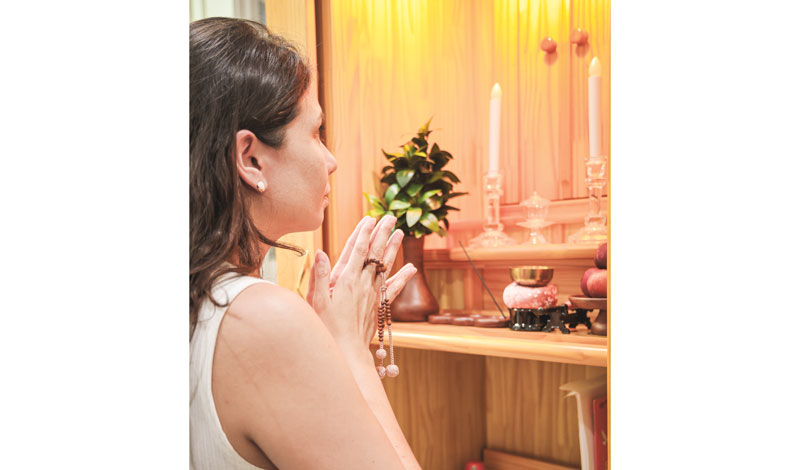
Nichiren Daishonin proclaims: “I, Nichiren, have inscribed my life in sumi ink, so believe in the Gohonzon with your whole heart” (“Reply to Kyo’o,” The Writings of Nichiren Daishonin, vol. 1, p. 412). Honzon means “object of fundamental respect or devotion,” while the prefix go is an honorific meaning “worthy of respect.” Nam-myoho-renge-kyo is the ultimate Law of the universe, and the Gohonzon is its graphic expression. As we chant Nam-myoho-renge-kyo to the Gohonzon, we call forth our innate enlightened nature.
To help us demonstrate our heartfelt respect for the Gohonzon as the embodiment of the Mystic Law, here are key points for embracing it in our daily Buddhist practice.
Why Don’t We Photograph the Gohonzon?
The Gohonzon is the fundamental object of respect and devotion in terms of faith, to which we afford the highest reverence. We regard the Gohonzon as the very life of Nichiren Daishonin, the Buddha of the Latter Day of the Law, and as the physical embodiment of the Buddha nature inherent in the lives of all people.
While the Gohonzon we receive upon joining the SGI is a physical object, we regard it as an expression of the enlightened life of the Buddha and a clear mirror to call forth the same enlightenment from within our own lives. Therefore, to treat the Gohonzon with respect is simultaneously an expression of respect for our own lives and for the lives of all people.
SGI does not recognize any still or video image of the Gohonzon as a valid object of faith, nor does it authorize the reproduction, posting, publishing or downloading of such images. The SGI urges its members and guests to refrain from posting or accessing images of the Gohonzon, as doing so makes light of and disrespects Nichiren Buddhism’s noble spirit and practice of treating the Gohonzon with utmost reverence.
Finding the Best Place for the Altar
The primary purpose of the altar is to protect the Gohonzon. Place it in a secure, stable location away from doors, open windows, fireplaces and busy passageways.
Minimal Distractions
Enshrine the Gohonzon in a place with minimal distractions. Ultimately, the focus of the altar in Nichiren Buddhism is the Gohonzon. Therefore, please refrain from adorning the altar with items that are not associated with or that take attention away from the daily practice of reciting the sutra and chanting Nam-myoho-renge-kyo.
Ample Light
The location should have ample light so the Gohonzon can easily be seen when the altar is open.
Enshrining the Gohonzon
The enshrinement of the Gohonzon is a deeply significant and joyful event, especially when done with local SGI leaders and members.
Respectful Attitude
The Gohonzon is the object of devotion representing one’s enlightened life. Therefore, it should be handled with care and respect.
Careful Handling
To prevent stains or soiling, avoid directly touching the face of the Gohonzon or its backing.
Level Position
The Gohonzon should be at eye level when sitting in a chair and be level horizontally.
Caring for the Altar
Cleanliness
Keep the altar area clean, orderly and dust-free. Candles and incense should not be placed too close to the altar.
Moving the Gohonzon to a New Location
When moving the Gohonzon, avoid touching it’s face or its backing. Gently roll it up, secure it with the ribbon, place it in a protective box, and have the recipient carry it to its next location. Reenshrine it as soon as possible.
Offerings
Chanting and reciting the sutra are fundamental to Buddhist practice, but offerings such as greenery, incense, candles (wax or electric), fresh water and fruit may be offered as expressions of sincerity and respect for the Gohonzon. These offerings are optional. Most important is the heart to treasure the Gohonzon.
What the offerings symbolize:
Water
Fresh water is offered before morning gongyo and removed before evening gongyo. In Sanskrit, the word for water also means “benefit.”
Fruit
Fresh fruit can be offered as a gesture of gratitude and appreciation. Ring the bell and chant three times when placing fresh fruit on the altar.
Incense
Offerings of incense symbolize purification or an awakening of the senses.
Candles
Candlelight symbolizes the light of Buddha wisdom. It signals our awareness of our innate Buddha nature.
Bell
The pleasing tone of the bell harmonizes the recitation of the sutra and chanting of Nam-myoho-renge-kyo.
Evergreens
Evergreens symbolize the Buddha’s enlightened physical property and compassionate action, representing permanence and purity. Plastic greenery is also acceptable.
How to Sit in Front of the Gohonzon
Let’s take a moment to consider how we chant in front of the Gohonzon. Taking into account each person’s health and circumstances, we can chant to the Gohonzon as though greeting the Buddha, with utmost dignity and respect, while developing an enjoyable and fulfilling daily practice.
Posture
Shakyamuni Buddha said, “Sit upright and ponder the true aspect” (The Lotus Sutra and Its Opening and Closing Sutras, p. 390). When chanting, we can sit upright and attentively, with our palms joined and eyes fixed upon the Gohonzon.
Voice and Rhythm
Whether speaking, singing or chanting, the voice reflects the state of our bodies and minds. Ikeda Sensei explains: “The chanting of Nam-myoho-renge-kyo is not only the voice of faith of ordinary people; it is also the voice of Buddhahood. For that reason, we should always try to chant resoundingly, with a vibrant and vigorous rhythm like that of a galloping horse” (On Attaining Buddhahood in This Lifetime: SGI President Ikeda’s Lecture Series, p. 21).
Unity
In addition to a powerful, resounding voice, it’s important to chant with a consistent tone and rhythm so that people can pray harmoniously. Sensei emphasizes that when voices are not in unison, it can reflect a lack of unity in spirit. He says: “Our resolve is reflected in our voices. Our voice can sweep away obstacles and limitations” (March 9, 2012, World Tribune, p. 3).
What Not to Do
1. Don’t get distracted by your phone.
2. Don’t chew gum or eat.
3. Don’t cover your mouth with your hands.
4. Don’t cross your legs when sitting in a chair. Place both feet on the floor.
5. Don’t rub your beads repeatedly.
What to Do
1. Keep eyes open and focused on the Gohonzon.
2. Maintain an upright posture (without overstraining yourself).
3. Press your palms neatly together and positioned at chest level.
September 18, 2026 World Tribune, pp. 6–7
You are reading {{ meterCount }} of {{ meterMax }} free premium articles