
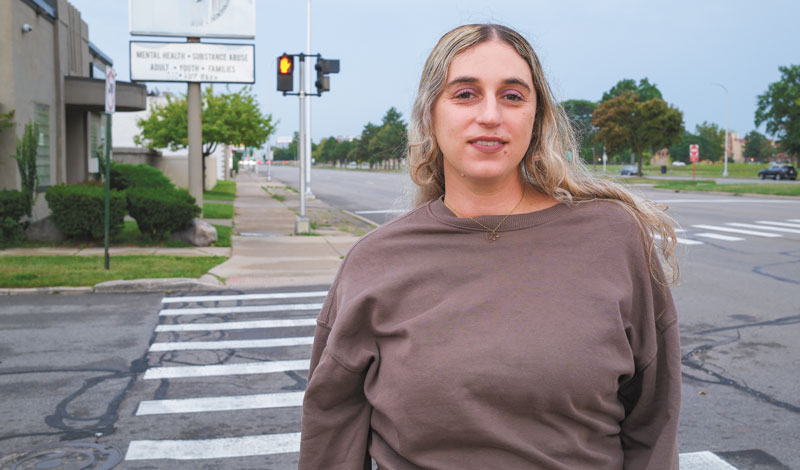
by Ariel Magidson
Detroit
I’d have never guessed I had such hell inside me—that I could fall so deep and so fast. What’s more, I’d have thought I was equipped to fend off the kind of inner demons that tore me apart.
In 2013, at 23 years old, a traumatic event triggered a deep depression, during which I tried to take my own life. Terrified, my parents rushed me home to Detroit, where, despite half a dozen pills prescribed to hold me together, I spiraled into shame and self-loathing. Afraid my suffering would engulf my family, I cut them off as best I could. Though I hardly left my room for two years, my parents never gave up on me. It took an eternity to begin to heal—at least it felt this way to me. What helped perhaps more than anything else were my neighborhood SGI gatherings. These were among the first places outside of our home that I was willing to show my face.
I’d encountered the SGI while living in Los Angeles, through the family of my best friend from college. They practiced Buddhism, which I thought I’d begun practicing too, though in truth, I never fully engaged. In my early 20s, with a philosophy degree, I did not even consider that Buddhism might offer some understanding that I didn’t already have.
Two years of depression, however, left me profoundly humbled and hungry to learn. Though a part of me wanted badly to hide, another part of me was even more desperate to grow. Month after month, I joined the neighborhood gatherings, and this time around, I studied. In particular, I was moved and impressed by the Buddhist view of life and death and the essential spirit of the Lotus Sutra. Studying these and chanting Nam-myoho-renge-kyo, I began to ask the questions I’d thought I’d answered, like what is the true purpose of my life?
Within my first year of committed practice, I enrolled and was accepted to a master’s program in psychology. Completing this in 2017, I immediately pursued my doctorate. Without doubt, it was my Buddhist practice that helped me turn poison into medicine.
But to do this, I would need to further transform certain deep tendencies—a particular karma I did not know I had. Working toward my doctorate in 2021, I found myself in a controlling relationship. This was, of course, at the height of the pandemic, and I was far more isolated than I realized at first.
I never fully stopped chanting or lost touch with my community—I knew firsthand where isolation could lead. But I knew I was drifting when, despite desperate need, I turned down multiple internships out of state. My partner, insisting he could not be left alone, made clear that these were not options. Slowly, I realized how lost I felt, and began chanting for one thing: clarity.
That relationship ended in the most surprising way, over a family dinner in 2021. Shocked by the latest attempt to isolate me, my family spoke up to him together. That night, he showed his true colors—and then he iced me out. I was shocked to be given no opportunity to patch things up. But it brought me to the Gohonzon for some deep conversations, long overdue with myself. That very year, I finished my dissertation, graduating with a doctorate in psychology.
When the relationship ended, I began supporting SGI activities behind the scenes and was soon appointed a behind-the-scenes training group leader. Supporting in this way helped calm my mind—I felt I was guarding the spiritual environment of our Buddhist centers. It was this quiet, unseen work that rebuilt the confidence my relationship had worn down. Building that team of dedicated young women, with its culture of unity and personal victory, remains among my proudest memories.
Throughout this time, I worked as a therapist for an organization that hired me during my doctoral studies. But three years in, I felt something changing—maybe me, or the place or both. After the pandemic, the organization reopened all its field offices in the suburbs but not the sole office it had in the city. For me, it was agony to see care remain out of reach of the people who needed it most. I began chanting, pure and simple, for clarity. When my appeals to reopen the city office were shrugged off again last December, I understood that my mission lay elsewhere.
December was a significant time for me—I graduated from the youth division and immediately took on district leadership, a chance to grow that I used to the fullest. Often, I headed straight from work to meet with the members, even when I had just enough money for gas. When you rely on the Gohonzon, your spirit is rich—you don’t doubt the path you’re on.
Quoting renowned author Eiji Yoshikawa, Ikeda Sensei says: “Rather than worrying about your future, thinking, ‘Perhaps I should become this. Perhaps I should become that,’ first be still and build a self that is as solid and unmoving as Mount Fuji” (Dec. 20, 2024, World Tribune, p. 2).
This spring, I was invited for an in-person interview at a company I’d never heard of before. I went and knew this opportunity was an answer to my prayer. Small and mission-driven, with collaborative leadership, its whole model of care was: Whatever it takes. Be it a ride, a bus ticket, a visit to the school or the house—the team, based in the neighborhood I grew up in, was driven to reach children across the Detroit Medicaid network. Invited to name my salary, I did, while enrolling in their student-loan-forgiveness program.
Today, I’m honored to serve Detroit as director of Children’s Mental Health—and to chant for the many kids, parents, nurses and social workers who come through our doors every day. My vow is to let Nam-myoho-renge-kyo shine in my life and environment.
The people suffering most deserve to be the happiest—Sensei has said this many times. That’s my standard in faith and in work—to lift up those at the margins. Every day, I ask myself: Who else is out there? Whom haven’t we reached in Detroit? I know firsthand that those suffering most are often suffering alone. It’s why I’m so earnest about making every SGI neighborhood gathering well-planned and encouraging. It’s why I’m so committed to my work.
I am proof that the motto of Detroit can become once more the story of its people: We hope for better things; It will rise from the ashes. We are that hope—my SGI family—growing stronger for every hardship. The key for us is determined prayer—from here anything becomes possible.
You are reading {{ meterCount }} of {{ meterMax }} free premium articles