
“What the world needs more than anything else at this moment is an outbreak of good-will and human understanding.”[1] —Jane Addams, pioneering American social worker
by Monica Soto Ouchi
SGI-USA Women’s Leader
Happy February! This month, the women and young women are celebrating Feb. 27—SGI-USA Women’s Day and the birthday of SGI Honorary Women’s Leader Kaneko Ikeda—by creating an “outbreak of goodwill.” For us, this means leaning into our “Peace in Miniature”[2] dialogues, bringing our friends, neighbors and family members to our district discussion meetings and enabling our guests to join the SGI.
On New Year’s Day, the SGI-USA introduced a peace pledge initiated by the youth titled a “Commitment to Peace.”
Signing this petition represents a commitment to introduce at least one young person this year to Buddhism. Why?
Because the quickest way to transform our world is to change the life of a single individual. It’s important that we believe deeply in this point.
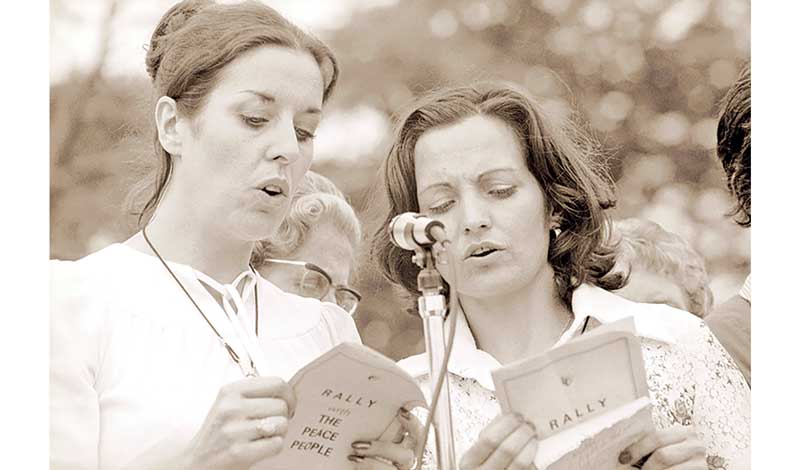
It made me think of an interview I did more than 15 years ago with the late Nobel Peace Prize laureate Betty Williams, who was a great friend of the SGI and of Ikeda Sensei. The reason I thought of her is because she is best known for a peace petition of her own.
Betty was born and raised in Belfast, Northern Ireland, where she lived through decades of conflict between Catholic and Protestant paramilitary groups over the fate of their country.
The conflict was so commonplace, in fact, that she had learned how to distinguish gunfire from other sounds. One day in August 1976, Betty was driving home from her mother’s house, her daughter in the back seat, when she heard shots ring out and saw a car careening out of control. It slammed onto the pavement into a mother and her three small children outside of a church.
Betty was the first person on the scene, and she cradled one of the young children in her arms and whispered in her ear, “I love you… I love you…” as the girl passed away. All three children perished in the accident. The mother survived.
After Betty got home, she said that four hours of her life went unaccounted for, but then she found herself standing in her garage, screaming at the top of her lungs. A psychologist friend told Betty later that it was her way of bringing herself out of shock.
She then jumped into her car with her son’s homework and began banging on doors and yelling, “We can’t live like this anymore!” She thrust the sheet of paper at a woman who had answered her door and said, “Sign this.” When the woman asked what she was signing, Betty scribbled across the top of the paper: “Petition for Peace.”
Betty gave voice to what many women and mothers were feeling—and they came out in droves to collect signatures for peace that same night.
Betty would later recall that fear is a contagious emotion that cripples societies. But courage is contagious too.
Within six hours, these women had spontaneously gathered 5,000 signatures for peace. These women had found their courage.
Since none of this was planned, she didn’t even know what to do with the signatures. So she called the local newspaper, which held the next day’s edition to make the petition front-page news.
Betty was then interviewed by the BBC and encouraged the women to gather outside of the church where the children had died. (Remember she was just an ordinary person. Before then, the biggest speech she had ever given was at her sister’s wedding.)
She was hoping and praying that at least 50 turned up at the rally. But as she stood there waiting, busloads of women started rolling up—both Protestant and Catholic—until they were 10,000 strong. She recalled how the women from opposing sides didn’t speak; they just ran into one another’s arms.
This groundswell of women and mothers calling for peace became the turning point in the Troubles[3] and paved the way for peace in Northern Ireland.
This petition that the SGI-USA youth initiated gives voice to what we are all feeling. The youth are telling us that we can’t live like this anymore.
And, at the same time, this petition carries a deeper dimension, because it’s rooted in the vow we share with our mentor, Ikeda Sensei, to enable all people to become equal to the Buddha without any distinction between them.
It seeks to transform the life of the individual as the means for creating lasting peace.
With the incredible hatred occurring in society, I hope that we can have conviction that the solution is “One Youth. Infinite Hope,” our collective effort to introduce 10,000 young people to Buddhism by Jan. 2, 2028, which will mark the 100th birthday of Sensei, who fought with every ounce of his life establish the foundations of a lasting peace.
Such a revolution will be real when it occurs from the ground up. And if this revolution starts from the United States, which represents the great cultural mosaic of our world, it will be proof that kosen-rufu is possible.
Sensei writes:
Kosen-rufu is a comprehensive revolution based on the revolution of the individual. … The effort to introduce Buddhism to a single individual and thereby transform [their] life is the most gradual and certain path of nonviolent revolution. Furthermore, to live dedicated to kosen-rufu is the best way of life for a genuine reformer.[4]
Just like Betty and the countless women who rose up with her at a single moment in time, it’s time for us to find our courage. By that, I mean the courage of our conviction in the profound mission we share with our mentor as Bodhisattvas of the Earth.
Introducing 10,000 youth will take incredible effort. We will have to roll up our sleeves and press in to expand the forces of the Buddha. But through engaging in this effort, we stand not only to transform our country but also our personal destinies.
I’ll share just one bit of home-spun advice that a senior in faith shared with me when I had a difficult challenge, and I couldn’t find my way through it. This person told me: “Perhaps Monica can’t do this. But Monica the disciple definitely can.”
Perhaps we may feel we can’t do this, but we, as Sensei’s disciples in America, definitely can.
I believe in 2030, and I believe in our youth. And if you do too, I encourage you to join them in signing this petition as our stake in the sand, our very real commitment to turning the tide this year in creating a century of humanity and a century of peace.
Thank you for all that you do! As women, let’s set the pace this month in expanding the forces of good in our communities and country.
Click here to sign the petition.
References
- June 10, 2011, World Tribune, p. 3. ↩︎
- See the Nov. 14, 2025, World Tribune, pp. 6–7. ↩︎
- The Troubles: A period of violent conflict in Northern Ireland, from about the 1960s to 1998, mainly between the unionists (overwhelmingly Protestant) and nationalists (overwhelmingly Roman Catholic), as well as other groups. ↩︎
- The New Human Revolution, vol. 14, revised edition, pp. 19–20. ↩︎
You are reading {{ meterCount }} of {{ meterMax }} free premium articles