
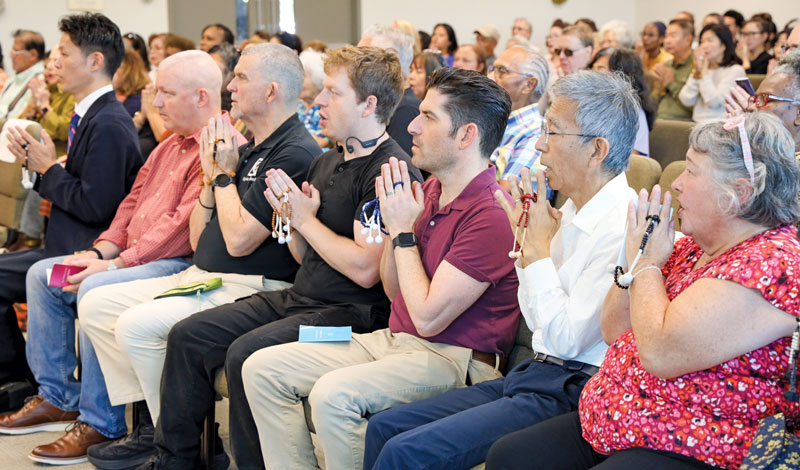
Gongyo—which includes reciting portions of the “Expedient Means” and “Life Span of the Thus Come One” chapters of the Lotus Sutra—is part of daily practice for Nichiren Buddhists. This series carries Ikeda Sensei’s explanations of gongyo, section by section. The full text can be found in The Heart of the Lotus Sutra, pp. 317–23.
I do shujo ko. Hoben gen nehan. Ni jitsu fu metsu-do. Jo ju shi seppo. Ga jo ju o shi. I sho jin-zu-riki. Ryo tendo shujo. Sui gon ni fu ken.
Literal translation: “In order to save living beings, as an expedient means I appear to enter nirvana but in truth I do not pass into extinction. I am always here, preaching the Law. I am always here, but through my transcendental powers I make it so that living beings in their befuddlement do not see me even when close by.” (The Lotus Sutra and Its Opening and Closing Sutras, pp. 270–71)
Ikeda Sensei:
Shakyamuni, who attained Buddhahood in the remote past, numberless major world system dust particle kalpas ago, is the Buddha who eternally leads people to enlightenment throughout the past, present and future. Why does a Buddha, whose life is eternal, pass into extinction?
The answer is that he does so as an expedient means “to save living beings.” The Buddha enters nirvana (that is, passes into extinction, or dies) as an expedient means to lead people to enlightenment.
Nirvana indicates a state of tranquility achieved by overcoming earthly desires. The early Buddhist teachings, moreover, put forth the goal of “complete nirvana,” or “nirvana of no remainder,” attained by not only overcoming earthly desires of the mind but by freeing oneself from the influence of the physical body through death. For this reason, a Buddha’s death is referred to as “entering nirvana.”
But the “Life Span” chapter indicates that the Buddha only appears to pass into extinction, or enter nirvana, as an expedient means. The truth is that, out of his compassion and wisdom, he eternally continues working to lead all people to happiness. …
Like a Concerned Parent Watching Over His Children
To the Buddha, “living beings in their befuddlement” are like children who have not yet reached the age of discernment. Mischievous children may resent and feel constrained by a parent who constantly watches over them. But if the parent momentarily disappears from the child’s sight, the child cries out for and tries to find the parent.
Similarly, only when the Buddha passes into extinction can befuddled people truly appreciate their fortune in having encountered the Buddha. He regards all people as his own children. Like a parent, the Buddha understands the people well and exerts himself in various ways on their behalf, employing all manner of expedient means. Passing into extinction is the ultimate expedient means at the Buddha’s disposal. …
Our relationship with the Buddha is not limited to this lifetime alone. The parent who constantly watches over the people is the eternal Buddha revealed in the “Life Span” chapter.
Yet befuddled people cannot even see the Buddha existing in their own hearts. For this reason, Nichiren Daishonin inscribed the life of the Buddha—his own identity—in the form of the Gohonzon. And this Gohonzon serves as a mirror for us to see the Gohonzon existing within ourselves. …
The Gohonzon, embodying Nichiren’s very soul, is the essence of the Buddha’s life. Even though the Buddha is always here in the world in the form of the Gohonzon, unless people have faith, the Gohonzon will appear to them only as paper or wood. But it is in fact the embodiment of the noble life of the Buddha.
Regarding “always here” in the passage “I am always here, preaching the Law,” Nichiren says: “‘Always here’ refers to the place where the votaries of the Lotus Sutra abide. ‘Here’ is the saha world” (The Record of the Orally Transmitted Teachings, p. 134). The Buddha is present wherever a person of action overcomes difficulties based on faith and correctly advances in life. …
The passage “as an expedient means I appear to enter nirvana,” according to second Soka Gakkai President Josei Toda, “sheds light on the question of why we die even though life is eternal.” He taught that, viewed from the eternal state of one who perceives the oneness of birth and death, death is an expedient means.
President Toda often compared death to sleep. When we have been awake for a long time, we tire and go to sleep. And when we wake up after a sound sleep, our vitality is restored. After we have been alive for a long time, we grow weary and die. And then we set out on a new life with a fresh spirit. …
One’s actions in previous existences are all engraved and contained in this lifetime. The causes for our present suffering or joy, happiness or misery, all lie in our own past actions. But Nichiren Buddhism enables us to fundamentally reform our destiny. When we truly base ourselves on Buddhism’s view of life’s eternity, we realize the first thing to change is how we live in the present.
When we pray to the Gohonzon, change arises from the depths of our being. Strong, pure vitality wells forth in abundance. The iron chains of destiny are cut, and our original identity, the fresh and robust world of Buddhahood, appears.
You are reading {{ meterCount }} of {{ meterMax }} free premium articles