
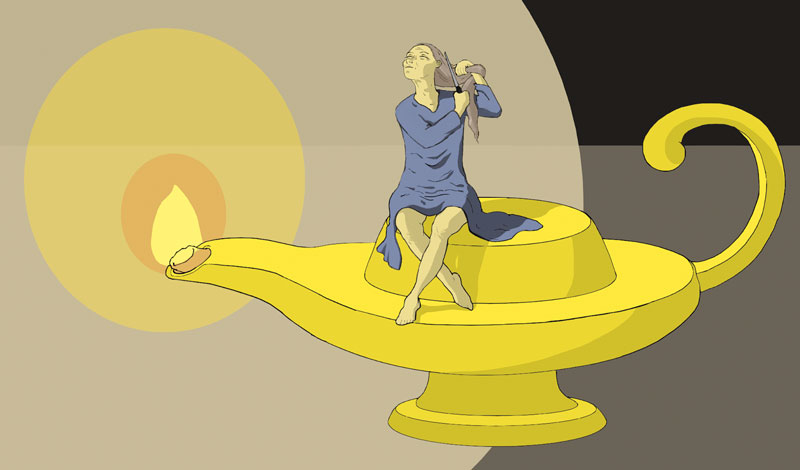
This new series, prepared by the SGI-USA Study Department, features timeless stories in Nichiren Daishonin’s writings (called the Gosho) that continue to offer practical wisdom for us today.
Once upon a time in the ancient city of Rajagriha, an old woman saw a long procession of carts carrying flax oil—an offering by King Ajatashatru to Shakyamuni Buddha. Moved by the sight, she longed to make an offering herself. Desperately poor, she cut off her long hair and sold it to a wig maker. She used the money to buy a small vat of oil—barely enough to last half the night. Still, she trusted that the Buddha would sense the sincerity of her heart.
When Shakyamuni Buddha arrived, the city glowed with hundreds of thousands of lamps. King Ajatashatru alone had offered tens of thousands of lamps and five thousand barrels of oil, displayed in vessels of gold, silver and precious stones—an overwhelming contrast to the poor woman’s simple clay lamp.
That night, a fierce storm swept through the city, extinguishing almost every lamp. By morning, only one flame remained—the poor woman’s. When people tried to blow it out, it only burned brighter. Seeing this, the Buddha reproached them and proclaimed that the woman was destined to become the Buddha known as Lamp Light Sumeru.
From ‘Reply to Onichi-nyo’
Nichiren Daishonin references the story of the poor woman’s lamp, praising his disciple Onichi-nyo for her offering, writing:
The Buddha, being truly worthy of respect, never judges by the size of one’s offerings. In the past, the boy Virtue Victorious offered a mud pie to the Buddha, and was reborn as King Ashoka and ruled over all of Jambudvīpa. A poor woman cut off her hair and sold it to buy oil [for the Buddha], and not even the winds sweeping down from Mount Sumeru could extinguish the flame of the lamp fed by this oil. Accordingly, your offerings of two and three strings of coins are far greater even than those of the ruler of Japan, who may offer the nation and build a pagoda adorned with the seven kinds of treasures that reaches to the heaven of the thirty-three gods.
—“Reply to Onichi-nyo,” The Writings of Nichiren Daishonin, vol. 1, p. 1089
Ikeda Sensei’s Guidance
What “the Poor Woman’s Lamp” teaches us is, more than anything else, the value of sincerity. It is true that her efforts were not impressive, and people preoccupied with mundane affairs might not have taken the slightest notice of the dedication she expressed in offering the small amount of oil. But Shakyamuni was indeed a man of penetrating insight. You can no more sever the ties of sincerity that bind human beings to one another in the depths of their lives than you can cut through water or air. Even when all other things wane and collapse into the whirlpool of life’s relentless difficulties, such sincerity will only glow all the more brilliantly. I cannot help but feel that, in the light of the lamp that the old woman offered, Shakyamuni saw the light of life which never fades away.
It is not the material worth of an offering but the spirit behind it that counts. The poor woman’s single lamp meant far more than the five thousand barrels of lamp oil that Ajatashatru, the ruler of that country, donated to the Buddha. The little lamp contained the sincerity that a nameless woman felt with her entire being. A mind that attaches importance even to the slightest matters and that loves and treasures even seemingly insignificant things can profoundly move people even through a small action. (March–April 2006 Living Buddhism, pp. 14–15)
April 17, 2026 World Tribune, p. 11
You are reading {{ meterCount }} of {{ meterMax }} free premium articles