

On June 30, 1957, the student division was formally established, becoming the last group formed by second Soka Gakkai President Josei Toda.
In September of the previous year, the student division consisted of less than 50 members—too few to be considered a formally established division. Throughout the next half year, the small group of students, supported by members in the youth division and their chapters, rallied to find new members to join. As a result of their vigorous efforts in dialogue, the group had exponentially grown to about 500 students by June 1957, leading to the inaugural meeting on June 30.
At the time, there was intensifying persecution from various political authorities who feared the rise of an influential people’s movement. In Hokkaido, the Yubari Coal Miners’ Union was excluding and expelling Soka Gakkai members who voted for candidates not backed by the union, accusing them of disrupting its solidarity. Also, Soka Gakkai members were being arrested under false charges.
Ikeda Sensei, then youth division chief of staff, traveled to Yubari and Osaka on behalf of President Toda to alleviate the situation and encourage the members. In Osaka, just a few days after the student division inaugural meeting, Sensei was wrongfully charged with election law violations and arrested.
Against this tumultuous backdrop, the student division succeeded in gathering hundreds of university students, a group commonly considered the least receptive toward religion. Anticipating college graduates to comprise the majority of society’s leaders in the future, President Toda was convinced that “unless educated people who embraced the Mystic Law, that is, those trained in the student division, assumed leading roles in various fields, it would be difficult to realize kosen-rufu” (The Human Revolution, vol. 2, p. 1064).
President Toda cherished these 500 students with the profoundest expectations of their becoming people steadfastly committed to truth and good. Sharing his mentor’s hopes, Ikeda Sensei wrote in an essay to student division members:
Youth, who are the future! Students possessing outstanding intellect! Battle against social evil and strive to keenly discern and resolve society’s contradictions. Develop relentless strength in criticizing injustice, along with a formidable ability to refute error and remonstrate against irresponsible speech and journalism, and the arrogant attitudes of those who think they are better than others. This is as befits a youth, a student. For that reason, hone your intellect and wield it with pride for the sake of truth and justice.
My friends, please do not simply indulge in abstract intellectualism, or allow yourselves to become intellectual posers who seek only popularity. Do not lead shallow, mediocre lives. Each person has his or her own particular mission. I hope you will be young champions of the spirit who strive to fulfill your missions. (June 2022 Living Buddhism, p. 19)
Kosen-rufu depends on the development of students’ happiness. It is with this conviction that Sensei gave his final university lecture in the U.S., titled “Thoughts on Education for Global Citizenship” on June 13, 1996. Delivered at Teachers College, Columbia University, his speech highlights the philosophical lineage between John Dewey, an American philosopher and educator who taught at Columbia University, and Tsunesaburo Makiguchi, the founder of the Soka Gakkai. Both educators envisioned the need for global citizenship education—a people-centered education transcending the limits of the nation-state to the whole human community.
Sensei defined the following three elements of global citizenship: 1) The wisdom to perceive the interconnectedness of life; 2) The courage not to fear or deny difference but to respect and strive to understand people of different cultures and to grow from encounters with them; 3) The compassion to maintain an imaginative empathy that reaches beyond one’s immediate surroundings and extends to those suffering in distant places. (See My Dear Friends in America, fourth edition, pp. 447–57) Continuously striving to embody wisdom, courage and compassion is the hallmark of a global citizen and of a Bodhisattva of the Earth!
Eternal Victory For Humanity

Name: Keiko Koguchi / City: New York
School: Teachers College, Columbia University
Living Buddhism: Hi Keiko. Thank you for speaking with us. Can you share how you started practicing Buddhism?
Keiko Koguchi: I was born into a family that practices Nichiren Buddhism. Growing up, I struggled to find my footing in the practice and understand what it meant to me. I eventually went to Kansai Soka High School and Soka University of America (SUA) where I met many people who practiced Buddhism. I began to feel inspired by them. It motivated me to become a better person.
The summer after my junior year at SUA is when I really started my own practice. I began supporting SGI meetings behind the scenes as a Byakuren member. I realized how much effort goes into each meeting. Learning the spirit to support others and hearing experiences from friends in faith empowered me to want to make this practice my own.
How did your Buddhist practice inspire you to apply to Teachers College?
Keiko: During the same time, I struggled to decide if I wanted to apply to graduate school. I realized my hesitation to apply came from a lack of belief in myself. But I had many friends who believed in and encouraged me. I wrote a goal in my notebook to “prove myself wrong through the practice,” and began chanting to overcome my self-doubt.
Eventually, I decided to apply to graduate schools in education based on my longtime goal to become an educator. After chanting a lot and working hard on my application essays, I proved myself wrong and was accepted into several graduate school programs. Based on my faith, I decided to attend Columbia University’s Teachers College as I felt my mission was there and that it’s where I’d grow the most.
Amazing! What’s it been like to lead the campus club there?
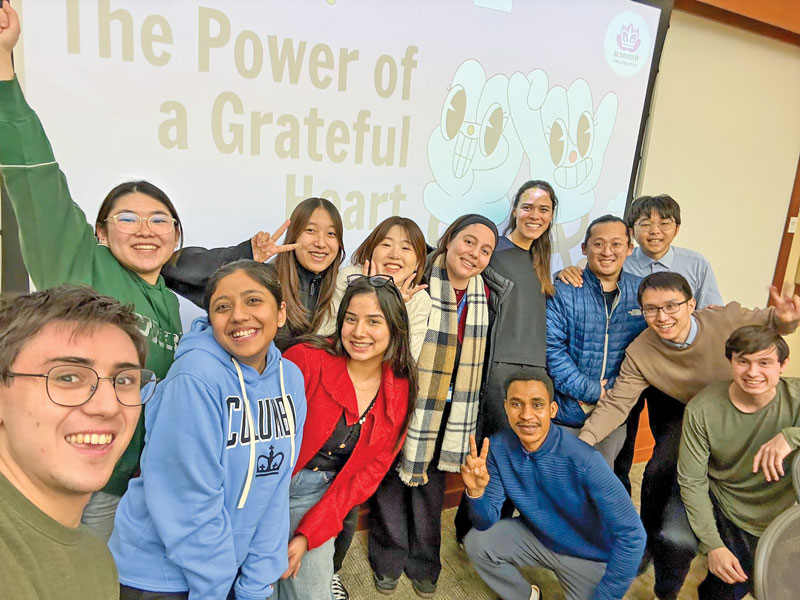
Keiko: It’s been challenging but so joyful at the same time. Teachers College is academically rigorous, and many people are juggling a lot at once. This makes it difficult to put together meetings and events that match people’s schedules. Regardless, we wanted the club to be a place where people can establish strong friendships.
Recently, societal and political challenges have directly impacted Columbia University. This caused many students to feel unsafe on campus. As campus club leaders, we wanted to respond by making the club a welcoming safe space where people feel a sense of community.
That said, we’ve been trying to focus on fun activities that naturally spark dialogue about Buddhism. In February we made appreciation cards. Naturally, conversations flowed about who we were writing our cards to. Since appreciation is such an important part of our Buddhist practice, we were able to have dialogue about it.
One person even shared later that the card they wrote at the event helped to establish a stronger friendship with the person they wrote their card for. This showed me that campus club activities have an impact on the wider community.
This year marks 30 years since Ikeda Sensei gave his address “Thoughts on Education for Global Citizenship” at Columbia University. How have you used this address in your studies and campus club activities?
Keiko: The address makes me think a lot about the purpose of the education I’m receiving. I’m privileged to receive an education, but I’m also responsible for creating value with it. There have been times where I’ve questioned if education is truly my passion. Reading Sensei’s address brings me back to my purpose and gives me appreciation for my academic str uggles. In the speech, he cites first Soka Gakkai President Tsunesaburo Makiguchi saying:
Educational efforts built on a clear understanding and with a defined sense of purpose have the power to overcome the contradictions and doubts that plague humankind, and to bring about an eternal victory for humanity (My Dear Friends in America, fourth edition, pp. 456–57).
Many students at Columbia are passionate about wanting to contribute to society through education. In the classroom, students only get to discuss their values in snippets. Our campus club is important because students can freely express their beliefs and determinations while offering a Buddhist perspective.
How will you commemorate the 30th anniversary of Sensei’s address?
Keiko: We want to create an event where we can learn from and correctly convey what Sensei meant in this speech. The bottom line is to encourage others—for them to see the significance of this speech but also to joyfully celebrate its lessons for us.
What is your determination and vision for the future?
Keiko: I’m determined to raise successors for the campus club and create more new friendships. I’m not the best with talking to new people, but I see that as an opportunity to do my human revolution. This is a cause to bring more people to campus club events and for them to feel happy and encouraged by our meetings.
Currently I’m studying to become an educator for people learning English as a second language. As a future teacher, I’m determined to support students so they feel that school is a safe place where they can grow, learn and improve their language skills.
You are reading {{ meterCount }} of {{ meterMax }} free premium articles