
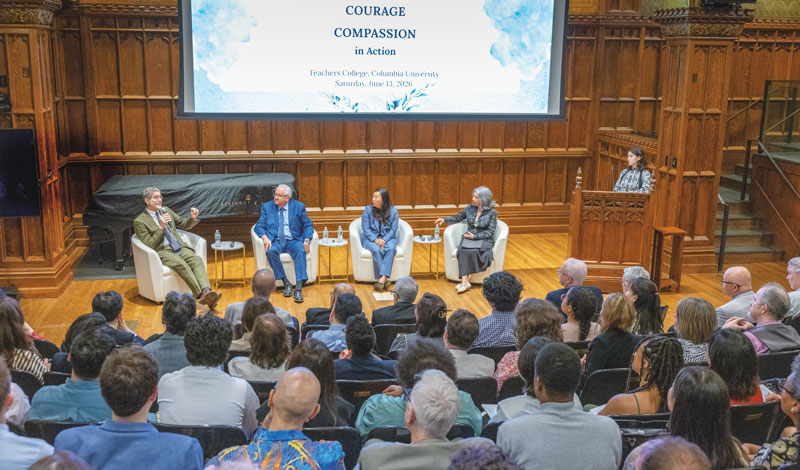
NEW YORK—“The world is not healed by cynicism,” said Andrea Bartoli, member of Soka University of America’s (SUA’s)board of trustees, addressing a packed Milbank Chapel at Teachers College, Columbia University, on June 13. “The world is not transformed by resignation. The world changes because people are willing to imagine something better, and they dedicate themselves to making it real.”
Bartoli, who also serves as executive adviser of the Soka Institute for Global Solutions and president of the Sant’Egidio Foundation for Peace and Dialogue, was one of four panelists at “30 Years of Daisaku Ikeda’s Vision: Wisdom, Courage and Compassion in Action.” The event commemorated “Thoughts on Education for Global Citizenship,”[1] the speech SUA founder Daisaku Ikeda delivered in the same room exactly 30 years earlier.
Joining Bartoli on the panel were Edward M. Feasel, SUA’s president; Ruby Nagashima, director of student leadership and service engagement at SUA; and Isabel Nuñez, professor of educational studies and dean of the School of Education at Purdue University Fort Wayne, as well as a member of SUA’s board of trustees.
“Mr. Ikeda delivered that speech five years before our campus opened in Aliso Viejo,” Feasel said in an interview before the event. “It was not only foundational for SUA—it introduced a paradigm shift for education in general.”
In the speech, Mr. Ikeda identified three essential qualities of a global citizen: “the wisdom to perceive the interconnectedness of all life; the courage not to fear or deny difference but to grow from encounters with people of different cultures; and the compassion to maintain an imaginative empathy that extends to those suffering in distant places.”
Following opening remarks by emcee Marina Inoue, graduate of the class of 2025, and a video excerpt of SUA founder Daisaku Ikeda’s original address, the panelists explored how the university continues to put those principles into practice. “What struck me most was that the speech was like a conversation,” Bartoli said. He noted that Mr. Ikeda brought the ideas of educator John Dewey into dialogue with those of Tsunesaburo Makiguchi, the founder of value-creating education.
Feasel focused on how students at SUA apply their education to real-world challenges through the four areas of global citizenship outlined by Mr. Ikeda in 1996: peace, human rights, development and sustainability.
A hallmark of this approach, he said, is SUA’s Learning Clusters, small research seminars in which students work closely with faculty members to address pressing global issues. He also highlighted initiatives such as the Soka Institute for Global Solutions and partnerships with organizations including Earth Charter International. Next month, SUA will host 100 young people from 24 countries for the inaugural Earth Charter Youth Summit.
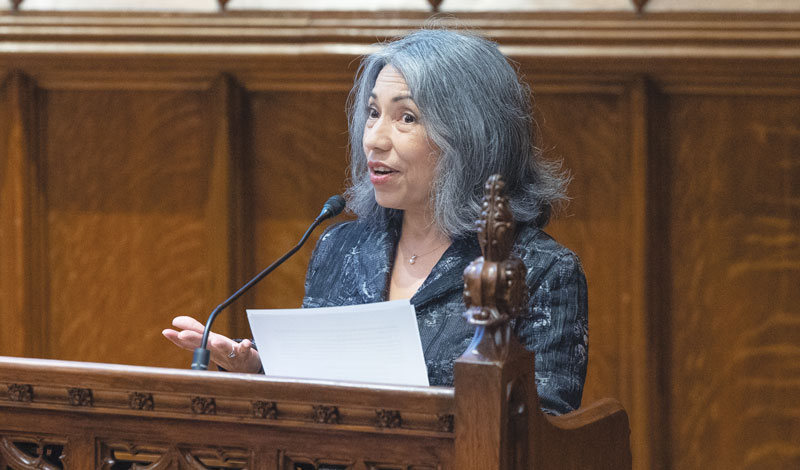
Nagashima reflected on her own growth as an SUA student and the impact of a campus culture dedicated to fostering human potential. “Looking back,” she said, “I realized that my education was shaped by an entire community committed to helping students grow.”
She also described Alternative Spring Break, a service-learning program during which students learn alongside communities facing social challenges, including refugee families resettling in Southern California. “My students have been some of the greatest teachers in helping me understand what global citizenship looks like in practice,” Nagashima said. “Some of the most meaningful expressions of global citizenship are found not in extraordinary acts but in the ways we choose to engage with one another each day.”
Nuñez emphasized the importance of SUA’s small, internationally diverse community in cultivating the ability to engage across differences. “What becomes crucial is the ability to disagree respectfully,” she said. “Practicing how to express different views while maintaining respect for others is extremely important.”
She also highlighted the role of storytelling in developing compassion. With roughly half of SUA’s students coming from outside the United States, students learn from one another’s experiences and come to recognize the shared humanity that connects people across cultures and borders.
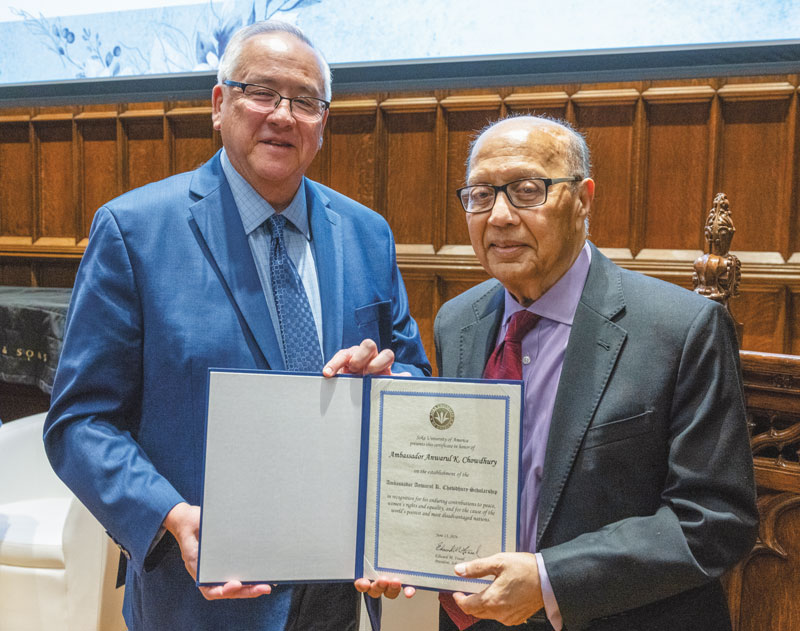
The event concluded with two major announcements. Feasel signed a memorandum of understanding with the Ikeda Center for Peace, Learning, and Dialogue, outlining a mutual intent to collaborate, and announced the creation of the Ambassador Anwarul K. Chowdhury Scholarship, a new annual $20,000 award for an SUA student.
Thirty years after Mr. Ikeda’s address, his call for wisdom, courage and compassion continues to resonate. As Nagashima reflected: “It is ordinary people choosing day after day to live with wisdom, courage and compassion that will bring about a new day.”
—Prepared by the World Tribune staff
References
- Daisaku Ikeda’s Columbia University speech, “Thoughts on Global Citizenship” can be found in the June 2026 Living Buddhism, pp. 28–33. ↩︎
You are reading {{ meterCount }} of {{ meterMax }} free premium articles