
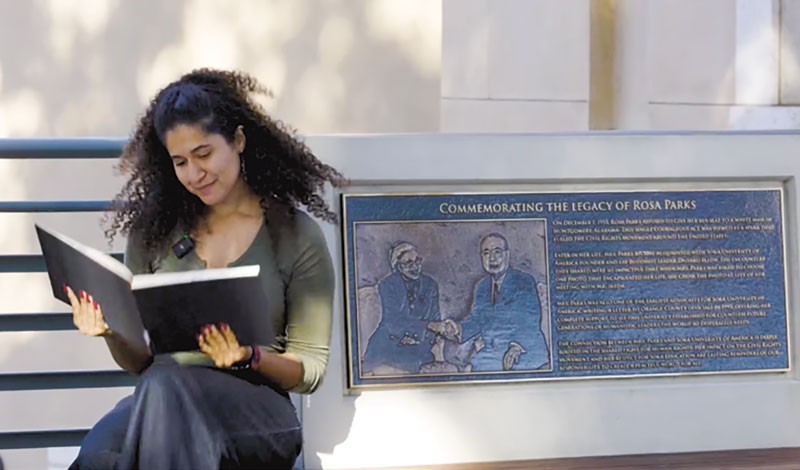
A quiet bench near the student center at Soka University of America (SUA) bears a powerful reminder of history: a cast bronze plaque commemorating the meeting between civil rights leader Rosa Parks and SUA founder Daisaku Ikeda on Jan. 30, 1993.
During that visit to SUA’s former graduate campus in Calabasas, California, Parks and Ikeda Sensei discussed racial justice and the challenges facing young people in both the United States and Japan. Parks later selected a photograph of their meeting for the 1994 book Talking Pictures, writing that it symbolized how people of different backgrounds can unite in a shared mission for peace. That spirit continues to resonate on campus today.
Recently, SUA students collaborated across several departments—including Student Leadership and Service Engagement and Diversity, Equity and Inclusion—to produce a video highlighting Parks’s connection to the university and her belief in its mission to foster global citizens.
“For students, this history shows they are part of something much bigger,” said Ruby Nagashima, director of student leadership and service engagement, who helped develop the project. Jun Sawada (Class of 2026), from São Paulo, Brazil, led the video’s production. Learning about Parks’s lifelong commitment to justice inspired him to reflect on his own path. “Filmmaking for impact is my way of contributing,” he said.
Other students say Parks’s example continues to shape campus life. Gracyn Ervin (Class of 2026), from Santa Fe, New Mexico, said her legacy is a call to create a more inclusive environment. Through her work with the DEI Office, she has organized events and projects that encourage dialogue around multicultural identity. Sia Tholath (Class of 2026), from Mumbai, India, sees Parks’s resilience as a model for youth leadership. “It reminds us to use our voices, especially in challenging times,” she said.
Though widely known for her role in the 1955 Montgomery bus boycott, Parks’s activism spanned decades—from civil rights organizing in the 1930s to advocating for fair housing and youth development later in life. Her commitment to empowering young people aligned closely with Sensei’s vision of education for global citizenship.
Today, that shared vision lives on at SUA, where students continue to take action in their communities—carrying forward a legacy of courage, dialogue and hope for a more just and peaceful world.
—Adapted from an article on soka.edu
You are reading {{ meterCount }} of {{ meterMax }} free premium articles