
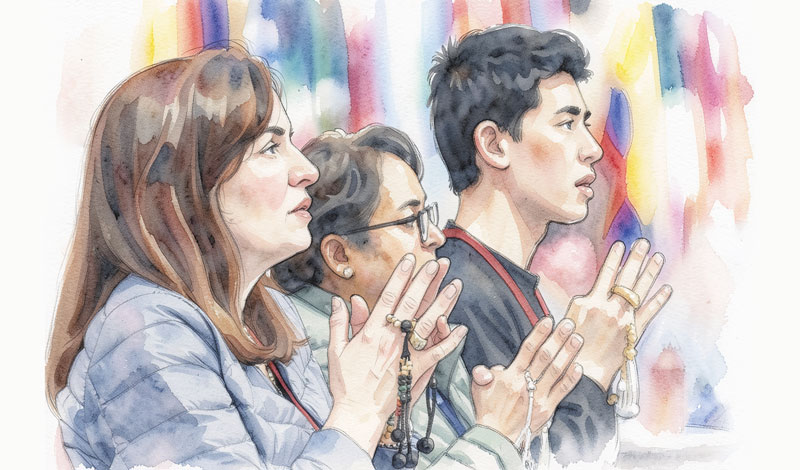
Eighteen U.S. representatives attended the SGI Training Course April 15–20, 2026, in Tokyo. They were among the 280 participating representatives from 60 countries and territories.
Among the highlights, they attended a gongyo ceremony at the Hall of the Great Vow for Kosen-rufu; a Soka Gakkai headquarters leaders meeting celebrating May 3, Soka Gakkai Day; and an exchange meeting with members from Taito Ward. They also took part in a Q&A session with Soka Gakkai President Minoru Harada; and divisional sessions with SGI men’s and women’s leaders.
During the opening session, held at the Soka Bunka (Culture) Center’s Kimmai Hall, SGI Vice General Director Kimiko Nagaishi spoke of Ikeda Sensei’s dialogue with Arnold J. Toynbee, Choose Life, which marked the beginning of his grand journey of dialogue with leading thinkers around the world.
In the “Dialogue” chapter of volume 16 of The New Human Revolution, Sensei pondered to what degree Toynbee, who was from a completely different religious and cultural background, could understand his own philosophy of humanism. Along those lines, Sensei quoted the American educator and philosopher John Dewey, saying: “Ideas which are not communicated, shared and reborn in expression are but soliloquy, and soliloquy is but broken and imperfect thought” (p. 114).
Nagaishi said that, unless Nichiren Buddhism and Sensei’s philosophy are communicated and shared, the door to world peace and the happiness of humanity will be closed.
“As Sensei’s successors, our mission is to engage in dialogue with wisdom, compassion and courage to connect people’s hearts and expand this network of understanding and agreement,” she said.
“A mission becomes a mission when it is accomplished. A vow becomes a vow when it is fulfilled.”
How do we move humanity in the direction of peace? SGI General Director Yoshiki Tanigawa focused on two points that offer a framework for victory, starting with this guidance from Sensei:
The decade from the Soka Gakkai’s 90th anniversary to its centennial in 2030 will be crucial. We must be even more determined to show victorious proof of our own human revolution, to transform all great evil into great good and to effect a powerful change in the destiny of all humankind. (Sept. 18, 2020, World Tribune, p. 3)
Tanigawa noted that 2026 marks the first year of the second half of that decade and the start of the second half of the Seven Bells,[1] which is aimed at solidifying the foundations for global peace.
He said that people around the world are deeply concerned and gripped with anxiety by the worsening division, conflicts and spread of war around the world.
He said that Sensei poured his entire being into laying the foundations for the peace and prosperity of humankind, thereby creating this very moment for disciples to rise up in his stead. “Never has there been a time more urgent than now to further elevate the tide of worldwide kosen-rufu, the only path to opening the way for the fundamental transformation in the destiny of humankind,” he said.
As Sensei’s disciples and SGI leaders, he encouraged the representative leaders to unite based on the unity of “many in body, one in mind” and set forth toward 2030 to realize Sensei’s vision and transform the destiny of humanity.
He then offered two points toward that end.
1. Prayer is most fundamental.
From his youth, Sensei consistently emphasized beginning every endeavor, every campaign, with prayer and practiced this himself. And the first of the women’s division’s “Five Eternal Guidelines” is “Everything begins with prayer.”
Sensei writes:
The first thing is to pray. From the moment we begin to pray, things start moving. The darker the night, the closer the dawn.
From the moment we chant daimoku with a deep and powerful resolve, the sun begins to rise in our hearts.
Hope—prayer is the sun of hope. To chant daimoku each time we face a problem, overcoming it, and elevating our life condition as a result—this is the path of “earthly desires are enlightenment” taught in Nichiren Buddhism.
Suffering and undergoing hardships for the sake of friends and for spreading the Law are manifestations of the great sense of responsibility of a genuine leader and the behavior of a bodhisattva.
There is no suffering or hardship that a Bodhisattva of the Earth cannot surmount. So no matter what happens, I would like you to advance steadily, one step at a time, always chanting Nam-myoho-renge-kyo with a vibrant voice. (My Dear Friends in America, fourth edition, p. 470)
Tanigawa said that by praying, we forge our determination into an unwavering resolve for victory. This represents the most fundamental aspect of our Buddhist practice. When praying, he said, what matters most is to chant with a firm conviction that our prayers will definitely be answered.
During Sensei’s youth, amid second Soka Gakkai President Josei Toda’s businesses struggles, he delivered a powerful lecture on “Reply to the Lay Nun Nichigon,” in which Nichiren Daishonin states:
Whether or not your prayer is answered will depend on your faith; [if it is not] I will in no way be to blame.
When water is clear, the moon is reflected. When the wind blows, the trees shake. Our minds are like the water. Faith that is weak is like muddy water, while faith that is brave is like clear water. Understand that the trees are like principles, and the wind that shakes them is like the recitation of the sutra. (The Writings of Nichiren Daishonin, vol. 1, p. 1079)
Tanigawa said what matters most is the conviction that the Gohonzon and Nichiren Buddhism are absolute. “A prayer born of strong conviction is the key that unlocks everything,” he said.
Sensei writes:
When we pray, it’s important to have a firm conviction that all our prayers will be answered and to pray with intensity. Mentors and disciples, Bodhisattvas of the Earth striving together for kosen-rufu, unite their hearts in prayer, so their prayers are certain to come true. When we truly pledge to achieve kosen-rufu as we chant, then our prayer is a prayer of the Bodhisattvas of the Earth. At that moment, our lives open and expand to that of the Bodhisattvas of the Earth. (The New Human Revolution, vol. 23, p. 315)
Tanigawa said that chanting based on a vow for kosen-rufu is an interaction between the lives of mentor and disciple, spanning past, present and future. “Let us engrave Sensei’s guidance in our hearts and advance resolutely based at all times on prayer,” he said.
2. The unity of ‘many in body, one in mind’ is the key to victory.
Nichiren Daishonin states:
Even an individual at cross purposes with himself is certain to end in failure. Yet a hundred or even a thousand people can definitely attain their goal, if they are of one mind. Though numerous, the Japanese will find it difficult to accomplish anything, because they are divided in spirit. In contrast, although Nichiren and his followers are few, because they are different in body, but united in mind, they will definitely accomplish their great mission of widely propagating the Lotus Sutra. Though evils may be numerous, they cannot prevail over a single great truth, just as many raging fires are quenched by a single shower of rain. This principle also holds true with Nichiren and his followers. (“Many in Body, One in Mind,” WND-1, 618)
He also writes:
All disciples and lay supporters of Nichiren should chant Nam-myoho-renge-kyo with the spirit of many in body but one in mind, transcending all differences among themselves to become as inseparable as fish and the water in which they swim. This spiritual bond is the basis for the universal transmission of the ultimate Law of life and death. Herein lies the true goal of Nichiren’s propagation. (“The Heritage of the Ultimate Law of Life,” WND-1, 217)
Tanigawa said that the unity of many in body, one in mind, is the essence of propagation taught by the Daishonin. If we can achieve unity, our great desire for kosen-rufu will be fulfilled.
In reality, however, there may be times when we simply can’t get along or build truly harmonious unity.
In the “Hope of the People” chapter of volume 9 of The New Human Revolution, Sensei asks:
“So how do we create unity? The key is prayer—chanting Nam-myoho-renge-kyo earnestly. When we encounter someone we find hard to deal with, we need to pray sincerely for that person. When we argue or fight with another person, it means that both of our life conditions are low. Praying for the happiness of the other person will greatly elevate our own state of life.
“Emotional conflicts frequently come from misunderstandings, so it’s important that we talk to each other with an open mind. We need to have the courage to engage each other in dialogue. There is no reason that two people of faith who share kosen-rufu as their fundamental goal shouldn’t be able to work out their differences.” (255–56)
On one occasion, Sensei said that, above all else, unity is essential for victory. However, creating unity is not easy. We must overcome our differences and fight with the same heart. At the center of that heart lies the single axis: the mentor-disciple relationship.
Tanigawa said that true unity is born when everyone unites based on the heart of the disciple’s vow to report our victory to our mentor and bring him joy.
“So, let us all pray and fight with the single-minded determination to realize kosen-rufu with Ikeda Sensei,” he said. “With the unity of many in body, one in mind, let us break through all barriers and achieve victory.”
May 8, 2026 World Tribune, pp. 6–7
References
- Realizing that the Soka Gakkai had made significant steps every seven years since its inception in 1930, Ikeda Sensei announced on May 3, 1958, the concept of the Seven Bells—seven sets of seven-year periods marking key milestones. The first Seven Bells (1930–79) marked the Soka Gakkai’s founding and development. The second Seven Bells (2001–50) center on consolidating the groundwork for peace in Asia and the world. The Third Seven Bells and onward, from the latter half of the 21st century to the 23rd century constitute Sensei’s far-reaching vision for peace. ↩︎
You are reading {{ meterCount }} of {{ meterMax }} free premium articles