
Like mangrove roots gathering to form an island, one connection can become the foundation for many more.
Imagine traveling from Texas to Aruba to visit family and wanting to chant with fellow members while you’re there. You search online for “SGI Aruba” hoping to find a local organization. You might find there’s no clear way to know who to contact or how to connect with local members. For someone seeking a place to practice, even a local organization just miles away could remain difficult to find.
For years, this was a challenge for members and guests throughout the Caribbean. SGI spans 192 countries and territories and 21 are part of the Florida Zone’s Caribbean Region. Yet many of these countries and territories did not have a clear digital presence where people could easily find their local organization.
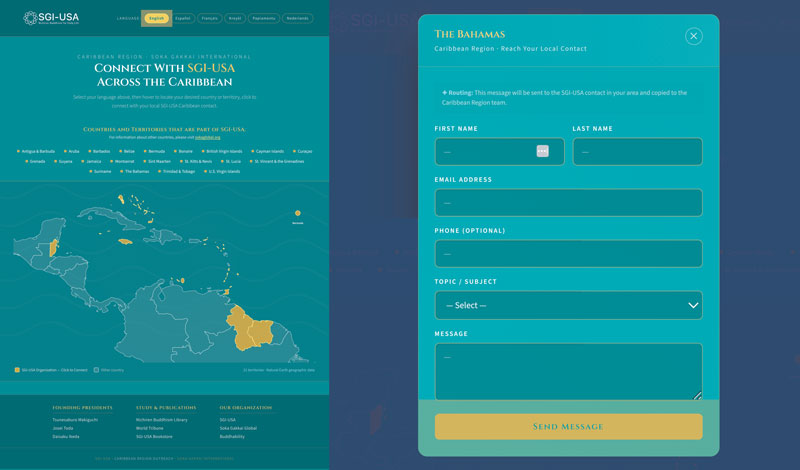
The Caribbean Region sought to change that by creating an interactive digital map that provides a clear path to connection. When visiting the new website, visitors are greeted by a world map highlighting the countries and territories that are a part of the SGI-USA. By clicking on specific locations, they can submit a contact form that connects them with a local organization, with the Caribbean Region team included for further support.
The website also reflects the rich diversity of the Caribbean by providing six language options: English, Spanish, French, Creole, Papiamentu and Dutch. And the opportunity to connect does not stop there. Visitors can find website links to resources including the Soka Gakkai Nichiren Buddhism library, World Tribune, SGI-USA Bookstore, SGI-USA, Soka Global and Buddhability, creating more opportunities to learn, study and deepen their connection to Buddhism.
This website is more than a digital map. It creates for Caribbean Region a digital identity and home—a place where members and guests can find the way to their local organization and connect with fellow members.
Having a digital presence and being visible to the world also creates a sense of pride for members living throughout the Caribbean: pride in belonging to a Buddhist community that is present and growing. The growth of the organization is like the mangroves found throughout the islands.
A mangrove begins with a single propagule—a seedling drifting through the water, searching for a place to take root. Once it finds shallow water and anchors itself, its roots grow outward and downward. They catch sediment and gradually create solid ground where there was once only water. Then another propagule arrives and takes root beside it. Their roots interlock, gathering more sediment and creating an increasingly strong foundation. Over time, what began as an individual root becomes an entire island ecosystem.
In this way, the website is like shallow water where someone searching can find a place to land. But the website does not build the land. The members do. The website creates a place where people can connect, where members can find and encourage one another and deepen their faith together in the local organization. Each connection becomes another root, and those roots grow stronger as they intertwine.
As these connections multiply, they create a stronger foundation for the Caribbean organization and its continued growth. And just as mangroves protect the ecosystems around them from storms and powerful waves, the Soka network provides connections and supports people’s lives by protecting and nurturing them.
This project represents the Caribbean Region’s growth and its determination to realize Ikeda Sensei’s dream of kosen-rufu. They’re making Buddhism more accessible and creating pathways for more people to connect, practice and grow together.
Click here to access the “Connect with SGI-USA Across the Caribbean”.
You are reading {{ meterCount }} of {{ meterMax }} free premium articles