

Please present the 3-Minute Gosho (pp. 46–47) at your discussion meetings. For the main study portion of the meeting, you can choose to expand on the 3-Minute Gosho or choose from one of the following:
1) What Do You Think? (pp. 48–49)
2) Material from any recent issue of the World Tribune or Living Buddhism.
3-Miunte Gosho
How to Grow Our Fortune and Benefit
This series serves as the basis for a brief study presentation at monthly discussion meetings, to be given by future, student or youth division members (or by other members if youth are not available). Those presenting can simply read the material or get creative!
Passage
The more one praises the blessings of the Lotus Sutra, the more one’s own blessings will increase. —“The Blessings of the Lotus Sutra,” The Writings of Nichiren Daishonin, p. 673
Background
Nichiren Daishonin wrote this letter in 1276 to his follower Myomitsu. We don’t know much about Myomitsu, but from this letter, we can see that he and his wife made offerings to and supported Nichiren while he was living at Mount Minobu.
Around 1276, more people were beginning to practice Nichiren’s teachings. At the same time, the government grew harsher in its treatment of his followers. In the face of this, Nichiren taught Myomitsu that the more sincerely someone supports the Lotus Sutra and praises its merits, the more benefit and growth they will experience.
Sharing the joy of chanting Nam-myoho-renge-kyo and showing appreciation for others uplifts both them and ourselves. This brings more happiness, courage and good fortune to everyone.
From Ikeda Sensei’s The New Human Revolution
Through the story of a member regaining his health, Ikeda Sensei conveys the significance of Soka Gakkai activities.
Soka Gakkai activities are the best place to cultivate and improve ourselves as human beings. Reaching our goals, whether in sharing Buddhism with others or increasing attendance at meetings, requires challenging and overcoming our own weaknesses, laziness and cowardice. There will be times in our efforts to tell others about Buddhism that we will be insulted and abused, times when people will scorn and laugh at us. This is all predicted in the Lotus Sutra, which states that there will be many ignorant people who will curse and speak ill of its votaries (see The Lotus Sutra and Its Opening and Closing Sutras, p. 232).
Soka Gakkai activities, however, are a struggle to win the understanding and support of others through tenacious dialogue, which we carry out with courage and all-embracing compassion. Engaging in this struggle enables us to polish and strengthen our own lives and sets us on the great path of transforming our karma and achieving our human revolution.
Nichiren Daishonin states, “The more one praises the blessings of the Lotus Sutra, the more one’s own blessings will increase” (WND-1, 673). Sharing Buddhism with others and offering guidance in faith are nothing more than declaring the greatness of Buddhism and praising its teachings. The benefit and fortune we gain as a result are boundless and immeasurable. (The New Human Revolution, vol. 18, revised edition, p. 198)
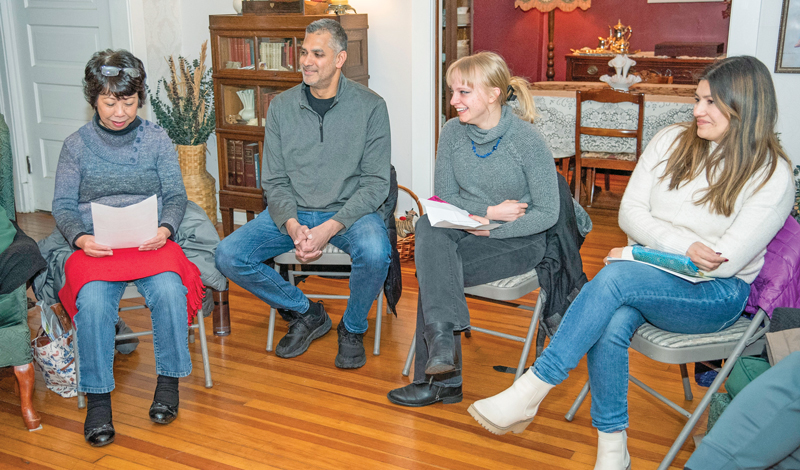
What Do You Think?
What Can We Say ‘Thank You’ for?
When was the last time someone genuinely thanked you? Perhaps a co-worker paused to appreciate what you did. Or maybe a friend remembered a small gesture of kindness. When someone appreciates you, or you do the same for them, something shifts for both of you. Gratitude, it turns out, is not a passive feeling but something that can transform us from the inside out.
In contrast, researchers have found that negative thinking—which might be expressed through complaining and even casual venting—trains our brains to focus mainly on the bad by selectively filtering out positive information. This can create a “negativity loop, ” where we focus on things that reinforce a pessimistic outlook.[1]
But regularly practicing gratitude retrains our brain’s “attentional filters.” Instead of scanning for threats, our brain begins noticing the good in people and situations. As a result, when anchored in appreciation, we can find reasons to be grateful, even in areas we previously overlooked. This strengthens our brain’s ability to find joy in simple pleasures and fundamentally raises our overall level of happiness.[2] Such mental training resonates with our practice of Nichiren Buddhism.
A Practice Of Gratitude
Buddhist practice is not about pretending that problems don’t exist. We learn to make our challenges the terrain on which we forge our lives. Making this shift is itself a form of Buddhist practice.
Kaneko Ikeda, SGI honorary women’s leader, often returns to these words that her husband, Ikeda Sensei, shared with her. “Complaints erase good fortune; grateful prayer builds happiness for all eternity.”[3]
Many SGI members have consciously chosen and made efforts to transform complaint into appreciation. As Sensei writes: “A person filled with gratitude is also filled with joy. And a joyous spirit is the driving force for new endeavors, development, victory and happiness.”[4]
A Time Of Reflection And Appreciation
Every year in the SGI-USA, during the May Commemorative Contribution period—celebrating May 3, Soka Gakkai Day—we have a meaningful opportunity to pause and consider the “debts of gratitude” we carry for Nichiren Daishonin, the three founding Soka Gakkai presidents and our Soka community. This is a momentous time to ask ourselves: What have I concretely gained through my Buddhist practice?
Many of us have gained the courage to face a health crisis, the clarity to make a difficult decision, the warmth of friends in faith when hope was fading or more. Through developing faith in the Gohonzon—a mirror reflecting our inherent Buddha nature—we can navigate life’s ups and downs, gaining wisdom, courage and compassion beyond what we imagined.
When we participate in SGI activities with a joyful spirit, we are making an “offering of the Law.”[5] This benefit accumulates and ripples outward in ways we may not immediately see. “Creating Ripples of Joy and Benefit,” the theme for this year’s May Contribution activity wonderfully captures this point.
Nichiren Daishonin expressed endless gratitude and praise to those who supported him. Drawing on Nichiren Daishonin’s words “the more one praises the blessings of the Lotus Sutra, the more one’s own blessings will increase,”[6] Sensei encourages us to open every interaction with warmth. A simple thank you refreshes both the giver and receiver. “Ripples of joy will spread out to others,” he wrote, “and all will enjoy that much more benefit.”[7]
This month let’s look at things in our lives that we can sincerely say “thank you” for, letting that gratitude ripple outward into all we do.
—Prepared by the SGI-USA Study Department
From the May 2026 Living Buddhism
References
- S.G. Disner, et al., “Neural mechanisms of the cognitive model of depression,” Nature Reviews Neuroscience, vol. 12(8), (2011): pp. 467–477. ↩︎
- H. Abdolahzadeh Delkhosh, “The Neuroscience of Gratitude: A Review of How Daily Practices Induce Neuroplasticity to Enhance Well-Being,” Humanistic Studies and Social Researches, vol. 2 (1) (2025): e236489. ↩︎
- Kaneko Ikeda, Kaneko’s Story, (Santa Monica, Ca.: World Tribune Press, 2007). p. 120. ↩︎
- The New Human Revolution, vol. 26, p. 335. ↩︎
- “Offering of the Law”: Traditionally in Buddhism, there are two kinds of almsgiving or offerings: 1) the offering of goods—such as food, clothing and other material goods; and 2) the offering of the Law—such as paying reverence to and sharing the Buddha’s teaching. ↩︎
- “The Blessings of the Lotus Sutra,” The Writings of Nichiren Daishonin, vol. 1, p. 673. ↩︎
- My Dear Friends in America, fourth edition, p. 480. ↩︎
You are reading {{ meterCount }} of {{ meterMax }} free premium articles