
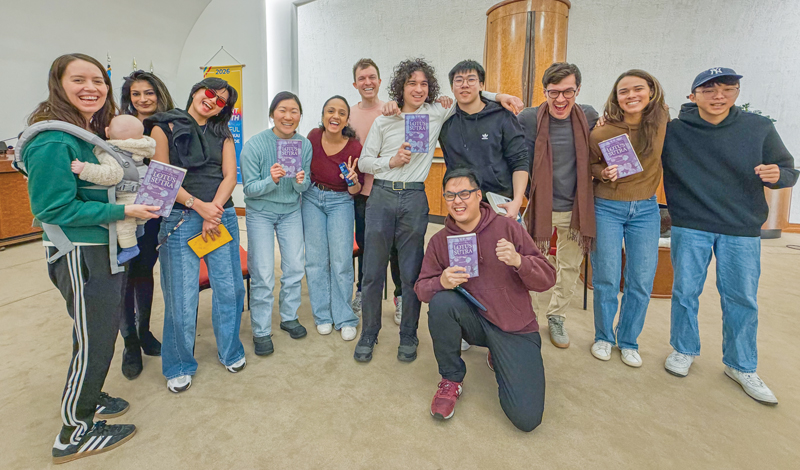
Ikeda Wisdom Academy members:
• are group through national youth leaders and all student division members.
• should have their own copy of The Wisdom of the Lotus Sutra, vol. 5.
• are encouraged to read the assigned material before each meeting.
May Syllabus:
The Wisdom of the Lotus Sutra, vol. 5, pp. 89–118
Part Four: “The Bodhisattva Never Disparaging” Chapter
4: “A Struggle Against Arrogance”
Supplementary Material:
• The Lotus Sutra and Its Opening and Closing Sutras, pp. 307–13
• The Record of the Orally Transmitted Teachings, pp. 150–66
• “The Three Kinds of Treasure,” The Writings of Nichiren Daishonin, vol. 1, p. 852
• “On Rebuking Slander of the Law and Eradicating Sins,” WND-1, 435
• “Letter from Teradomori,” WND-1, 209
• “How Those Initially Aspiring to the Way,” WND-1, 882
Chapter Overview
The Concrete Practice of the Lotus Sutra
This month’s study covers the Lotus Sutra’s 20th chapter, “The Bodhisattva Never Disparaging.” Regarding this chapter, Nichiren Daishonin states:
The heart of the Buddha’s lifetime of teachings is the Lotus Sutra, and the heart of the practice of the Lotus Sutra is found in the “Never Disparaging” chapter. What does Bodhisattva Never Disparaging’s profound respect for people signify? The purpose of the appearance in this world of Shakyamuni Buddha, the lord of teachings, lies in his behavior as a human being. (“The Three Kinds of Treasure,” The Writings of Nichiren Daishonin, vol. 1, pp. 851–52)
Who was Never Disparaging? The sutra states:
This monk, whatever persons he happened to meet, whether monks, nuns, laymen, or laywomen, would bow in obeisance to all of them and speak words of praise, saying, “I have profound reverence for you, I would never dare treat you with disparagement or arrogance. Why? Because you will all practice the bodhisattva way and will then be able to attain Buddhahood.” … [He] simply went about bowing to people. (The Lotus Sutra and Its Opening and Closing Sutras, p. 308)
Although he was often met with scorn and even violence, Never Disparaging remained undeterred, continuing to praise others from a safe distance. His unwavering respect for all people represents the very core of the Buddha’s teaching.
His words of praise—known as the “twenty-four-character Lotus Sutra”—are said to “represent the Lotus Sutra in miniature” (The Record of the Orally Transmitted Teachings, p. 152).
Ikeda Sensei surmised that Never Disparaging was likely not eloquent, highly educated or someone with social standing. Yet, through his consistent practice of unconditional respect, he embodied what Sensei calls “the concrete practice of the Lotus Sutra” (The Wisdom of the Lotus Sutra, vol. 5, p. 92).
“One must not vaguely think of the Lotus Sutra as simply a 28–chapter text,” Sensei cautions. It is a living teaching expressed in the reality of people’s lives. “The Lotus Sutra,” he says, “teaches that in the depths of the present, we find the remote past. Fully grasping this profound truth is called attaining Buddhahood” (WLS-5, 104).
Underlying Never Disparaging’s persistence in respecting all people is the concept of the oneness of good and evil. Those who appear evil possess the Buddha nature and those who express goodness also possess evil. As Sensei concludes: “Respect invites respect, and contempt breeds contempt. When we ourselves change, the other person changes, too” (WLS-5, 114–15).
—Prepared by the SGI-USA Study Department
Ikeda Sensei’s Guidance
The ‘Oneness of Good and Evil’
The concept of the oneness of good and evil doesn’t mean to simply recognize evil as evil. It means resolutely struggling against and defeating the negative functions in life and turning them into allies.
To practice Buddhism is to wage a decisive battle. If you allow good to be overpowered by evil, or if you are defeated by negative forces, you are not actualizing the oneness of good and evil in your life. By resolutely winning in our endeavors to vanquish evil, we can turn even the ill-intentioned into positive influences. …
A passage in the Lotus Sutra says, “Although the devil and the devil’s people will be there, they will all protect the Buddhist Law” (LSOC, 145). Kosen-rufu becomes a reality when we turn even enemies into allies. And the only way to do this is for those who have this awareness to stand up with fierce resolve and forge an iron unity of the people. (WLS-5, 116)
Digging Deep
May Study Guide
Please use these questions to guide your study of The Wisdom of the Lotus Sutra, vol. 5, pp. 89–118.
1) Nichiren Daishonin writes: “The heart of the Buddha’s lifetime of teachings is the Lotus Sutra, and the heart of the practice of the Lotus Sutra is found in the ‘Never Disparaging’ chapter. What does Bodhisattva Never Disparaging’s profound respect for people signify? The purpose of the appearance in this world of Shakyamuni Buddha, the lord of teachings, lies in his ______________________________________” (WND-1, 851–52). Fill in the blank.
Based on this passage, what does it mean to be a genuine Buddha? Where can we find the “ultimate teaching”? And where is the “concrete practice” explained? (WLS-5, 91–92)
2) In relation to Bodhisattva Never Disparaging, what passages from The Record of the Orally Transmitted Teachings explain the relationship of “self” and “others”? (WLS-5, 113)
3) Sensei explains that the concept of the “oneness of good and evil” doesn’t just mean perceiving evil as evil. What kind of struggle or battle do we need to carry out in order to actualize this concept? (WLS-5, 116)
Looking Forward: June Syllabus
The Wisdom of the Lotus Sutra, vol. 5, pp. 121–46
Part Five: “Supernatural Powers of the Thus Come One”
Chapter 5: “The Transmission to the Bodhisattvas of the Earth”
You are reading {{ meterCount }} of {{ meterMax }} free premium articles