
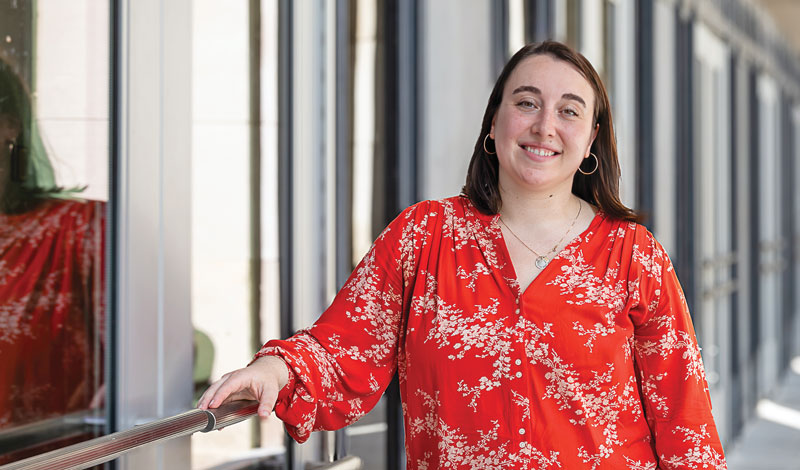
Living Buddhism: Thank you for talking with us today, Madison. Growing up, both your parents practiced Nichiren Buddhism, but you did not take it up until the end of college. What happened to prompt you to begin practicing in earnest?
Madison Roesler: That’s right. Not until the very end of college did I give Buddhism an honest try. And when I say the very end of college, I mean the very end. I mean that I had literally walked with the rest of my class in cap and gown, shaken the dean’s hand and received my diploma. Anyone watching would have thought I’d graduated. The difference was in the diploma, which read, quite unnecessarily, in bold and all caps: “THIS IS A FAKE DIPLOMA.” It mirrored the way that I felt exactly—like a fake and a total failure.
You were a voice major at the San Francisco Conservatory of Music. What prevented you from receiving your diploma?
Madison: The reason, from one angle, was simple: I hadn’t completed the final requirement of performing my senior recital. But the reason I could not bring myself to perform was not so simple at all: I was riddled with anxiety and self-loathing. Earlier that year, for no apparent reason, my voice changed suddenly, out of the blue. I had to learn new methods of singing, which meant relearning the basics of voice. Learning such things in my senior year, at such a competitive, prestigious school, brought on waves of anxiety that grew larger by the day. Soon I was gritting my teeth through every rehearsal, excusing myself to an empty bathroom nearby and breaking down in full-blown panic attacks.
In such moments, every self-criticism felt undeniably true: I had no business being here at this college, no business wasting people’s money and time. In such a state, it never occurred to me to chant.
Soon though, it did. What happened?
Madison: Just two weeks after my “fake graduation,” out to lunch with my now-fiancé, I felt one half of my face fall slack and my words become labored and slurred. Confused and afraid, we rushed to the emergency room for treatment for whatever it was. As it turned out, I had a case of Bell’s Palsy, caused by inflammation of the facial nerve. Thankfully, it’s a temporary condition, but also, a rather mysterious one. They could not tell me, for instance, when I’d regain control of my face or whether it might happen again. Fear and doubt raced through my head as I picked up the phone to call my mother. As usual, she listened first—a lot—before taking a deep breath with me. Then, she said, “Madison, right now, I’d just encourage you to chant.”
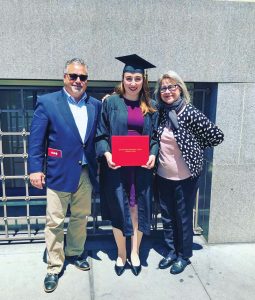
You had the Gohonzon.
Madison: In an altar in my room since freshman year. Only now, though, did I sit down to chant in earnest, laboring slowly over every syllable: Nam-myoho-renge-kyo. Maybe because I was chanting so painstakingly slow, I found myself reflecting on the literal meaning of the phrase. In particular, I thought about Myoho-renge—“the Mystic Law of Cause and Effect.” And from somewhere in the back of my mind, a passage came to me from The Writings of Nichiren Daishonin.
If you want to understand the causes that existed in the past, look at the results as they are manifested in the present. And if you want to understand what results will be manifested in the future, look at the causes that exist in the present. (“The Opening of the Eyes,” WND-1, 279)
I reflected on my causes over the past several years. I realized that on the surface level, I worked hard and stayed consistent. But on a deeper level, the causes I made were terrible—I’d been disparaging myself savagely the entire time. I began to feel increasingly sure that this illness had not struck me from out of the blue. I began to hear in it a message I could no longer ignore: The toxic relationship I had with myself was literally making me sick. If I did not transform this relationship now, my body would shut down in ways I could not even predict.
It took me six weeks to regain full control of my face, time I spent in deep reflection. Reaching out to the local young women’s leaders, I invited them over to talk and chant. As we did, I began to feel curious about the Buddhist perspective on music and began reading what Ikeda Sensei had to say on the subject.
He writes, “Great music and art transcend national and ethnic barriers, resonating in people’s hearts and bringing them together” (The New Human Revolution, vol. 30, p. 695).
When the paralysis subsided, I performed my senior recital to receive my real diploma. Then I went on to pursue a master’s from the same university, in the same discipline—voice. But I was not the same student. I’d made a determination in front of the Gohonzon to learn to believe in myself so I could impart hope to others. It was the first time I’d laid claim to my karma, deciding to use it to reveal my mission.
You took full responsibility for transforming the situation. Where did that determination come from?
Madison: I was becoming more aware of my responsibility to create joy, not only in my life but in the lives of others. One thing I’d spoken about with my young women’s leaders was the idea of taking part in the SGI-USA’s Sustaining Contributions program. They both had tremendous conviction, having experienced transformative effects in their own lives from offering financial contributions to the Soka community. I trusted and admired them, so when they encouraged me to take part as well, I thought, OK, I’ll try.
There’s tremendous pride in knowing that I’m supporting a grassroots movement for peace, helping make possible encounters with Buddhism. I think of my friends who’ve gone to the Florida Nature and Culture Center (FNCC) and come home with a completely renewed determination, or people who encounter Nichiren Buddhism and eventually receive the Gohonzon. To be able to say, I’m helping make that possible—that means so much to me.
Looking back over these years, I see that the spirit of challenge—to contribute more year over year—has infused every area of my life, moving me forward in ways I never could have imagined.
Beautiful. In terms of your singing—did you ever find joy in it again?
Madison: I did, but in a way I did not expect.
In May 2021, I performed my master’s for the smallest audience imaginable—just my parents, my boyfriend and my teacher. Now, a four-person turnout may sound disappointing, but under the circumstances, it was perfect for me. This rehearsal came at the height of the pandemic, when school regulations limited indoor crowds. This relieved me of the expectation of a large audience and so relieved me of all fear of judgment. Performing in such an intimate setting, for the people who’d witnessed my struggle, was profoundly liberating. Not only did I find that I was singing quite well, I was actually having some fun. In the days that followed, I reflected on this and realized how healing this was—simply to have a relaxing space to perform where I didn’t feel judged. Chanting about this, I realized what I wanted to do as a career: collaborate with students and teachers to create more spaces like this.
Is that why you pursued a career in musical administration?
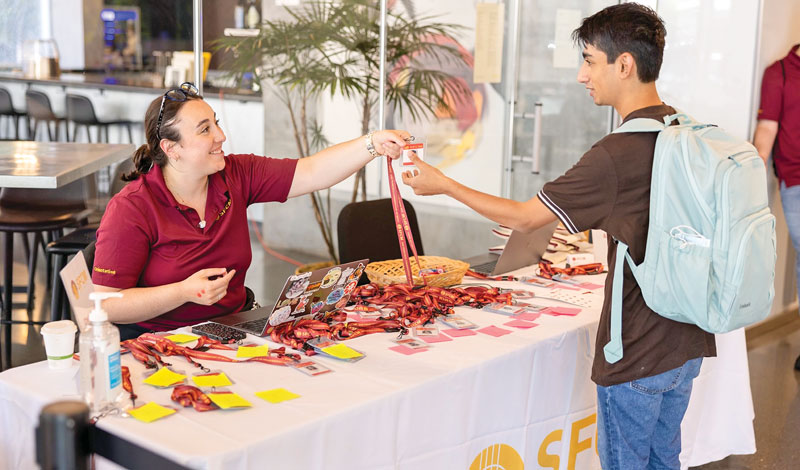
Madison: Yes, and I began my career at my alma mater, landing a job at the San Francisco Conservatory of Music (SFCM) soon after receiving my master’s. For five years, I continued at that incredible school. Honestly, were it not for the call I got from my father last winter, I’d have likely kept working there.
What happened?
Madison: He’d been given two to five years to live—the doctors had diagnosed him with Stage 3 cancer. It was the same cancer my uncle had died from, so it felt like history was repeating itself. I had so many immediate feelings, but fear was at the top of the list. Fear that my father might pass away and also that he’d pass before we’d transformed our relationship.
Yours was a tumultuous one.
Madison: Yes, though it had improved tremendously over the course of my Buddhist practice. At one time, I’d considered him the source of my problems and was prepared to cut him out of my life. Over the years, I saw that blaming him wouldn’t ever make me happy. Still, there was tons of work to do—I felt that acutely last winter, the moment he told me the news. For the past 10 years, I’d lived 2,000 miles away, away from our hometown of Grand Rapids, Michigan. It was one thing to skip town whenever I felt rubbed the wrong way, and quite another to decidedly transform the relationship.
So you put in your notice to move home?
Madison: The decision was a whole experience in and of itself. It did not happen overnight. A turning point came at a conference at the FNCC, which I attended with my dad last December. It came when we said our goodbyes at the airport before heading home. I realized that the next time I’d see him, he’d be doing chemotherapy. Suddenly I was gripped by the fear that I could lose him to this cancer. After he left, for the first time in years, I had a panic attack, waiting for my plane to take off.
As the plane climbed higher, I thought about my life—about my last 10 years in California. I’d built a whole life and career 2,000 miles from home and, in that moment, I realized why. I’d been running from the memory of my childhood in Michigan and from my family, especially my dad.
I had a humbling thought as we broke through the clouds: I did not believe I could be happy in Michigan. It came as a shock, after practicing Buddhism as long as I had, that yes, a big part of me believed that. This, of course, is not Buddhism.
I was terrified, sure, of losing my dad, but was I willing to do the work required to truly love him while he was still here? These thoughts came to me one after another.
At the conference, we’d studied the Buddhist principle of “voluntarily assuming the appropriate karma,” which offers a revolutionary perspective on hardship. Instead of some quirk of unfortunate destiny, Buddhism says that our circumstances are the very ones that can help us fulfill our missions. Reflecting on this, I stopped asking, Why is this happening? And I began asking, What if this is the mission I chose?
What did you choose?
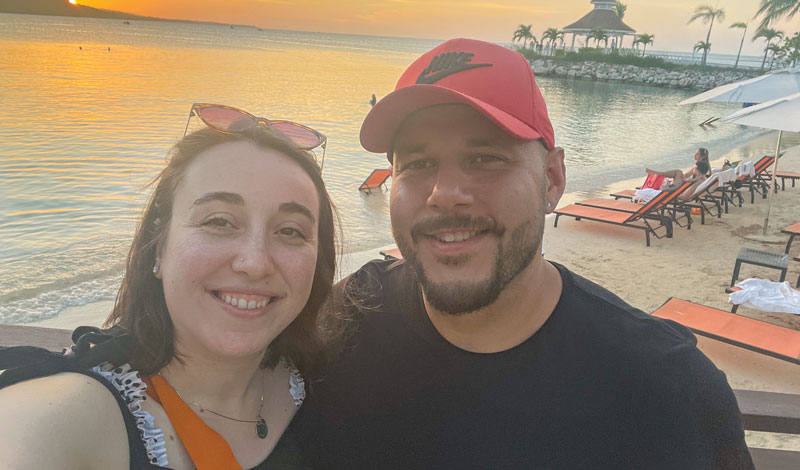
Madison: Ultimately, to move back to Michigan—one of the hardest decisions of my life. But there I was, in the summer of 2025, driving cross-country with my fiancé and our three cats. The main thing was, I didn’t want any regrets. Whatever happened to my father, I wanted to know that I’d challenged myself to transform the relationship. In June, we arrived in Michigan, where everything immediately became difficult.
How so?
Madison: My dad was coming out of treatment, heavily medicated, in tremendous pain. There were arguments, family tension and friction between my fiancé and me. We kept asking each other, “Did we do the right thing?”
It’s not that I’d hoped to be singing “Kumbaya,” but nor had I imagined just how difficult things would be. Plus, I’d soon be out of work—SFCM was allowing me to work remotely to organize that year’s student orientation, but after that ended in September, I’d need to find local work.
Chanting abundantly, I poured my heart into these preparations and returned to San Francisco in September to execute the enormous two-week event that is student orientation.
How did it feel returning one last time?
Madison: It was a tremendous source of closure.
Students and teachers I’d supported over the years told me how much of a difference I’d made. At the farewell celebration, I could actually see the bonds I had created and the culture we’d fostered while I was there.
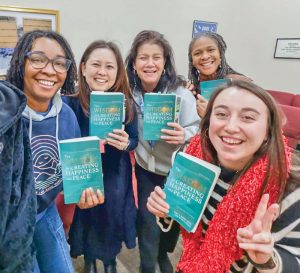
Yet this came on the heels of a painful experience.
Madison: Yes. Earlier that year, I had a miscarriage.
The grief was and is difficult to explain—I’d told almost no one about the pregnancy, lost early in the second month. I was mourning a future few were even aware was possible, and suddenly that future was gone.
For months, I struggled with why it had happened, until I shared openly at a women’s conference at the FNCC. After, women approached me, sharing their own experiences with infertility, miscarriage and losing hope for creating families.
I realized that even this experience could become part of my mission. I knew what it was to grieve the future of a child, and if transforming that grief allowed me to encourage even one other woman to rebuild hope, then my suffering clearly had meaning. As I chanted for the little life I had lost, a new hope emerged from my life. I realized how much I wanted a child and how much it would mean for that child to have an amazing relationship with my dad.
How is your father doing today?
Madison: Incredibly, he’s in remission, a tremendous benefit for our family. Not everything between us has been magically resolved, but it’s improving, and what’s more, we have time.
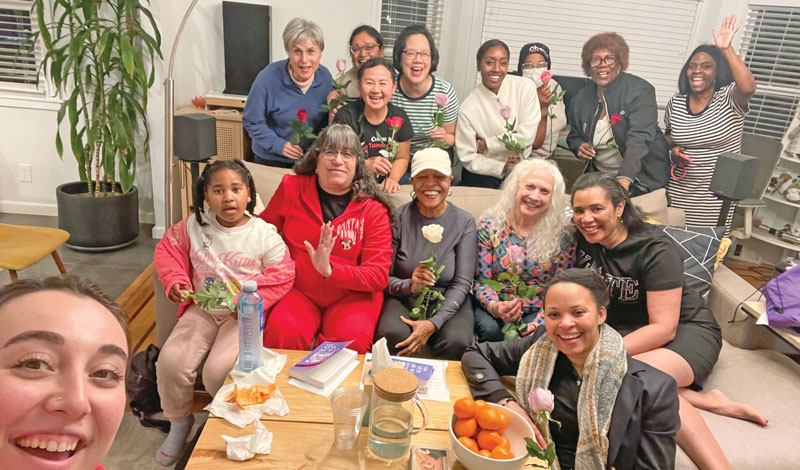
What else?
Madison: I started my new job with the Grand Rapids Symphony in May, and I was just appointed women’s leader for Great Lakes Chapter, which I’m determined will be the happiest chapter in the country. And also, I’m pregnant again—four months along by the time you’re reading this. I’m determined that we’ll make wonderful memories here, that my baby will grow up knowing their mission isn’t somewhere far off, but that it’s wherever they happen to be. And I’ll be their proof, with my feet planted here, shining as the sun for my family and community.
You are reading {{ meterCount }} of {{ meterMax }} free premium articles