
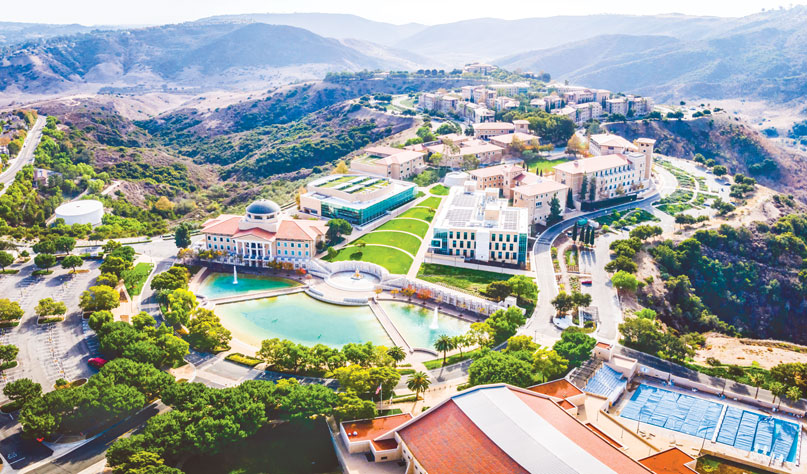
In Ikeda Sensei’s lecture titled “Thoughts on Education for Global Citizenship,” delivered in June 1996, he identified three essential qualities required of a global citizen: wisdom, courage and compassion. One educational institution that embodies this philosophy is Soka University of America (SUA). But how has the vision of the school’s founder, Daisaku Ikeda, been articulated and developed over time? This interview was published in the January 12, 2026, issue of the Seikyo Shimbun, the Soka Gakkai’s daily newspaper.
This year marks the 25th anniversary of SUA’s founding. The founder, Daisaku Ikeda, described SUA as “an international university that has begun a great challenge toward the fostering of true global citizens.” He also set forth the guiding vision of “establishing a firm current of global citizens who lead contributive lives.” How do you understand the reasons why the founder chose the United States as one of the key bases for educating global citizens?
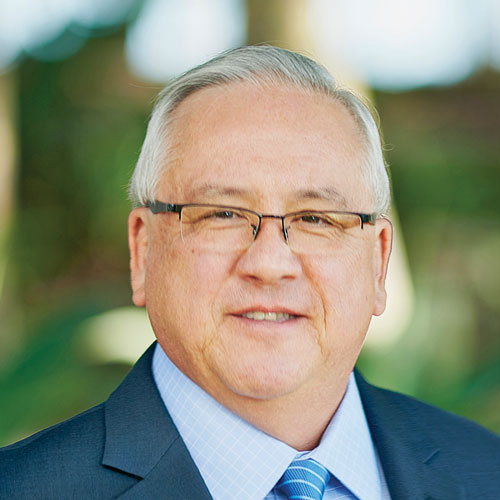
Ed Feasel: I would organize my thoughts into three points.
First is the founder’s profound spirit of gratitude. In his message for the opening ceremony of SUA (May 3, 2001), he wrote as follows: “That postwar Japanese society was able to regain ‘democracy’ and ‘freedom of religion’ was due entirely to the United States. I wish, in some way, to repay this great debt of gratitude.”
The conception of SUA was one crystallization of this sincere sentiment held by the founder.
Second is the geopolitical potential of the Los Angeles region. In his long poem “The Sun of Jiyu Over a New Land” (1993), the founder wrote:
Los Angeles is a bridge
linking East and West,
a land of merging and fusion
where cultures of the Pacific
encounter traditions of the West.
He continued:
Once, the Mediterranean
was inland sea and mother to the
civilizations of the surrounding regions—
Europe, the Middle East and Africa.
In like manner, the Pacific’s depths
must not divide—
but be the cradle of a new civilization,
an enormous “inland sea” connecting
the Americas North and South,
the continents of Asia and Australia.
This is my firm conviction—
California will be the energy source
for the Pacific region
in the twenty-first century
and Los Angeles its eastern capital.
In fact, around the time this poem was written, the founder’s vision took concrete form with one step after another: the establishment of the Soka University Los Angeles campus (1987), the founding of the Pacific Basin Research Center (1991), the creation of SUA’s graduate programs (1994) and the decision on the site for SUA’s campus (1995), culminating in the university’s opening in 2001.
Third is that the United States is an optimal place for advancing liberal arts education.
The founder himself was exposed to a wide range of disciplines at what he described as the “Toda University,” where he received comprehensive instruction from his mentor. This experience corresponds precisely to what we now call a liberal arts education. While the origins of modern liberal arts education lie in ancient Greece, in the United States, an increasing number of private universities since the 17th century have placed it at the core of their educational philosophy.
Although European universities later advanced toward greater specialization, liberal arts education flourished and continued to develop in American higher education. Building on the founder’s vision, SUA has expanded partnerships with other institutions, including establishing the Pacific Alliance of Liberal Arts Colleges, thereby broadening its intellectual network.
In his lecture at Teachers College, Columbia University, the founder emphasized “wisdom, courage and compassion” as the essential qualities of a global citizen. What kind of ethos or traditions has SUA cherished to help each student cultivate these qualities?
Feasel: This question touches on the very core of SUA’s educational philosophy.
The “global citizenship education” proposed by the founder, I believe, is grounded in a universal and open philosophy clearly distinguished from any religious doctrine. At SUA, where students from diverse backgrounds come together, a culture of dialogue rooted in the principle of the dignity of life has taken firm hold.
From the university’s earliest days, students gathered spontaneously to study the founder’s lectures and messages. Faculty and staff joined them, and this evolved into a campus-wide culture of learning. On the occasion of SUA’s 20th anniversary, students themselves took the initiative to publish Dear Global Citizens, a book compiling the founder’s messages. I regard this volume as a “textbook for global citizenship education” at SUA.
A particularly emblematic example is SUA’s unique educational program known as the “Learning Cluster.” In this program, students and faculty collaboratively engage in research on global issues. Rather than remaining confined to desk-based study and discussion, students gain hands-on experience while cultivating the qualities of wisdom, courage and compassion.
In the final message he sent to SUA welcoming the undergraduate class of 2027 and 10th class of the master’s program, the founder referred once again to his Teachers College lecture and taught us the following: “Courage leads to compassion in that it compels us to tend to the woes of other people. And from such compassion wells forth the wisdom to create constructive value.”
This interconnection—courage as compassion, compassion as wisdom—lies at the heart of SUA’s education.
Regarding the significance of “value creation,” the founder also taught, in the first half of that same lecture, that it is “the power to find meaning in any circumstances, to strengthen oneself, and to contribute to the happiness of others.”
The wisdom of value creation embodied by a single individual who seeks the happiness of both self and others leads the three qualities to reinforce one another in a virtuous cycle, becoming a driving force for addressing global challenges.
The founder repeatedly emphasized the importance of “nurturing hope” as one of the missions of education. In an age when numerous challenges threaten humanity’s future and sustaining hope has become increasingly difficult, how do SUA students cultivate hope and aspirations for social contribution amid a world marked by anxiety and division?
Feasel: Education at SUA does not stop at “understanding problems”; it continuously asks, “How can we create value?” This repeated inquiry itself becomes a source of hope. In the courses I mentioned earlier, as well as through a wide range of student organizations, students actively engage with local communities and society, seeking pathways toward solutions.
In 2022, SUA established the Soka Institute for Global Solutions (SIGS). In his 1987 peace proposal, marking the opening of Soka University’s Los Angeles Campus, the founder proposed the creation of “a research institution that would bring together the world’s wisdom to address global problems through scientific and comprehensive approaches.” He further wrote that this institution would be “not merely an affiliated research body of Soka University,” but one that would “form networks with research institutes and universities around the world, as well as United Nations research bodies, and play a role in generating strategies for the stabilization and peace of the Earth in the twenty-first century.”
At SIGS, which embodies this vision, research and symposia have been conducted in collaboration with scholars and institutions across fields such as global citizenship education, nuclear abolition, the environment, development, peace and human rights. In the area of nuclear abolition, SIGS inherits the spirit of the Declaration Calling for the Abolition of Nuclear Weapons by second Soka Gakkai President Josei Toda, and has invited representatives of the International Campaign Against Nuclear Weapons along with renowned researchers from Japan and abroad to engage in vigorous dialogue and exchange.
What deserves particular mention is the active involvement of many alumni in SIGS initiatives. This July, SIGS hosted a Global Citizenship Education Symposium. Approximately 80 educators and specialists from early childhood through secondary education, representing 11 countries, participated—and many of them were SUA graduates. Through lectures and workshops, participants actively shared practical approaches to global citizenship education. Keynote addresses were delivered by Monte Joffee, co-founder of the Renaissance Charter School; Melissa Bradford, Senior Lecturer at the College of Education, DePaul University; and Professor Fernando Reimers of the Harvard Graduate School of Education.
SUA alumni continue to thrive as leaders who embody “contributive lives” across diverse fields, while generously supporting and mentoring the next generation. This steady, ever-expanding current of global citizens is a central mission of SUA and represents a sure path toward broadening solidarity for peace and coexistence.
You are reading {{ meterCount }} of {{ meterMax }} free premium articles