
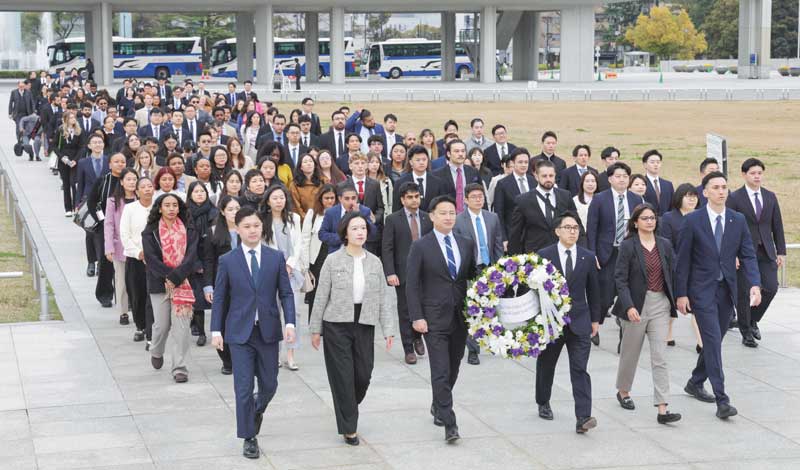
Near the heart of the Hiroshima Memorial Peace Park, a saddle-shaped monument watches over a cenotaph—an empty tomb, as it were, that holds the names of every life lost to the atomic bombing of the city on Aug. 6, 1945, and which carries the epitaph: “Let all the souls here rest in peace; For we shall not repeat the evil.”[1]
Such was the prayer and determination of the some 120 SGI-USA youth leaders, who, together with representative youth leaders from Japan, laid a wreath there on March 22, 2026, and pledged to inherit the vow for peace.
The visit was part of a larger training course, held March 18–23, 2026, specifically for the U.S. youth, and which included a brief visit to Tokyo, where they attended a gongyo ceremony at the Hall of the Great Vow for Kosen-rufu. They then flew south to the Chugoku Region, the westernmost region of Japan’s main island, to attend local exchange meetings in five prefectures that the members there had been planning since September.
The apex of their training course came in Hiroshima, where, after laying the wreath at the memorial, they toured the Hiroshima Peace Memorial Museum, which displays belongings left by the victims of the atomic bombing to underscore the cruelty and depravity that war visits upon ordinary people. Among the items on display are the personal effects of victims, such as watches and eyeglasses, which were the only ways that some could be identified by family members.
The participants shared afterward how profoundly the memorial had affected them, describing a mixture of emotions from sadness to rage to grief at the disregard for human life.
The youth then heard directly from atomic bomb survivor Keiko Ogura, who was 8 years old when the bomb dropped on her city, and who survived only because her father told her to stay home from school that day. All her classmates were killed. At 88, she continues to speak out about the effects of nuclear weapons.
When asked how she would address the leaders of the countries who possess these weapons, she said: “I would tell them nuclear weapons are quite different from conventional weapons. Nuclear weapons kill the future.”
Kenichi Hackman, the SGI-USA young men’s leader, was deeply struck by her words. Reflecting on the mission of the SGI and its commitment to peace, he said, “We are a collective group that loves the future, treasures the future and builds the future, based on Sensei’s example. This is why we shakubuku youth, why we empower the youth to take the lead and give them platforms to share their ideas.”
While in Hiroshima, the youth stayed at the same hotel as the leaders of the G7 nations when they held a summit in 2023 to discuss challenges
to peace. The hotel also overlooks the harbor where Sensei’s eldest brother left for war in Burma (now Myanmar) and never returned.
Before the training course, the youth met weekly to study from a more than 400-page packet of Sensei’s guidance from The New Human Revolution on various topics, including his visit to Hiroshima, the founding of the SGI and the vow for kosen-rufu.
They read about Sensei’s efforts leading up to his visit to Hiroshima in November 1975 to shape the coming century toward peace, including his travels to China, the former Soviet Union and the U.S. to meet with world leaders and build bridges of understanding.
This included his trip to New York in January 1975, where he met with the United Nations Secretary-General at the U.N. Headquarters and presented 10 million signatures collected by the Soka Gakkai youth calling for an end to war and the eradication of all nuclear weapons.
It was only after laying this groundwork that Sensei visited Guam—the site of intense fighting during the Pacific War—to attend the First World Peace Conference, during which the Soka Gakkai International was founded and he was named its president.
Later the same year, in November, Sensei laid a wreath at the memorial cenotaph to condemn the evils of war, making Hiroshima his prime point for peace.
The youth leaders went to Japan seeking guidance on how to accomplish “One Youth. Infinite Hope.”—the youth-led campaign to introduce 10,000 young people to Buddhism by Jan. 2, 2028, the 100th birthday of Ikeda Sensei, as the means to empower the next generation and elevate the life state of our country.
For Sasha Ndam, of Boston, the training course reawakened a vow she had made during high school to become someone who can “thaw frozen hearts.”
“I have already begun refreshing my heart about shakubuku,” she said, “that no matter how long it takes, by being patient, steady and focused on the person in front of me, I will transform others’ hearts.”
April 10, 2026 World Tribune, pp. 6–7
References
- The New Human Revolution, vol. 22, p. 311. ↩︎
You are reading {{ meterCount }} of {{ meterMax }} free premium articles