
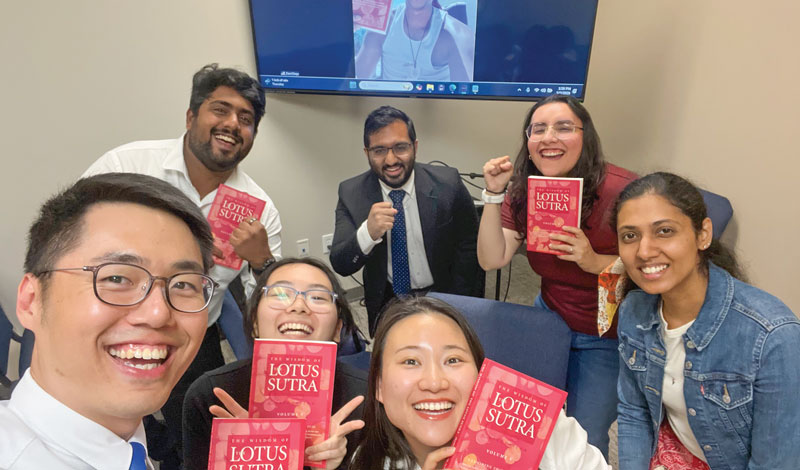
Ikeda Wisdom Academy members:
• are group through national youth leaders and all student division members.
• should have their own copy of The Wisdom of the Lotus Sutra, vol. 5.
• are encouraged to read the assigned material before each meeting.
August Syllabus: The Wisdom of the Lotus Sutra, vol. 5, pp. 175–206
Part Five: “Supernatural Powers of the Thus Come One” Chapter
7: “Ordinary People Are the True Buddha”
Supplementary Material:
• The Lotus Sutra and Its Opening and Closing Sutras, pp. 314–18
• The Record of the Orally Transmitted Teachings, pp. 166–70
Chapter Overview
Ordinary People Are the True Buddha
This month, we’re studying a core message of the Lotus Sutra’s “Supernatural Powers of the Thus Come One” chapter and of the entire sutra: Ordinary people have the potential to become genuine Buddhas, just as they are.
Ikeda Sensei discusses how ordinary people are too often exploited by those in positions of power—people who see themselves as superior to those they serve. Yet, without patients, doctors could not fulfill their role; without people in need, lawyers or politicians would have no work; and without believers, clergy would have no purpose.
In the same vein, Buddhahood is not distant or reserved for special individuals—it exists within everyday people. Shakyamuni Buddha and Nichiren Daishonin taught a revolutionary, deeply human-centered view of religion: gods, Buddhas and religion itself exist to serve the people, not the other way around. Sensei says:
Anonymous and poor “ordinary people” are themselves most noble and respectworthy. Ordinary people who strive for kosen-rufu are themselves Buddhas. This is the secret of the Thus Come One. It was to teach this that the Thus Come One—the Buddha—appeared. (WLS-5, 184)
Bodhisattva Superior Practices, the leader of the Bodhisattvas of the Earth, represents ordinary people who take on the mission of seeking their own enlightenment while helping others reveal their Buddha nature. He symbolizes a key shift—from focusing on the “effect,” or result, of Buddhahood to valuing the “cause,” the ongoing effort to bring forth our Buddhahood in daily life.
In the “Supernatural Powers” chapter, Shakyamuni entrusts Superior Practices and the Bodhisattvas of the Earth with spreading the Mystic Law in the Latter Day. This transmission shows the Buddha’s conviction in the power of ordinary people to overcome challenges and fulfill their mission.
At its heart, Buddhism isn’t about becoming someone else or achieving perfection. It’s about growing, encouraging others and living with purpose each day. By believing in ourselves and taking action for others, we can reveal our Buddha nature.
Sensei also discusses in this chapter how the Mahayana sutras were compiled. Some argue that these teachings are not directly from Shakyamuni, since they were compiled some 500 years after his passing.
However, they were shaped by disciples who were earnestly seeking the Buddha’s true intent. They asked profound questions like: What made the Buddha a Buddha? What was the cause of his enlightenment? Can ordinary people attain that same state?
Their efforts reflect a deep desire not just to accept teachings but to actively seek, question and realize the truth for themselves.
Early Buddhism emphasized monastic discipline and practice, sometimes losing sight of the Buddha’s wish for everyone to reveal their enlightenment. Later, Mahayana teachings explored the idea of eternal, otherworldly Buddhas, but these could seem far removed from everyday human experience.
The Lotus Sutra brings these together, revealing that the Buddha is both eternal yet deeply human and accessible to all. Sensei says, “It could be said that this constitutes returning to the essential point of Shakyamuni the human being” (WLS-5, 204).
Most importantly, the Lotus Sutra is an expression of the disciples’ heartfelt effort to understand the Buddha and to share that understanding with others, awakening all people to their inherent dignity.
—Prepared by the SGI-USA Study Department
Ikeda Sensei’s Guidance
Striving for Happiness Just as We Are While Helping Others
Since religion is the very foundation of society, a revolution in the realm of religion will rectify all of society’s ills on a fundamental level.
In any event, whatever our station in life, we need to be aware that arrogance strips us of our humanity. The more we think ourselves better than others, the less humanistic we become, and the lower our life condition falls. …
Those who think themselves above others do not toil selflessly. To avoid personal harm, they shrewdly get others to do the hard work, while taking all the credit themselves. This is cowardice, and it is despicable.
The fundamental teaching of the Lotus Sutra and of the Buddhism of Nichiren Daishonin is that ordinary people—just as they are—should live, assert themselves and strive wholeheartedly for happiness while fully expressing their humanity. To do so is to throw oneself completely into the struggle, to stand up against adversity. This is what it means to practice without begrudging one’s life. Apart from this, there is no “living Lotus Sutra.”
The social elite has not advanced the movement for kosen-rufu. The path has been opened up by the fully engaged efforts of ordinary people. Herein lies the true practice of the “Supernatural Powers” chapter. (WLS-5, 177–78)
Digging Deep
August Study Guide
Please use these questions to guide your study of The Wisdom of the Lotus Sutra, vol. 5, pp. 175–206.
1) Why were Nichiren Daishonin and Shakyamuni Buddha “revolutionaries of the most radical and fundamental kind” (WLS-5, 177)? How does such a revolution in the realm of religion “rectify all of society’s ills on a fundamental level” (WLS-5, 177)? And how does this inform our efforts for kosen-rufu? (WLS-5, 175–78)
2) What are the three different levels of understanding the Lotus Sutra? Which is most important and why? (WLS-5, 187)
3) Ikeda Sensei says: “A Buddha who does not expound the Lotus Sutra is not a Buddha” (WLS-5, 194) and “The Lotus Sutra is not great because it was expounded by Shakyamuni; rather, Shakyamuni is the Buddha because he expounded the Lotus Sutra. No matter who the person is, one who expounds the Lotus Sutra is a Buddha” (WLS-5, 200). Can you explain the principle that the great life of the eternal Buddha manifests itself in ordinary human beings? (WLS-5, 194–96)
Looking Forward: September Syllabus
The Wisdom of the Lotus Sutra, vol. 5, pp. 207–33
Part Five: “Supernatural Powers of the Thus Come One” Chapter
8: “ ‘Buddhism for the People’—The Implicit Teaching”
You are reading {{ meterCount }} of {{ meterMax }} free premium articles