
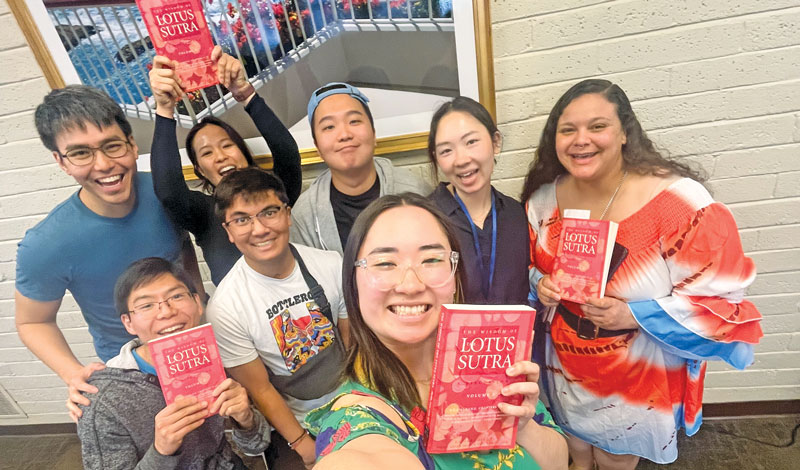
Ikeda Wisdom Academy members:
• are group through national youth leaders and all student division members.
• should have their own copy of The Wisdom of the Lotus Sutra, vol. 5.
• are encouraged to read the assigned material before each meeting.
September Syllabus:
The Wisdom of the Lotus Sutra, vol. 5, pp. 207–33
Part Five: “Supernatural Powers of the Thus Come One” Chapter
8: “Buddhism for the People”—The Implicit Teaching
Supplementary Material:
• The Lotus Sutra and Its Opening and Closing Sutras, p. 318
• The Writings of Nichiren Daishonin, vol. 1, p. 606
• The Record of the Orally Transmitted Teachings, p. 146; pp. 166–70
Chapter Overview
Understanding the Lotus Sutra’s Implicit Teaching
This month, we conclude our study of the Lotus Sutra’s 21st chapter, “The Supernatural Powers of the Thus Come One,” as covered in The Wisdom of the Lotus Sutra, volume 5. In this section, Ikeda Sensei focuses on the sutra’s true intent—its “implicit” teaching. In the context of the sutra, “implicit” refers to universal truths that are inferred rather than literally stated.
For instance, while not stated directly, a remarkable feature of the sutra is: the Thus Come One, or Buddha, refers to all living beings.
“This is the point,” Sensei says, “that all living beings are Buddhas, which is nowhere explicitly stated in the text of the ‘Life Span’ chapter” (The Wisdom of the Lotus Sutra, vol. 5, p. 211).
Bringing this truth to life means revealing our Buddhahood through the way we live and contribute to society. Rather than seeing enlightenment as something distant to attain, we begin from the conviction, “I am Buddha,” and act for the happiness of others. This reflects the Buddhism of “from effect to cause,” which contrasts with the common assumption that we must first solve all our own problems before helping others.
We can put this teaching into practice by chanting Nam-myoho-
renge-kyo and taking action to help others by spreading the Mystic Law. Through these efforts, we develop strong character and embody the qualities of a Buddha in our daily life. Sensei says:
How we behave as human beings is really the bottom line. Buddhism ultimately boils down to character. The purpose of Buddhism is to produce people of fine character.
People of excellent character are humble. They are not jealous. They are not self-
absorbed but are concerned with everyone’s happiness. For us, this means caring about kosen-rufu. People who do so are fair and compassionate. And because they have compassion, wisdom wells forth in their lives. (WLS-5, 208)
The sutra’s description of the Buddha’s thirty-two features originally served to inspire people to seek the Buddha and ultimately realize that they themselves are Buddhas.
Today these features might be compared to qualities such as success, social status or financial security. But Sensei affirms:
It’s not a matter of appearance, position or education. The strength of mind in which one is determined to help the suffering become happy and to accomplish kosen-rufu is most respectworthy. This is what it means to be at one with the Law. (WLS-5, 210)
While accomplishments and benefits can help demonstrate the power of Nichiren Buddhist practice, they are not our ultimate goals. The essence of faith is revealing our Buddhahood through compassionate action, wisdom and a life dedicated to the happiness of self and others.
—Prepared by the SGI-USA Study Department
Ikeda Sensei’s Guidance
‘Becoming a Buddha Is Nothing Extraordinary’
[The Mystic Law] is the original seed that has enabled all Buddhas throughout time and space to attain enlightenment. And the Daishonin says that if we embrace this original seed of enlightenment, “Becoming a Buddha is nothing extraordinary” (“Letter to Niike,” WND-1, 1030). This is a statement of no small significance.
When we truly have confidence in these words, we will never become deadlocked in life. We are Buddhas. We cannot possibly fail to be victorious. Buddhas never remain downcast. They are not defeated by hardship or hopelessness.
Whatever happens, it is vital that we muster our courage and continue advancing, reminding ourselves: “That’s right! I have the Mystic Law! There is no difficulty that I can’t overcome!” As long as we possess this fighting spirit, our lives will develop greatly in accord with the principle that earthly desires are enlightenment, in that our desires and sufferings work as fuel for our development.
A seed may be a tiny thing. But a single seed contains all the necessary elements to produce a towering tree more than a hundred feet tall. This is the mystery of the seed. When we plant the original seed of Buddhahood, Nam-myoho-renge-kyo, in our heart and cultivate it, we develop boundless good fortune and wisdom. (WLS-5, 224)
Digging Deep
September Study Guide
Please use these questions to guide your study of The Wisdom of the Lotus Sutra, vol. 5, pp. 207–33.
1) What are two superb features of the Lotus Sutra’s implicit teaching? (WLS-5, 211) What are some of the differences between practicing Buddhism from the perspective of going “from the cause to the effect” versus “from the effect to the cause”? (WLS-5, 211–12)
2) Ikeda Sensei explains that the Buddha’s thirty-two features “were expounded initially to arouse in people a sense of respect and a seeking spirit toward the Buddha. The point is not whether Shakyamuni actually possessed these features. Their purpose is to lead ordinary people to the awareness that they themselves are Buddhas” (WLS-5, 221).
What could be described as “modern equivalents of the thirty-two features”? What are the dangers of seeing these equivalents as the goal of our Buddhist practice?
What can we learn from Devadatta’s example of trying to take on the same thirty-two features as the Buddha? (WLS-5, 221–23)
3) Sensei stresses Nichiren Daishonin’s point that “if we embrace this original seed of enlightenment, ‘Becoming a Buddha is nothing extraordinary’” (“Letter to Niike,” WND-1, 1030) (WLS-5, 224).
What is this “original seed of enlightenment”?
What happens when we truly have confidence in the idea that “Becoming a Buddha is nothing extraordinary”? (WLS-5, 224–25)
Looking Forward: October SYLLABUS
The Wisdom of the Lotus Sutra, vol. 5, pp. 237–62
Part Six: “Entrustment” Chapter
9: “Completing the Ceremony of Transmission”
You are reading {{ meterCount }} of {{ meterMax }} free premium articles