

On Nov. 18, 1930, Tsunesaburo Makiguchi, a forward-thinking educator, and his disciple Josei Toda founded the Soka Kyoiku Gakkai (Value-Creating Education Society). That day, Makiguchi, with Toda’s support, published The System of Value-Creating Pedagogy, outlining his belief that education should enable students to lead happy, fulfilling lives. Makiguchi’s approach to education sharply contrasted with the trajectory of Japanese education at the time.
Initially established to promote educational reform, the organization developed into a movement based on Nichiren Daishonin’s teachings, later becoming the Soka Gakkai (Value Creation Society).
Despite his advanced years, Makiguchi traveled throughout Japan to share Buddhism and hold discussion meetings in people’s homes. During the first two years of World War II, amid increasing police surveillance, he attended more than 240 discussion meetings. From May 1941 until his arrest in July 1943, he personally introduced some 500 people to Nichiren Buddhism.
His determination to encourage each individual knew no bounds. In 1938, at age 67, he spent 10 days in Kagoshima attending discussion meetings and engaging in dialogue. Traveling there from Tokyo took more than 26 hours each way, yet he made the trip several times. Ikeda Sensei describes his spirit:
[Makiguchi’s] efforts to share Buddhism with others never ceased. He would travel to the remotest areas to visit even a single member, offer encouragement and discuss Buddhism with that person’s friends and family. He did this until the military authorities arrested him. Makiguchi struggled right up to the very end, his life a true example of faith equaling action. (The New Human Revolution, vol. 8, revised edition, p. 257)
In July 1943, 21 Soka Gakkai leaders were arrested for refusing to compromise their religious beliefs and opposing the military government’s policies. Only Makiguchi and Toda refused to recant their faith.
Makiguchi endured 500 days of imprisonment and relentless interrogation, remaining steadfast until his death on Nov. 18, 1944—the 14th anniversary of the Soka Gakkai’s founding.
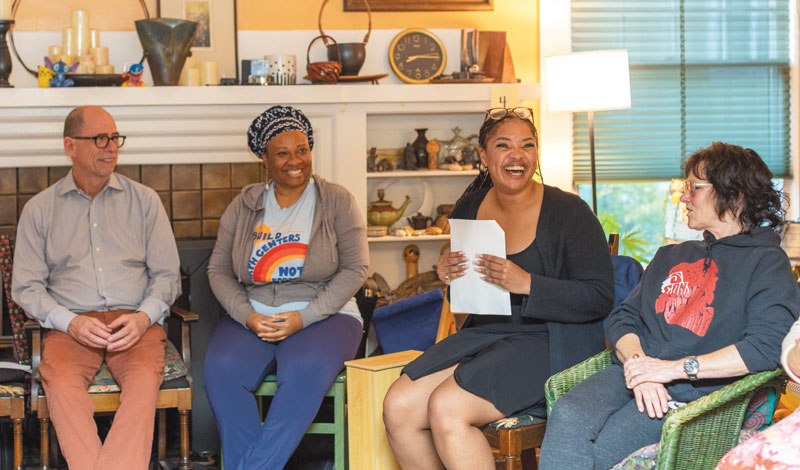
Discussion Meetings Are the Foundation
Released from prison on July 3, 1945, Josei Toda resolved to rebuild the Soka Gakkai into a movement dedicated to peace. He emphasized the importance of discussion meetings, declaring, “One actual discussion meeting is far more effective in turning the wheels of kosen-rufu than a million fine-sounding words of theory” (March 14, 2008, World Tribune, p. 3).
These gatherings became the foundation for fostering friendship, deepening understanding of Buddhism and expanding the kosen-rufu movement. It was at a discussion meeting on Aug. 14, 1947, that 19-year-old Daisaku Ikeda first encountered Toda, who would become his lifelong mentor.
With discussion meetings at its heart, the Soka Gakkai grew to 750,000 households by the end of 1957. Today, such gatherings continue in communities throughout the world.
Valuing Each Individual
What makes discussion meetings a cherished Soka Gakkai tradition is not simply their long history but the spirit underlying them. Sensei explains:
In the Soka Gakkai, when we speak of “the tradition of discussion meetings,” we’re not referring to our history of holding discussion meetings for many years. Rather, we’re talking about the Soka Gakkai tradition of valuing each individual, which is epitomized in our discussion meetings. (The Wisdom for Creating Happiness and Peace, part 3, revised edition, p. 127)
Each November, SGI members celebrate the Soka Gakkai’s founding through discussion meetings, carrying forward Makiguchi’s determination to encourage even one person. Sensei describes these gatherings as “oases where ordinary people gather,” places where suffering becomes courage and people discover renewed hope (The Wisdom for Creating Happiness and Peace, part 3, revised edition, p. 127).
Amid growing anxiety and division in society, our discussion meetings offer opportunities to strengthen friendships, share victories and inspire others. By treasuring each person and expanding our circles of encouragement, we carry forward the founding spirit of Nov. 18 and create ripples of peace throughout our communities and the world.
—Prepared by the World Tribune staff
You are reading {{ meterCount }} of {{ meterMax }} free premium articles