
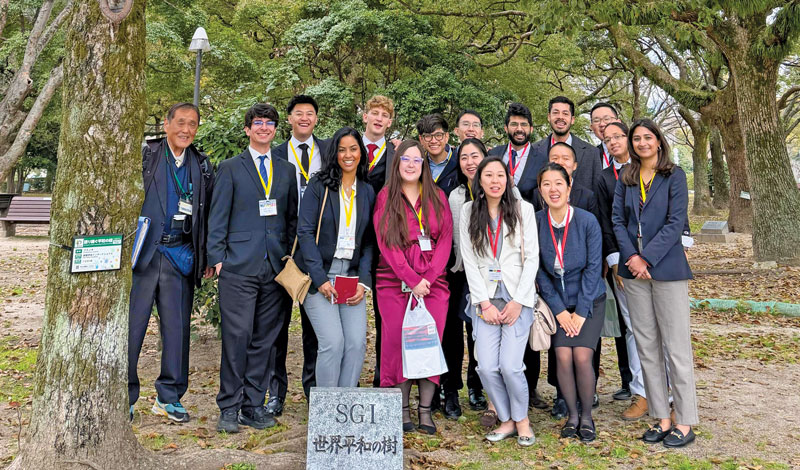
The 120 SGI-USA youth training course participants traveled to several prefectures in Chugoku region, the westernmost area of Honshu, the largest island of Japan. There, they traveled to 15 locations to attend exchange meetings in groups of eight.
In Okayama, the local members shared with the youth their rich history of spreading the humanistic tenets of Nichiren Buddhism with Ikeda Sensei in a war-torn Japan. During the iconic Osaka Campaign,[1] the members of Okayama District—part of the Osaka organization at the time—introduced 999 of the 11,111 households that joined during the single month of May 1956. The campaign itself created an enduring blueprint for making the impossible possible.
A month later, in June, the members held a large rally at the Okayama Castle, where they welcomed second Soka Gakkai President Josei Toda. Even though there were only 3,000 practicing in Okayama at the time, members from surrounding prefectures joined too, drawing a crowd of over 10,000 eager to hear President Toda speak.
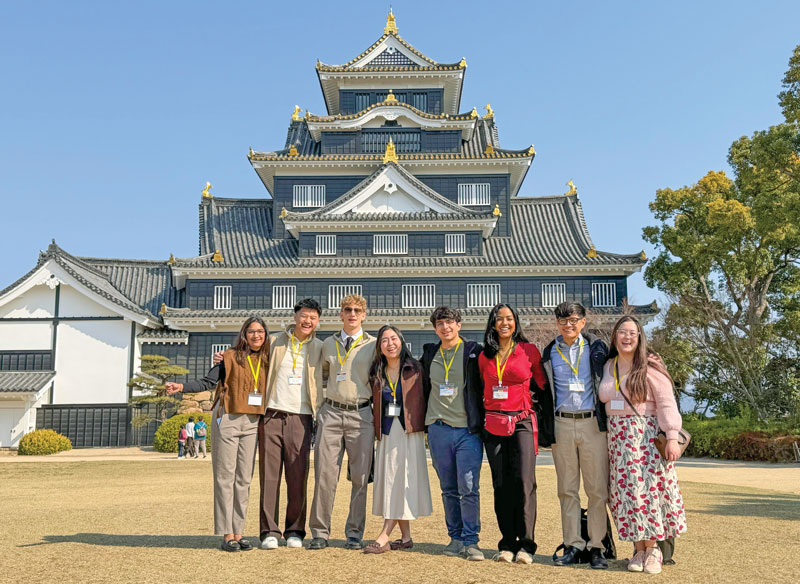
The youth training course participants were invited to walk the same path as President Toda when he visited Okayama Castle, engraving within them the earnest struggle of mentor and disciple for the happiness of all people.
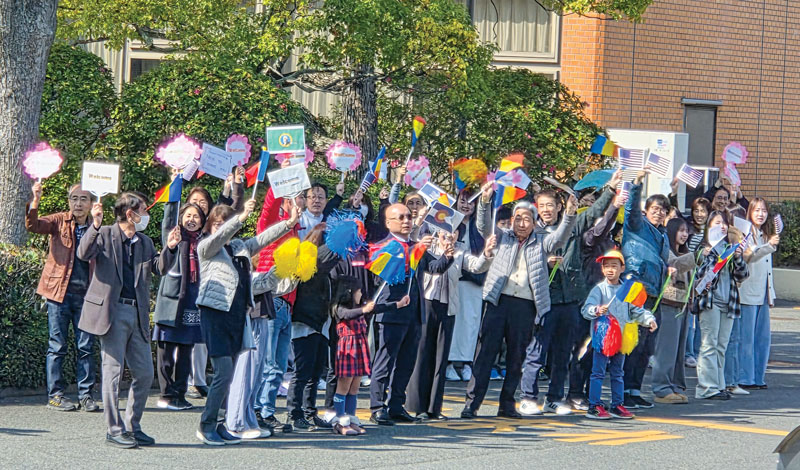
At the Okayama Culture Center, the largest center in Okayama, the youth were greeted by an enthusiastic crowd of 1,000 people. During the meeting held there that day, one family gave their faith experience together. It centered on their young son’s struggle with cancer, and how they all fought together to ensure his victory. Now cancer free and totally healthy, this member’s experience showed how the members of Okayama emphasize the spirit of raising and treasuring successors.

Burning With Energy and Excitement
Joseph Aguilar Leavenworth, Kan.
What struck me the most in the Okayama exchange meeting was the intense enthusiasm, excitement and celebration upon our arrival. They were just as excited to see us as we were to be there. It felt like an embodiment of the Buddha’s injunction to “rise and greet [them] from afar, showing [them] the same respect you would a Buddha” (see The Lotus Sutra and Its Opening and Closing Sutras, p. 365).
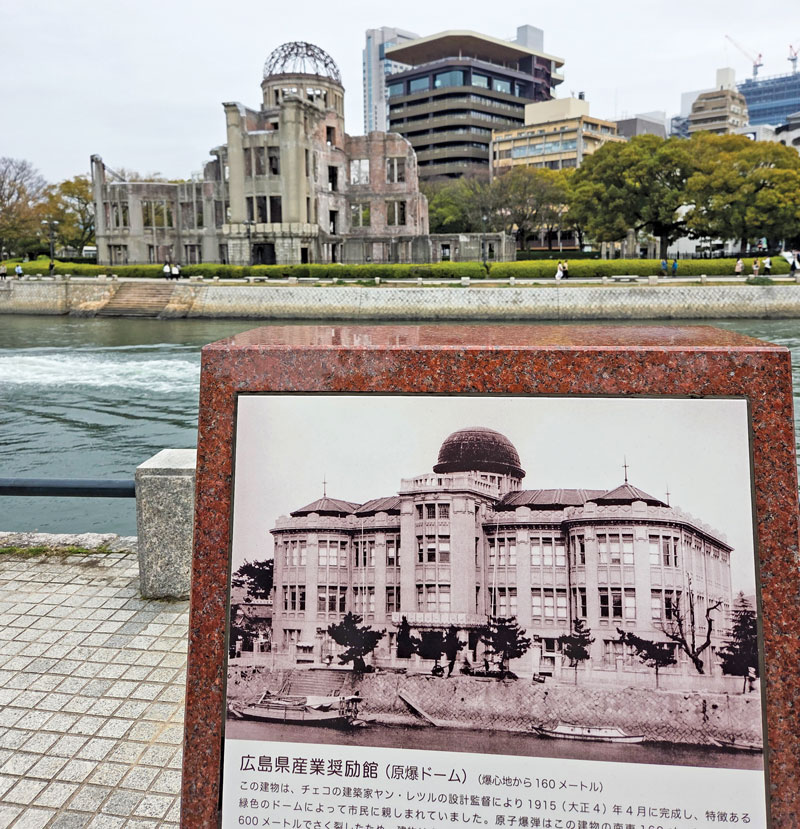
The Hiroshima Peace Memorial Park was where the purpose of our mission for kosen-rufu became clearer to me. The documented effects of the atomic bomb felt like a clarion call to redouble my efforts for dialogue so inhumane events like this will never happen again.
Now, more than ever, I want to greet others not only with warmth but with burning joy and excitement, even if it is just one person. I am determined to unite more deeply with my local SGI community to transform the land so everyone can experience the same energy when they come to our center, helping them awaken to the nobility and fortune of their own lives.

Having an Indomitable Spirit
Mifuyu Hamilton Puyallup, Wash.
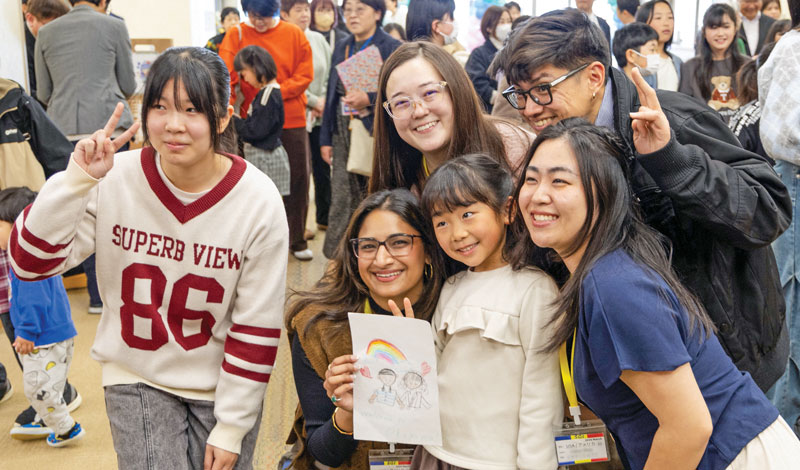
Our visit to the Okayama Culture Center, where we connected with members, interacted with future division members and participated in breakout introduction meetings, helped me envision what my region could look like one day. Hearing how the Okayama members introduced 999 out of 11,111 households during the Osaka Campaign in 1956, I was struck by their strong desire to win with their mentor for the happiness of the people. What stood out most was the feeling evoked: I will take full responsibility for creating a spirit in my region as indomitable as Okayama.
Visiting the Hiroshima Peace Memorial Park and Museum with other training course participants was the most impactful part of the training course. It deepened my vow to fight for kosen-rufu; I now understand the Soka Gakkai’s fight to abolish nuclear weapons more clearly. It was a profound experience that I will carry with me forever.
I have increased my daily daimoku since returning from the training course. I have shared what I learned with my region team, and we have united to progress toward our “One Youth. Infinite Hope” initiative with Ikeda Sensei. Recently, a close friend suddenly expressed interest in Buddhism and has been experiencing the benefit of actual proof since she began chanting. I am determined to help three of my friends receive the Gohonzon this year and take full charge of their lives.
May 15, 2026 World Tribune, pp. 14–15
References
- In May 1956, the Kansai members, uniting around the young Daisaku Ikeda, who had been dispatched by second Soka Gakkai President Josei Toda to support them, introduced 11,111 households to Nichiren Buddhism. In elections held two months later, the Soka Gakkai-backed candidate in Kansai won a seat in the Upper House, an accomplishment that was thought all but impossible at the time. ↩︎
You are reading {{ meterCount }} of {{ meterMax }} free premium articles