
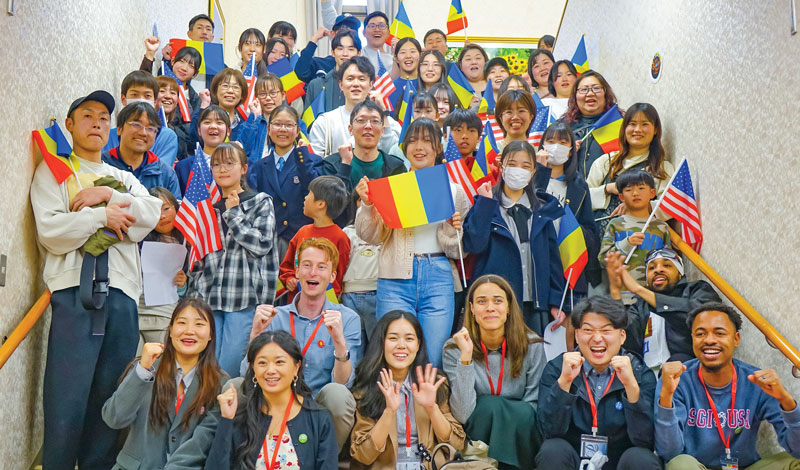
On their way to Kure, a historic naval and industrial city on the southern outskirts of Hiroshima Prefecture, this group stopped at Karugahama Beach, where members were waiting with guitars in hand. They sang a rendition of the enduring “Morigasaki Beach,” replacing the word “Morigasaki” with “Karugahama.”
Ikeda Sensei came to this beach on his first visit to Kure and took photos. He’d remarked at the time about the litter strewn about and how a little care would do much to bring forth the beach’s beauty. After this, the members began to gather regularly for clean-ups, a task that was eventually taken up by the city. Every year, the members commemorate that visit, taking a photograph on the pristine shore.
As the youth boarded their bus and pulled away from the beach, they waved to the members. None noticed their newest passenger—an elderly woman holding a bouquet of lilies close to her chest. As the bus drew to a stop at a nondescript corner, she stood to introduce herself, and with an excited smile, began: “I met Sensei on this corner—this corner right here, as he was departing from Kure.”
She’d been among a group of Kure members who hadn’t made it to the center in time to see Sensei there. Hoping at least to see him depart, they’d waited on this street corner to wave. And indeed, Sensei saw them in passing and somehow knew that they were Soka Gakkai members. When he rolled down his window, she brought the flowers to him, and he’d thanked her and them all, saying, “Let’s meet again!”
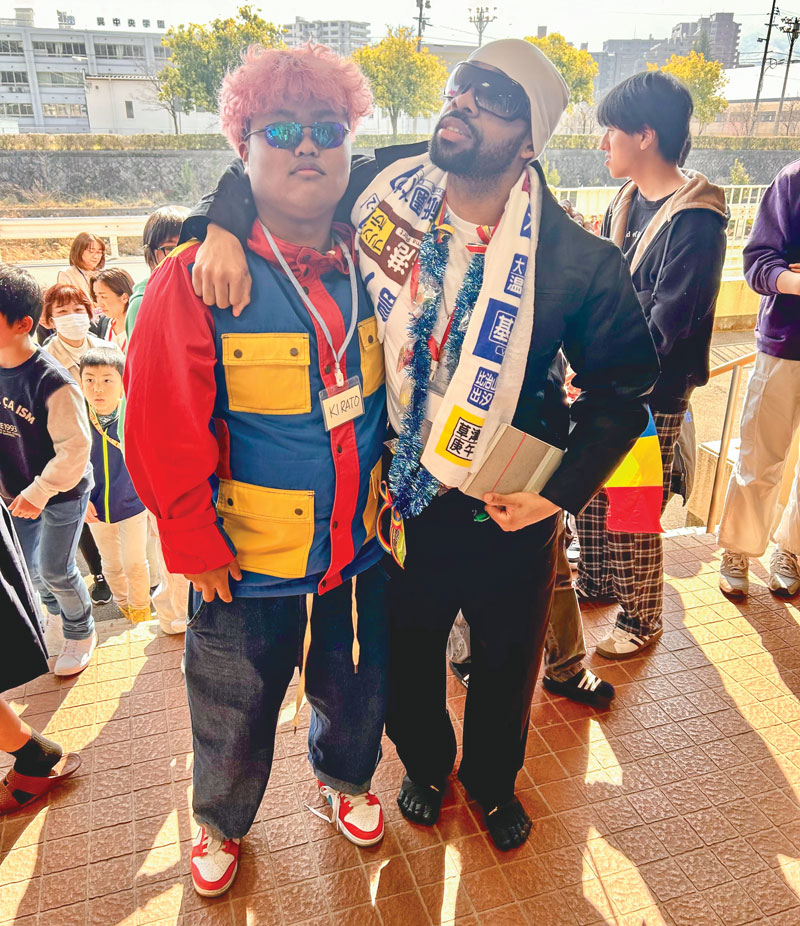
Approaching the steps of the Kure Peace Center, the youth were met by a big huddle of future division members who held signs that welcomed each of them by name. Inside, the youth performed an original rap, calling all disciples to stand and fight as one with their mentor. To everyone’s surprise, a young man from the area leaped up to join them onstage. In his freestyle verse, he pledged to fight with them for worldwide kosen-rufu, with the members of Kure, as disciples of Sensei. Then they held exchange meetings with the members and their friends.
The group then left for the Higashi Hiroshima Culture Center, where they sang “Eternal Journey With Sensei” with the future division members and engaged in warm exchanges.
It’s Our Turn to Carry Hope Forward
Anna Lane New York
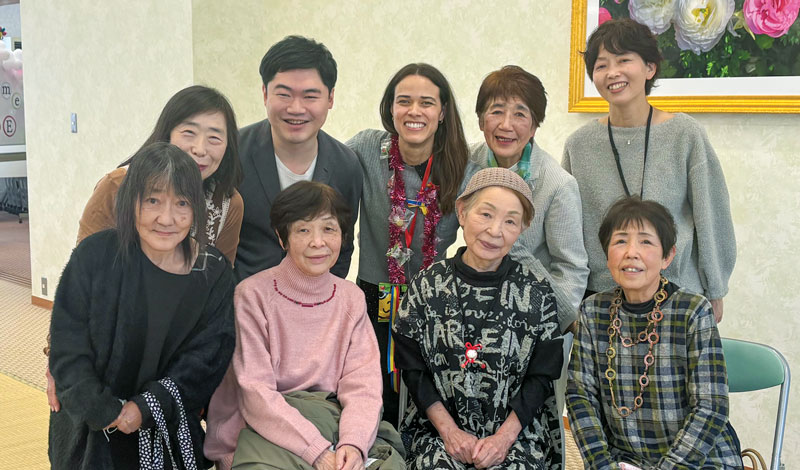
During the exchange meeting, I was encouraged to see that many in my discussion group were Many Treasures Group members, including two who had brought friends. One woman had even brought three co-workers. Seeing their spirit to share Buddhism made me realize that age doesn’t matter; what matters is the determination to fight for others’ happiness. At times, I struggle to bring out that same fighting spirit, but their example stirred something within me to keep advancing, no matter what.
Also, a young man shared openly about his recent divorce. It was the sincere invitation of a women’s division member that led him to attend the meeting. Witnessing their exchange reminded me of the power of one person to courageously reach out to and support another.
Standing at the Hiroshima Memorial Cenotaph, offering prayers alongside fellow youth, I felt the weight of our shared mission. It made me realize that it is now our turn to carry hope forward through dialogue and friendship.
Looking to the future, I am determined to win over my fears, show actual proof with my life and become someone who can truly encourage others.

Art as a Force for Peace
Hunter Ferguson New York
Among my first impressions at the exchange meetings was the warm and heartfelt welcome of the future division members. Their joyful spirit reminded me of the children back home and the importance of supporting them to become people who contribute to society. Engaging with guests was also a challenge due to the language barrier, but it pushed me to think deeply about how to connect heart-to-heart in a short amount of time.
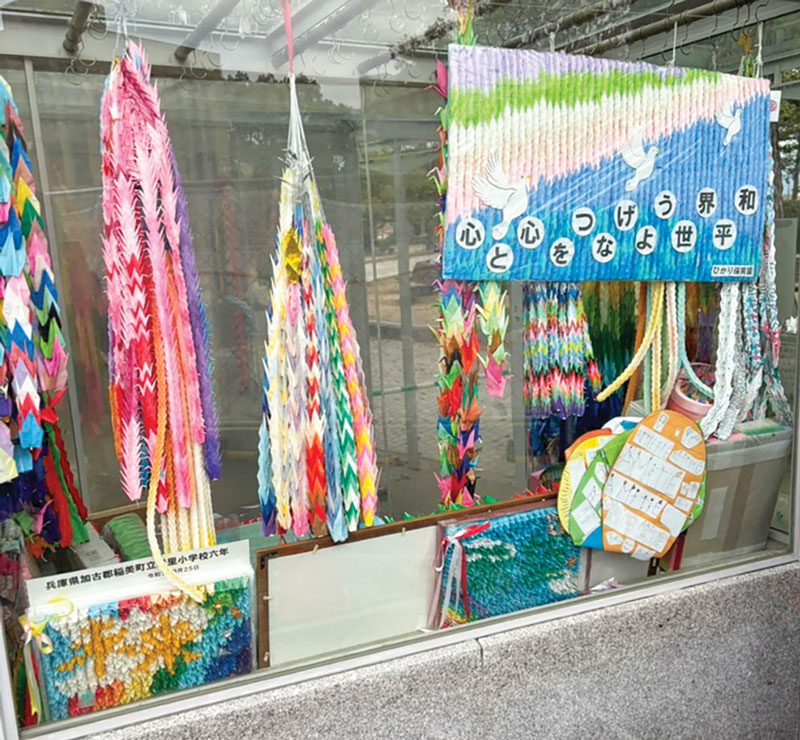
One of the most powerful experiences for me was hearing from Keiko Ogura, an atomic bomb survivor. Through photography, paintings and music, she shared her story in a way that deeply moved me. It made me reflect on how art and culture can influence people’s hearts and prevent tragedies from being repeated. I came to feel that true change happens not through laws but through human connection.
As an artist, this experience transformed my perspective. I now see art not only as a form of expression but as a tool for unity, education and hope.
Returning home, I am determined to use my life and my art to encourage others and contribute to peace.
Guidance | Ikeda Sensei
Joy Is Found in Struggle
Ikeda Sensei’s first visit to the Higashi Hiroshima Culture Center in Kure in 1975 is recorded in volume 22 of The New Human Revolution. The following is an excerpt from his address to the Kure members.
Life is long, and the effort for kosen-rufu is too. … I’ve come this far myself by making chanting my top priority. When we pray, we change ourselves. And by bringing forth the life state of Buddhahood from within ourselves, it is possible to influence those around us to change. We can also make the entire universe our ally. …
Life is always filled with troubles. The Buddha was constantly troubled about how to help all living beings. If we had no more troubles, life would be completely dull and uninteresting. Food tastes good because we’re hungry. Getting a raise makes us happy if our salary before was low and we were having a hard time making ends meet. Real joy is to be found in struggle. (NHR-22, 359–60)
May 15, 2026 World Tribune, pp. 10–11
You are reading {{ meterCount }} of {{ meterMax }} free premium articles