
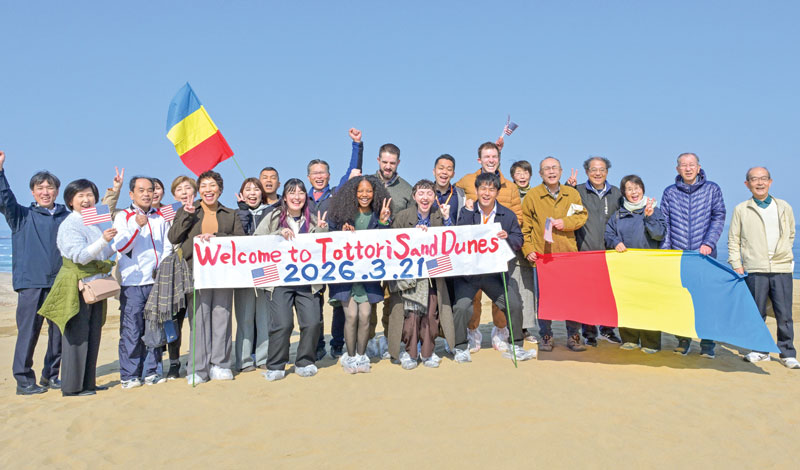
The 120 SGI-USA youth training course participants traveled to several prefectures in Chugoku region, the westernmost area of Honshu, the largest island of Japan. There, they traveled to 15 locations to attend exchange meetings in groups of eight.
In Tottori, the local members took the youth to the iconic 9-mile expanse of the Sand Dunes, using the same path that Ikeda Sensei walked when he visited there for the first time on Feb. 23, 1960.
As they set out, they were given the sheet music to the local folk song, “Tsuki no Sabaku” (Desert Moonlight), which all those years ago Sensei proposed the members sing together with him as they strolled through the area.
The youth said that the members had been waiting for two hours atop the largest sand dune, with a large welcome banner and SGI flags dotting the horizon. The youth learned that when Sensei visited, he had gathered the members in a circle and encouraged each to write a poem.
Postcards in hand, the youth were also encouraged to each compose a poem. As their pens moved across the paper, something unexpected occurred. The members started to sing. One young man started to cry. And when he looked around, every youth in the circle was crying too. They were moved deeply by the members’ spirit to convey Sensei’s heart to them and, for a moment, felt as though their mentor were sitting there too.
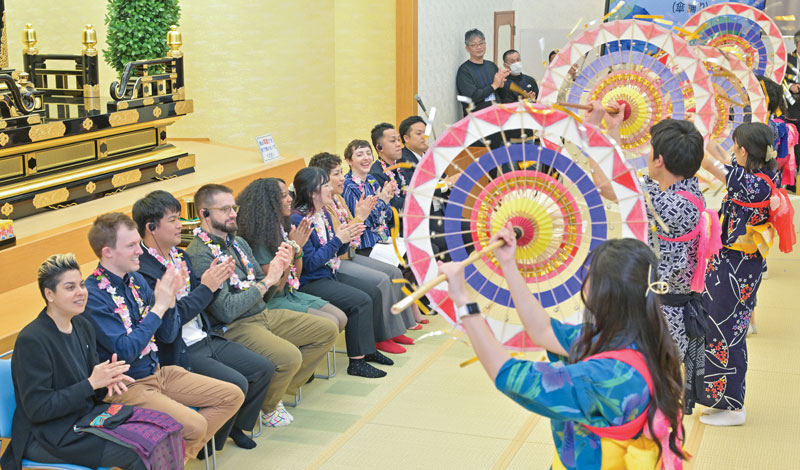
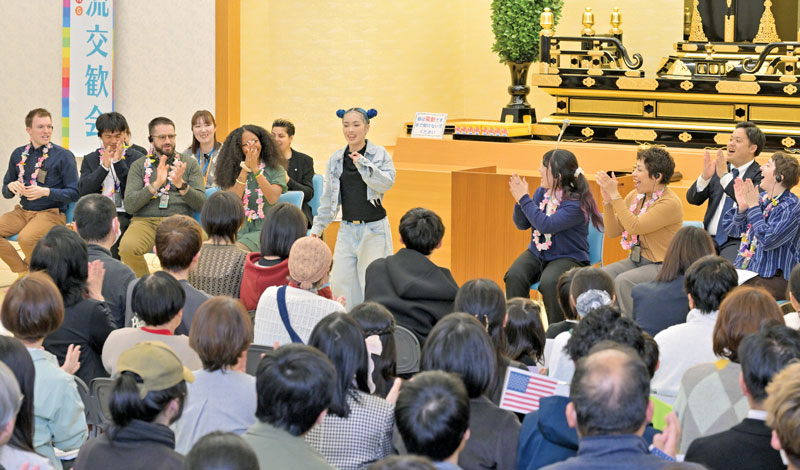
After the dunes, they headed to the Tottori Culture Center where they joined an exchange meeting with 400 in attendance, including 50 guests. The youth performed a local folk dance, and the future division members sang a song. More than anything, the visiting youth experienced an interchange of hearts, beyond language or culture or any other superficial distinctions, as disciples.

Kosen-rufu in Real Time
Charlotte Mayeda Detroit
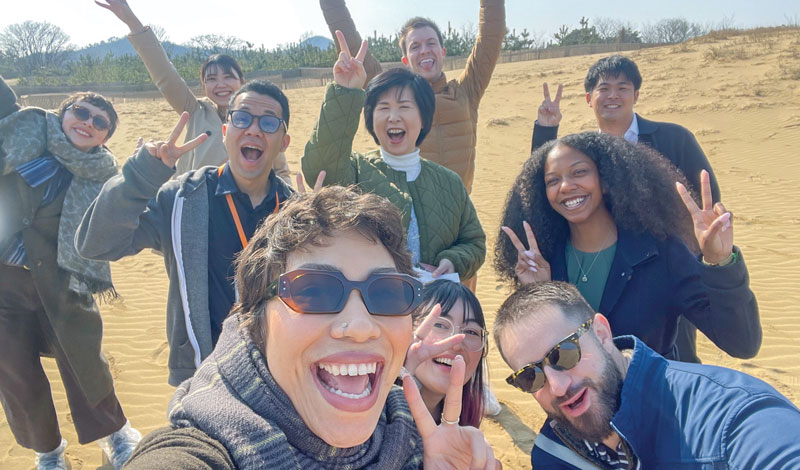
The Tottori Prefecture members guided us through the sand dunes, walking the same path that Ikeda Sensei had walked with the members there in 1960.
They encouraged us to connect to Sensei’s heart, and shared openly about their personal prime points with him. This visit to the sand dunes left a deep impression on me.
At one point, the Tottori members sang for us as we wrote short poems. In that moment, I knew that I was experiencing kosen-rufu in real time. Undoubtedly, Sensei helped many people participate in kosen-rufu through his ceaseless efforts to encourage each person he met.
At our exchange meeting, a young woman, who is a professional dancer, shared how her Buddhist practice has helped her address her mental health. Afterward, she performed a dance that she had choreographed. Knowing her struggles, it was invigorating to watch her use her entire life to encourage us.
Since the training course, I’ve had the chance to reflect deeply on my efforts to care for members. It is my determination to visit youth members, unite with them in shakubuku and study with them regularly, creating bonds of enduring friendship rooted in faith. Additionally, I’m determined to raise one youth in each district in my chapter to ensure that the future of kosen-rufu is secure in Detroit.

Feeling My Mentor’s Care
Allen Hirahara Santa Cruz, Calif.
The Tottori members woke up early to give us a tour of the sand dunes—a visit they had planned for many months. They guided us up the dunes and shared experiences of when Ikeda Sensei visited. They also presented us with many gifts and made sure we had lunch and snacks. The way the Tottori members treated us made me think—this must be what it feels like to receive Sensei’s care—and my heart filled with appreciation.
During the exchange meeting, we were each paired with a future division member, who walked into the room with us. The boy I was paired up with was nervous, but I could see that he wanted to do his best. I encouraged him to be himself and enjoy the event. His smile, courage and sincere spirit left an impression on me.
To bring the same compassionate spirit of care back to my local organization, I’ve increased my home visits. Whenever I get a chance, I bring the young men a small gift and try to reach out to them to strengthen our bonds of friendship. Through these efforts, I’m determined to expand the number of successors in our chapter!
Guidance | Ikeda Sensei
‘Advance Headlong Into the Raging Waves’
The exchange between the Tottori members and Ikeda Sensei at the Tottori Sand Dunes is recorded in The New Human Revolution, vol. 10, “Bastion of the Pen” chapter.
Sitting in a circle atop one of the dunes, they began to talk. Shin’ichi [Yamamoto] said: “Looking out at this vast landscape gives one a sense of grandeur. With that noble spirit, why don’t we each compose a waka poem conveying our determination to carry out kosen-rufu. We can preserve them in a safe place and then open them again 10 years from now. What do you say?” …
They presented their poems one by one. Shin’ichi then recited his:
Resolutely advance
to realize
kosen-rufu in Asia,
no matter how rough the waves
of the Japan Sea.
It was almost two years since the death of second Soka Gakkai President Josei Toda, who called for the realization of kosen-rufu in Asia. Since that time, many of Toda’s disciples had unconsciously forgotten the vow they made to their mentor. Shin’ichi, however, continued to strengthen his resolve to stand up and actualize his mentor’s vision.
Everyone listened intently to Shin’ichi’s poem, deeply moved by the profound commitment of a genuine disciple.
Rising to his feet and gazing out at the sea, Shin’ichi said in a determined voice: “Buddhism means to advance headlong into the raging waves, into the storm. Kosen-rufu cannot be achieved if we are cowardly. Each of us was born into this world with a mission. Let us all play out our roles in this grand drama of life as true champions of kosen-rufu.” (NHR-10, revised edition, 14–16)
May 15, 2026 World Tribune, pp. 28–29
You are reading {{ meterCount }} of {{ meterMax }} free premium articles