
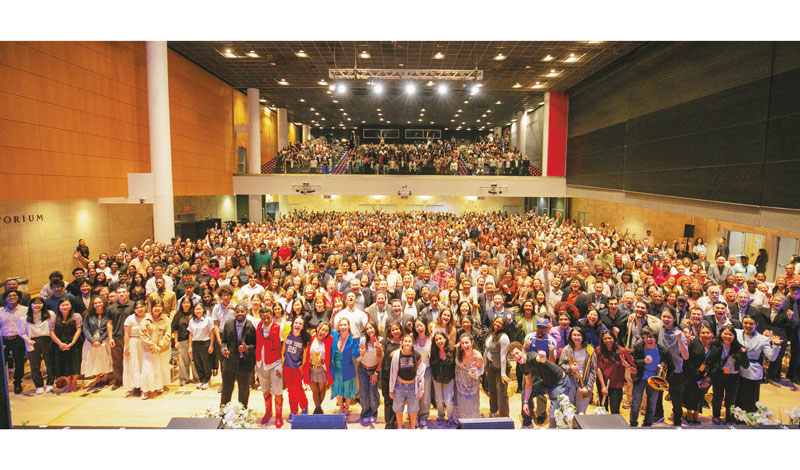
NEW YORK—In June 1996, Ikeda Sensei delivered his landmark lecture “Thoughts on Education for Global Citizenship” at Columbia University’s Teachers College during what would become his 27th and final visit to the United States. Thirty years later, on June 20, 2026, members from across the greater New York area returned to Columbia University to commemorate that historic trip and renew their vow for kosen-rufu.
Some 1,300 members converged on Lerner Hall for the commemorative meeting celebrating both the 30th and 45th anniversaries of Sensei’s visits to New York. It was there, in June 1981, that he penned the enduring poem “To My Beloved Young American Friends—Youthful Bodhisattvas of the Earth,”[1] underscoring the meeting’s theme of a youth-led departure toward the future of kosen-rufu.
Standing before members from New York, New Jersey, Connecticut, Massachusetts and Washington, D.C., Grady Tesch, SGI-USA’s vice young men’s leader, called the meeting not just a historical moment but a moment “that brings us into the present.”
“This anniversary is not just a time to reflect,” he said, “but a time to grab the baton of kosen-rufu from our mentor.”
That spirit shaped the entire meeting.
Planned from beginning to end by youth from New York, New Jersey and Brooklyn-Queens-Long Island zones, the event was designed not simply to look back on history but to explore what Sensei’s visits mean for the present and future. Through months of dialogue, the youth created a program that was creative, interactive and forward-looking, while placing newer members at the forefront of the celebration.
The meeting opened with the original song “Proud to Be,” performed by the Ikeda Youth Ensemble. Following a video about Sensei’s 1981 and 1996 visits, youth leaders shared their determination, and in a flash-mob-style presentation, participants throughout the auditorium rose one by one to recite passages from “To My Beloved Young American Friends,” including the oft-quoted stanza:
Faith is—
to fear nothing
to stand unswayed
the power to surmount any obstacle.
Faith is the source from which
all solutions flow.[2]
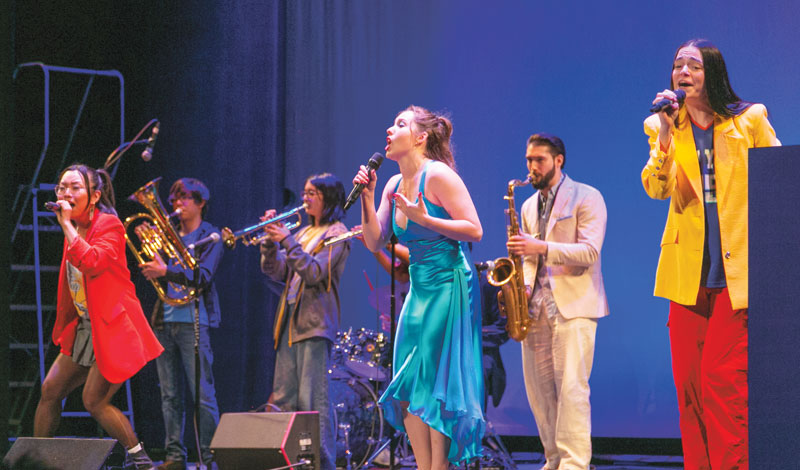
The program also featured recent faith experiences, a future-focused skit and a closing performance of “Try Again City,” an original song inspired by Sensei’s essay “Morning in New York.”
The video and presentations highlighting the significance of Sensei’s 1981 visit to New York spoke to the major challenges the local organization faced amid the first priesthood issue at that time.[3] The local priests, in collusion with corrupt leaders who later left the organization, caused activities to come to a standstill, discouraging the members, who suffered deeply amid the confusion.
In his words near the conclusion of the meeting, Tariq Hasan, SGI-USA senior vice general director, who supported both the 1981 and 1996 visits, recalled how only a small group of young men were available to support Sensei’s movement when he arrived in New York in 1981. Yet Sensei came determined to encourage the members and help them stand up once again.
Central to that visit was the poem “To My Beloved Young American Friends,” which Sensei wrote throughout the night. Hasan recalled how the poem gave members “profound courage and an incredible sense of mission” at a time when many felt defeated. It became a source of inspiration for a generation of youth and helped spark a powerful resurgence of the kosen-rufu movement throughout the 1980s.
Youth attending the meeting 45 years later said the poem continues to resonate with them today. As they prepared for the event, the youth leaders studied “To My Beloved Young American Friends” together, finding in its passages fresh encouragement for the present moment. Many said the poem continued to speak directly to them and deepen their determination to advance kosen-rufu and encourage others.
Hasan also reflected on what left the deepest impression on him during Sensei’s visits—his behavior as a human being. Whether meeting a world leader, a hotel doorman or a small child, Sensei treated every person with the same respect and sincerity.
During the 1996 visit, Hasan recalled a day when Sensei met with a dignitary at a hotel in New York. After the meeting, Sensei came downstairs and bowed deeply to the doorman, thanking him profusely for his efforts and apologizing to have caused him to work so hard with all the staff going in and out of the hotel. The doorman, who had probably opened the door for many heads of state and other dignitaries, appeared truly shocked by the sentiment.
Through his actions, Hasan said, Sensei demonstrated the spirit of Bodhisattva Never Disparaging and showed members what genuine Buddhist leadership looks like.
By the time Sensei returned in 1996, the New York organization had undergone a dramatic transformation. Reflecting on the members’ growth, Sensei declared: “Your organization today is truly outstanding. You have won over everything! Congratulations!” Hasan said those words reflected Sensei’s joy at seeing how far the members had come since his 1981 visit.
To commemorate the occasion, Sensei dedicated the following poem to the members, which was read at a gongyo meeting, held on June 15, 1996, at the New York Culture Center:
New York,
serene and at last triumphant,
you have created a record
invincible and immortal.
• • •
New York,
deep in faith,
deep in camaraderie,
is watched and praised
by friends the world over.
The Daishonin will
protect you without fail.
Therefore, New York,
enjoy each day
with courage and hope.[4]
During his 1996 Columbia University speech, Sensei outlined the three qualities of global citizenship—wisdom, courage and compassion—the same attributes as a Bodhisattva of the Earth, thereby transforming the purpose of education.[5] Five years later, Soka University of America opened its doors on May 3, 2001, in Aliso Viejo, California, with the foundational mission to “foster a steady stream of global citizens committed to living a contributive life.”[6]
Voices of a New Generation
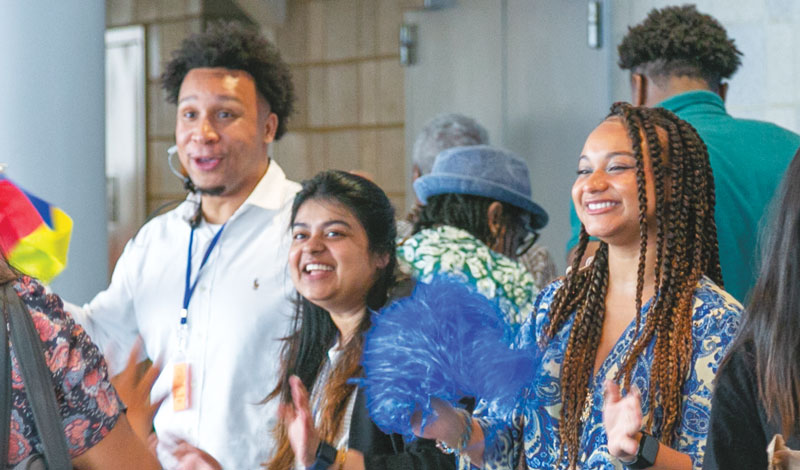
The future-oriented spirit of the meeting was perhaps most evident in the experiences shared by newer members.
Ella Myers, who encountered the SGI after returning home from college, spoke of receiving the Gohonzon and preparing to serve as a Peace Corps volunteer in Peru.
Isaac Nikolic shared how chanting transformed his relationship with his father and helped him support his father’s recovery from illness.
Harvey and Kaya Wright described how practicing Buddhism enabled them to overcome profound personal struggles and inspire one another to develop hope and confidence.
For many attendees, the gathering provided a deeper appreciation of the efforts that built the organization they inherited.
“It was impactful to see and hear from the members who were there and were the first members on the ground in New York City,” said Macy Browning, “to see the results of their work, their efforts at that time, blossom to what it is now.”
Yuki Kitayama, a student division member from New Jersey Zone, said the meeting helped him better understand the significance of Sensei’s visits. “With this, I naturally understand what [Sensei’s visit] meant to all these people,” he said.
For Kaylah Tucker of Brooklyn, who recently began practicing Buddhism, “it was nice having more of an introduction to Sensei.” She said, “With everyone there, it made me feel like we could do something powerful.”
As the meeting concluded, Hasan challenged the members to inherit the spirit Sensei entrusted to New York and create what’s missing today in American society: a sense of community.
“Let’s make Sensei proud and assured that his disciples in the greater New York area are following in his footsteps,” he said.
Forty-five years after Sensei’s 1981 visit and 30 years after his final visit to New York, the message resonated clearly: These anniversaries are not simply occasions to remember the past but opportunities to deepen one’s vow and open a new chapter for kosen-rufu in America.
Try Again City. Click here to hear the song based on Ikeda Sensei’s essay “Morning in New York.”
July 3, 2026 World Tribune, pp. 6–8
References
- “To My Beloved Young American Friends—Youthful Bodhisattvas of the Earth” can be read in its entirety in The Sun of Youth, pp. 63–75. ↩︎
- Ibid., p. 72. ↩︎
- On April 24, 1979, Daisaku Ikeda stepped down as third Soka Gakkai president to shield the members from the perverse machinations of the Nichiren Shoshu priesthood, which had colluded with corrupt former Soka Gakkai leaders to wrest control of the lay organization. While Ikeda Sensei’s activities in Japan continued to be curtailed by the priesthood, he turned his focus to opening the path of worldwide kosen-rufu. ↩︎
- My Dear Friends in America, fourth edition, pp. 458–59. ↩︎
- Ibid., pp. 447–57. ↩︎
- https://www.soka.edu/about/mission-and-values <accessed on June 25, 2026>. ↩︎
You are reading {{ meterCount }} of {{ meterMax }} free premium articles