
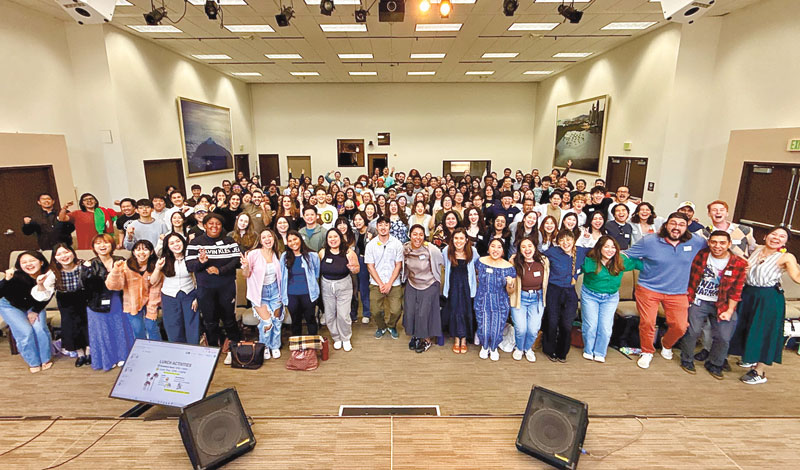
The following essay by Ikeda Sensei was originally published in the Soka Gakkai’s daily newspaper, Seikyo Shimbun, as part of his “The Light of the Century of Humanity” series and later appeared in the March 14, 2008, World Tribune.
Vigorous
Soka youth
dedicated to truth and justice,
exert yourselves
in raising the curtain
on a new history.
People. It all comes down to people.” These words are attributed to Zhuge Liang, one of the heroes of The Romance of the Three Kingdoms, in Japanese novelist Eiji Yoshikawa’s retelling of the classic Chinese tale, which I studied with my mentor Josei Toda. Zhuge Liang said this to Liu Bei immediately after their victory in the famous Battle of Red Cliffs. Liu Bei had asked Zhuge Liang, his advisor on military strategy, the secret to leading the nation to victory and prosperity.
Everything depends upon people.
This year [2008] marks the 30th anniversary of the signing of the Japan–China Peace and Friendship Treaty. To celebrate this landmark event, the Tokyo Fuji Art Museum in Hachioji, Tokyo, will be holding an exhibition titled “Great Romance of the Three Kingdoms.” Among the items that will be on display, I am told, are such artifacts as arrowheads and spears excavated from a site where the Battle of Red Cliffs is said to have occurred, exactly 1,800 years ago (in 208). I wish the exhibition great success.
The three kingdoms were the ancient states of Wei, Wu and Shu. The northern state of Wei was ruled by Cao Cao. Allied with the imperial house, it held the advantage of perceived legitimacy and was the most powerful of the three. Wu was ruled by Sun Quan, and enjoyed the benefits of the rich farmland south of the Yangtze River. The third kingdom, Shu or the Shu Han, ruled by Liu Bei, was known for its domestic harmony, or the unity of its people, and had secure hold of the west.
While this balance of three powers—outlined in the Longzhong Plan—was in effect, Zhuge Liang emphasized the importance of fostering capable people as the basis for strengthening the state of the Shu Han.
Referring to The Romance of the Three Kingdoms, second Soka Gakkai President Josei Toda used to say: “We mustn’t be petty and incompetent. A true hero cherishes capable people. Those who don’t value capable people cannot rise to heroic action. We must make the Soka Gakkai a bastion of capable people.”
And just as Mr. Toda taught, the Soka Gakkai has triumphed because it has continued to foster, on multiple levels, capable people who are committed to furthering kosen-rufu, upholding sound convictions and principles and achieving peace.
Exactly 55 years ago, in the cold February of 1953, the year following my February Campaign in Kamata Chapter, I took the lead in a new struggle to develop capable individuals. Being 25 years old at the time, I fought with a vigorous spirit much like the younger members of our young men’s division today.
I was in my second month as leader of the young men’s division First Corps,[1] having been appointed to that position by Mr. Toda at the start of the year. In order to realize my mentor’s goal of attaining 750,000 member households, I launched an intense campaign to rally young people with whom we could together foster and develop new capable individuals. I made a steadfast vow: “Our mentor President Toda is praying and hoping for his disciples to surge forth in great numbers. I will present him with an impressive force of youthful disciples committed to truth and justice!”
Boldly
set forth to win,
to advance—
a heroic force
of tremendous numbers.
That year’s goal for developing capable people was very clear. Our First Corps would become a corps of 1,000 by the end of the year. When I became leader of the corps, members were centered around Sumida, Koto and Edogawa wards (on the east side of Tokyo). There were six groups and about 300 members. Our goal was to increase our numbers more than threefold. I was sent there on assignment, away from my home area of Kamata (on the south side of Tokyo). Obviously, it would not be an easy task. But if we were to attain Mr. Toda’s larger goal, it was crucial at that moment to accelerate the solidarity of the youth division. Just as Kamata Chapter had achieved a breakthrough for kosen-rufu as a whole, if the youth division could show the way to create expansion in one locale, it was certain to have positive repercussions that would spread throughout the country.
Mr. Toda appointed me First Corps leader as an expression of his total confidence and faith in me, knowing that if he entrusted me with this critical task, I was certain to achieve it. In my mind, there was no challenge that couldn’t be achieved if it were assigned by such a superb mentor of kosen-rufu. Moreover, we had the strategy of the Lotus Sutra. The key was to inspire each member to stand up with burning faith. It was essential to enable the core members striving alongside me to launch into the struggle feeling confident that our course of action would lead to victory.
The first thing I did was to expand the number of groups within our corps from six to 10 by adding new group leaders, and I designated these 10 group leaders the “10 corps champions.” I understood that in order to achieve victory in any struggle, it was absolutely necessary to solidify the core. My next task was to develop 10 subgroup leaders under each of the 10 group leaders, with the aim of creating 100 strong leaders in the corps. Then, to cap it off, if each of the 100 subgroups could cultivate a membership of 10, our corps would become a force of 1,000 capable individuals.
Therefore, we had no need to be intimidated by such a large numerical goal. All we had to do was to inspire and rally new youth, one after another. Knowing that this was the path to certain victory, I united all of the members of my corps to take on the challenges before us.
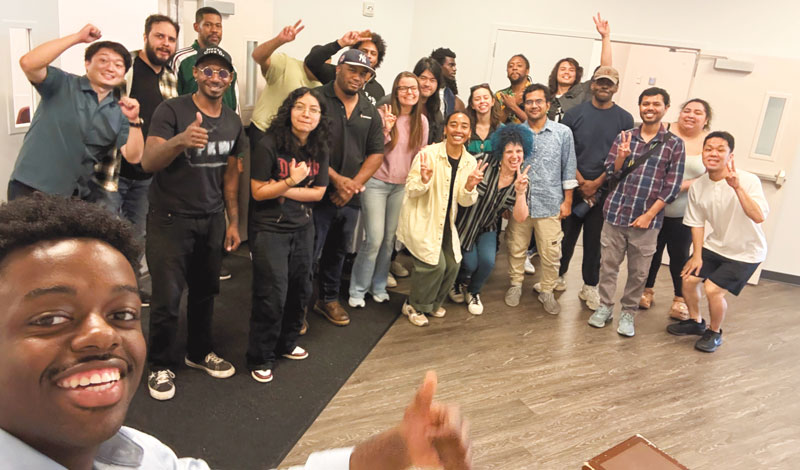
This path I have built
with my fellow members,
conversing happily
as we live out our lives
with confidence and dignity.
As a matter of fact, before I was appointed leader of the First Corps, there was very little feeling of corps solidarity. Many new members were quickly leaving the organization; all the efforts involved in introducing them to Nichiren Buddhism were negated by the poor follow-up in providing them the necessary encouragement and guidance in the early stages of their practice.
This troubled me. Every young person who decides to start practicing Nichiren Buddhism does so out of a serious interest in learning about the philosophy. Those who left so soon had not yet had the chance to experience the wonderful benefits of the Mystic Law. They hadn’t learned about our remarkable teacher, Josei Toda. And they didn’t have a chance to learn of the profound mission of the Soka Gakkai youth division. For them to stop practicing without knowing any of this was, I felt, a tragedy. And so I set out on an earnest struggle to create an alliance of capable individuals united in spirit with our mentor, Mr. Toda.
The first step I took was to carry out a diligent search for capable people. This meant making a sincere effort to get to know each and every member in the corps.
While it may be the trend in modern society to settle for shallow relationships, the Soka Gakkai is different. We should not waste any opportunity to meet and talk with others. It is important to listen and offer encouragement. Sharing the worries and concerns of fellow members, we should chant and take part in activities together.
The more we know a person, the more deeply we can pray for that individual to bring out his or her full abilities for kosen-rufu and to cultivate a relationship with a mentor in faith. Such profound prayer is the driving force for developing capable people.
The second step I took was to strive to impart pride and self-confidence to all my members. Enthusiasm is important in any endeavor. Pride, in the positive sense of the word, is essential. No one can succeed at anything with a defeatist attitude.
I urged the members of the First Corps to be first in every challenge, in line with the group’s name. And whenever I discovered individuals who were producing first-class results, or making a first-rate effort behind the scenes, I offered my praise and gratitude.
My third step was to create a rhythm in our activities. Every Sunday, I opened up my apartment in Sanno, Omori [in Tokyo’s Ota Ward] to any corps members who wanted to receive guidance and discuss ways to conduct our activities, and these gatherings naturally developed into planning meetings for the corps. Each month, we held a full corps meeting as a target to achieve immediate goals as well as a launching point for the next month’s activities.
Now, during this “second act of kosen-rufu,” the monthly Soka Gakkai youth division leaders meeting in Japan serves the same purpose as a pivotal occasion for spurring our successive victories and continuous advance.
My fourth step was to strengthen members’ conviction in faith and their ability to articulate our message through regular Buddhist study. Together with members who met at my apartment, we studied such major writings of Nichiren Daishonin as “The Object of Devotion for Observing the Mind,” “The Selection of the Time,” “The Entity of the Mystic Law,” “On Practicing the Buddha’s Teachings” and “On the Buddha’s Prophecy,” deeply engraving in our hearts Nichiren’s momentous personal struggle and profound philosophy to work for the people’s welfare.
Our corps carried out consistent study of Buddhism. We also initiated a tradition of reading good books, just as Mr. Toda had trained me to do. Through these activities, members honed their abilities to read, write and speak for kosen-rufu, enabling them to effectively convey the message of Nichiren Buddhism to anyone.
Members are not “soldiers” of the organization. They each have a significant mission to be a leader for kosen-rufu and an exemplar of winning in society, and each is certain to gain tremendous benefits.
The struggle
of courageous
Bodhisattvas of the Earth
will bring successive victories
that will last forever.
The French author Andre Maurois wrote, “Not only must he make use of existing [capable people], but it is his duty and to his interest to create new [capable people].”[2] I agree. For any organization, the true ability of its leaders is evident in whether it has a wide array of talented individuals engaged in vibrant activity and whether it is continually fostering new capable people. The failure to produce able new individuals is a sign that its leaders are afflicted by arrogance, conceit and self-interest. That is why leaders need to be the first to break through their own limitations and constantly develop themselves. They must actively undertake their own human revolution.
In February 1953, I was striving wholeheartedly to foster capable people and develop our organization. I wrote in my diary: “Someday, I want Sensei to see the result of our behind-the-scenes unity and growth. … I, myself, however, must first take the initiative and serve as an example. Personally resolved to take a great leap forward during the coming year.”[3]
Live out your youth
to the fullest
and win certain victory
in this life,
just as a Buddha would.
Dr. Aurelio Peccei, the co-founder of the Club of Rome with whom I once published a dialogue, was a courageous fighter in the resistance movement against the barbarity of fascism during World War II. Though imprisoned and tortured in his youth, he refused to betray his comrades. Dr. Peccei said that the first step toward the victory of truth and justice is to create “a small nucleus of like-minded people.”[4]
Each group and subgroup of our First Corps was just such a small nucleus. Indeed, the First Corps as a whole was the key nucleus for the explosive expansion of kosen-rufu that we achieved, together with our mentor Josei Toda.
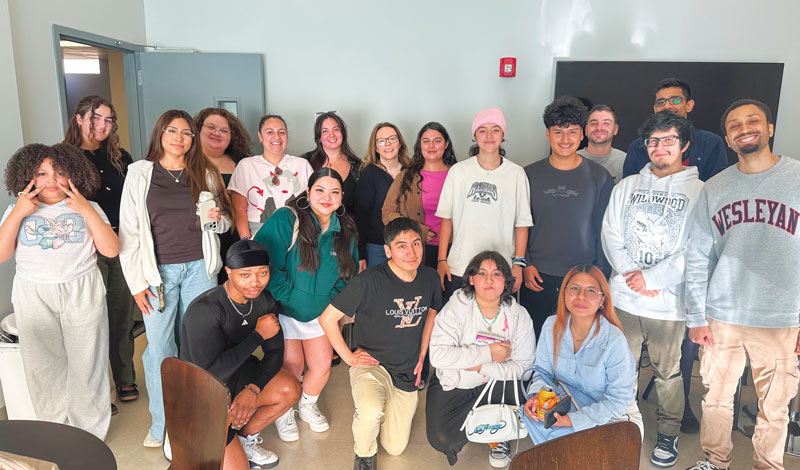
In June 1953, six months after I became the First Corps leader, 100 enthusiastic members assembled for a corps meeting in Koiwa in Tokyo’s Edogawa Ward. It was a magnificent occasion. Though they were all poor young men, wearing clothes smeared with grease, threadbare shirts and unkempt hair, the spirit to live for kosen-rufu was ablaze in their eyes, which sparkled as they looked to the future. The force of “100 corps champions” was boldly taking shape.
I felt a thrill in my heart, thinking to myself: From this group, many revolutionary leaders of the Mystic Law are certain to appear. They are all youthful pioneers. They are Bodhisattvas of the Earth. I will expand this gathering of a hundred individuals into a thousand, ten thousand, millions! And in line with that determination, our First Corps fostered capable people and developed, growing to a membership of 1,000 in a single year. Our youthful network spread throughout Tokyo and to neighboring prefectures such as Saitama and Chiba.
I was able to report to Mr. Toda that I had built the foundation of an ever-victorious youth division that was directly connected to him, a youth division that would gloriously open the way to the future of kosen-rufu. I consider my mentor’s joyful smile on that occasion to be one of the greatest badges of honor of my youth.
The light of kosen-rufu
brilliantly illuminates
the entire world,
thanks to you,
our wonderful youth.
In his treatise “The Selection of the Time,” Nichiren points out:
Little streams come together to form the great ocean, and tiny particles of dust accumulate to form Mount Sumeru. When I, Nichiren, first took faith in the Lotus Sutra, I was like a single drop of water or a single particle of dust in all the country of Japan. But later, when two people, three people, ten people, and eventually a hundred, a thousand, ten thousand, and a million people come to recite the Lotus Sutra and transmit it to others, then they will form a Mount Sumeru of perfect enlightenment, an ocean of great nirvana. Seek no other path by which to attain Buddhahood! (The Writings of Nichiren Daishonin, vol. 1, pp. 579–80).
In complete accord with this passage, our Soka youth division has developed into a grand worldwide alliance of peace and justice through faith dedicated to kosen-rufu together with their mentor.
This February [2008], during the coldest part of winter, insightful young leaders of the SGI-USA youth division have come to Japan in the noble pursuit of study and training. Their earnest desire to seek Buddhism, their unity and their vigor shine with the spirit of a “First Corps” of global kosen-rufu.
Last June [in 2007] the SGI-USA youth made a fresh start with new leaders. Since then, they have achieved unprecedented growth. More than 7,500 members have joined the SGI-USA in the past year, a remarkable increase spurred in large part by the youth’s efforts.
They have identified the source of the organization’s momentum in the following: 1) New members, filled with the joy of faith, are introducing Nichiren Buddhism to their friends, thus creating an expanding groundswell of happiness; 2) Fellow members and local leaders are continuing to look after the new members, offering encouragement and support so that they may joyfully participate in activities and develop in faith; 3) Members of the men’s and women’s divisions are working together to support the youth, and everyone in the organization is amicably helping one another; 4) And most of all, behind all of these efforts has been a steady focus on deepening the mentor-disciple spirit. As a result, the youth have been able to demonstrate greater strength than ever before.
The vision of the emergence of countless Bodhisattvas of the Earth that my mentor Josei Toda and I dreamed of 55 years ago has now been actualized as the harmonious unity of our magnificent Soka youth throughout the world.
Nothing could make me happier or give me greater joy.
A towering
mountain range
of capable individuals—
the realm of the heart
has golden wings.
The American poet Henry Wadsworth Longfellow wrote:
Not enjoyment, and not sorrow,
is our destined end or way;
but to act, that each tomorrow
finds us further than today.[5]
Now, having turned 80, I am determined to work with my beloved young friends, from today toward tomorrow, as this poem implies, to open up a bright future and apply the finishing touches to the foundation of our movement so that it will continue on for generations to come.
Nichiren states: “What a joy it is for us to have been born in the Latter Day of the Law and to have shared in the propagation of the Lotus Sutra!” (“Letter to Niike,” WND-1, 1026) and “The reason that you have survived until now when so many have died was so that you would meet with this affair” (“Reply to Yasaburo,” WND-1, 829). How wondrous it is that we were born into this world together and are spreading the torch of happiness that is the Mystic Law throughout the world and into the future!
This February [2008], which marks the 108th anniversary of Mr. Toda’s birth, the profoundly significant youth division leaders meeting will not be held as a single-venue assembly of representatives from all over Japan. It will be conducted by having youth members gather together at their local discussion meetings around the country. This is something that would have given immense joy to Mr. Toda, who wished more than anything that youth members would be active in Soka Gakkai discussion meetings. I hope that the “parents” of our Soka Gakkai family, the men’s and women’s divisions, will support them.
Discussion meetings were also the driving force behind the famous February Campaign in Kamata Chapter (in 1952). And now, youth members will play a pivotal role in discussion meetings that will form the history of a new February Campaign in the second act of kosen-rufu.
My wife and all the women’s division members especially are looking on with praise and approval at the formation in Japan of the young women’s division group Ikeda Kayo-kai,[6] whose members are vibrantly active and opening the door to a hope-filled new era.
Mr. Toda declared, “If you summon the immense power of faith and generate the tremendous power of practice in your chanting and efforts to share Buddhism with others, the supreme power of the Buddha and power of the Law cannot fail to appear.”
My young friends, advance with pride and dignity on the journey toward the victory and glory of mentor and disciple.
The whole world
is watching
our youth division—
adorn your youth
with a victory cheer.
June 12, 2026 World Tribune, pp. 6–9
References
- In early 1953, the Soka Gakkai youth division consisted of four corps for the young men’s division and five for the young women’s division, with several chapters represented in each corps. ↩︎
- Andre Maurois, The Art of Living, translated by James Whitall (Harmondsworth, Middlesex: Penguin Books, 1960), p. 167. ↩︎
- A Youthful Diary, p. 135. ↩︎
- Aurelio Peccei, The Human Quality (Oxford: Pergamon Press, 1977), p. 62. ↩︎
- Henry Wadsworth Longfellow, The Poetical Works (New York: AMS Press, Inc., 1966), vol. 1, p. 21 ↩︎
- The Ikeda Kayo-kai, comprising all active young women’s division members in Japan, was established on March 16, 2008, in commemoration of the 50th anniversary of March 16, Kosen-rufu Day. ↩︎
You are reading {{ meterCount }} of {{ meterMax }} free premium articles