
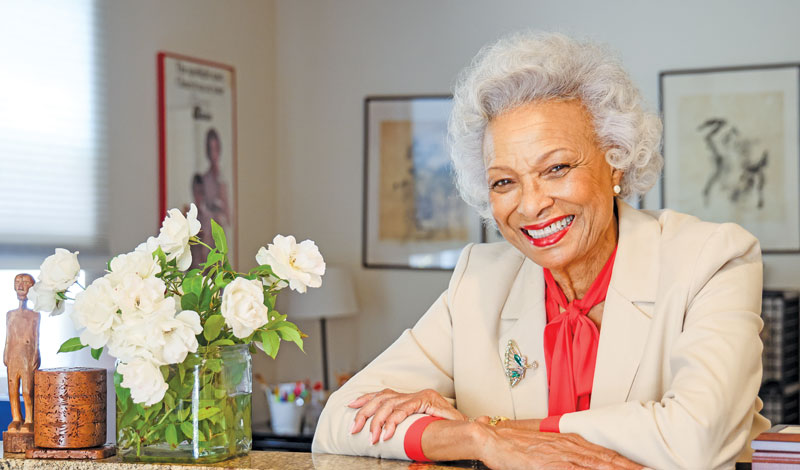
Living Buddhism: Lavelle, you’ve been acting and modeling for over 60 years—about as long as you’ve been in Los Angeles. But you didn’t come to LA as many actors have done, as a young person chasing the big screen.
Lavelle Roby: No, no, I had no thought of acting. I came for school, for the summer, with just enough money to get by. The reason I stayed was that my housing fell through, so I had to pay more for rent than expected. I postponed school and started working odd jobs, planning to re-enroll when I’d made back the money.
You moved from Mississippi, is that right?
Lavelle: From its backwoods, yes. I’m a country girl from a farming family, raised by a very young mother. She worked nights as a chef at the restaurant where my brothers took turns washing dishes. For my part, I landed my first job at 11, babysitting, so I could chip in. If this taught me one thing, it’s that life is not easy—we need and should take care of each other.
How did you begin working as a model and actor?
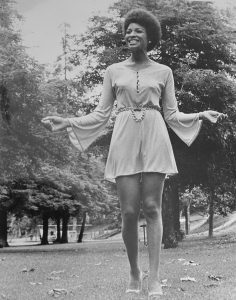
Lavelle: In my day, many young women enrolled in modeling or “charm” schools that taught “the social graces.” I enrolled in one such school as something to do, really just for fun. But when I earned my diploma, I thought to myself, Heck, I ought to put the training to use. I managed to book a few modeling gigs, then, eventually, one on TV. The year was 1965, the show was Get Smart, and it launched my acting career. By 1971, I’d broken into commercials, no easy feat for a Black actress. Many barriers stood between Black people and representation in mainstream advertising at the time.
The following year, I encountered Nam-myoho-renge-kyo, backstage of a play called The Crucible. I was an understudy, sharing a dressing room with other actresses. One actress, I noticed, had a habit of murmuring to herself between sets.
“What are you doing?” I asked her one day, and she told me, “Chanting Nam-myoho-renge-kyo.” She did not explain much, only that it worked, and that I could chant for anything.
At that particular moment, I was madly in love, really for the first time in my life. So, I started chanting, not for my career and certainly not for world peace, but for my relationship to become something more committed.
When the guy I was into invited me to join him in Acapulco on vacation, I felt my prayers had been answered at last. In the end, though, it didn’t pan out, but what it did do was keep me chanting. For that, I’m eternally grateful. I chanted to be his girlfriend and then for him to propose, until after two years it became clear he had no such intention. It took me a long time—years—to let go, but through it all, I developed a deeper relationship with the Gohonzon and Nam-myoho-renge-kyo, awakening to the inherent dignity of my life. When that relationship ended in 1972, I began to ask myself: What do I want? And high up on the list was to get some fresh air—to get away from LA for a while.
The thing was, I’d fallen in with a bad crowd—just about everyone in showbiz did drugs. You would imagine that I’d know that this was no good, but I didn’t know that at all. The reason was that these were glamorous people. They were lawyers, architects, producers and actors. They were filmmakers, businessmen, models and professors.
But the fast life was taking its toll, and I began chanting to go somewhere new. I chanted to land a job somewhere in Europe. When I did, in Sweden in 1973, I took it, thrilled to be leaving my problems behind. I know now what I didn’t know then, that you can’t so easily run from your karma.
What happened while you were there?
Lavelle: Well, I fell in with a similar crowd and saw what drugs can do to a person. I saw a young woman so wasted by drugs that she could hardly move, close to death. When I returned to LA in 1974, it was with a renewed sense of what actually mattered—what was truly irreplaceable—my life.
I came back just ahead of Ikeda Sensei, who, unknown to me, was kicking off a historic trip across the U.S. that April. I attended his address at UCLA “The Enduring Self”—his first at a university outside Japan. The speech outlined the principles he believed would serve as the bedrock of peace in the 21st century. One that struck me was the principle of impermanence.
“It is a basic tenet of Buddhism that clinging fast to the illusion of permanence causes the sufferings of the human spirit” (A New Way Forward, p. 6), Sensei said. “Each of us consists of a lesser self and a greater self. To be blinded by temporary circumstance and tortured by inordinate desires is to exist only for the lesser self. To live for the larger self means to recognize the universal principle behind all things and, thus enlightened, rise above the transience of the phenomena of the world” (p. 8).
This encounter marked for me the start of a new way of life, in which I stopped chasing after fixations—be it a role or a high or a relationship—and began living for the happiness of myself and others.
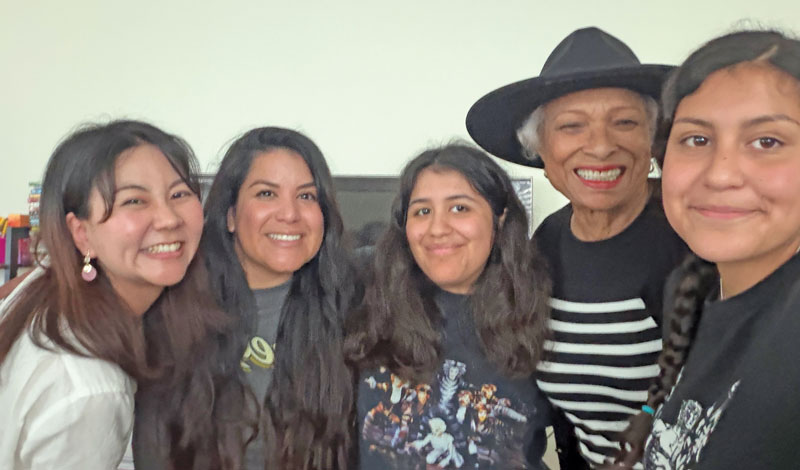
At that time, a friend of mine who’d been practicing this Buddhism for years explained something simple yet profound: “As you chant with and for another person, not only does that person’s life change, but your life changes too.” This was around the time that I took on district leadership, which, in the ’70s, meant I had many young people to support. And these youth, really, were the people who helped me grow.
Say more.
Lavelle: Before Buddhism, I spent a lot of time telling people how to live—“talking out the side of my head.” But I quickly discovered that this doesn’t have any lasting impact. I realized that, if I sincerely wanted someone to experience the power of Nam-
myoho-renge-kyo, I had to put aside my need to be right. I had to listen to, encourage and stay with them. Often, I’d seek guidance on how to support people going through things I didn’t know how to help them transform. By seeking on their behalf, I always discovered something that helped me see my own life more clearly and identify the best path forward. For me, this involved returning to college to receive degrees in French and journalism before taking a leap of faith to pursue acting full-time.
Tell us about that leap.
Lavelle: I got guidance in the early ’80s, that took all of five minutes to receive. At the time, I was seriously considering whether I should continue acting, which remained at that point an endless battle for work—a battle for hope amid so much rejection. Family often asked me when I’d get a “real job,” a nine-to-five that brought home regular pay. But when I met with this senior in faith, she said, very simply, “Become No. 1 in your work.”
At that time, I could hardly imagine such a thing, but it gave me courage, nonetheless. I stopped doubting so much the path I was on—I simply decided to pave my path to victory.
Something happened in 1994 that had a lasting impact on the way you’ve lived your life.
Lavelle: I got sick—horribly sick and was hospitalized for 21 days. My condition was life-threatening and required a surgery, but the surgery did nothing to improve my condition. In fact, it got worse, my temperature running at 105 degrees. At some point, in that fever, I began to chant Nam-myoho-renge-kyo with a very simple prayer: Gohonzon, if I live through this, I will give my life to sharing the greatness of Nam-myoho-renge-kyo with others. On my 11th day at the hospital, I underwent a second, life-saving surgery, from which I woke feeling dramatically better. Steadily, I improved and, as I did, began sharing Buddhism without any reservations.
The thing was, I’d realized something profound: I needed to deepen my faith. For over two decades, I’d accumulated heaps of proof that my Buddhist practice truly worked—what I call my “victory receipts.” But when push came to shove, when it mattered the most, these shrank to almost nothing in my mind. Every time I encountered a major obstacle, I’d think to myself, Sure, Buddhism has always worked before, but for this problem—this problem’s too big.
Coming out of the hospital alive, in better health than I’d been in years, I decided that I wanted to eliminate that doubt once and for all.
Every morning for the next two years, I chanted an hour before reading Nichiren Daishonin’s writing “On Attaining Buddhahood in This Lifetime.” Here, Nichiren explains that if we view the Mystic Law as existing outside ourselves, then even if with our mouths we chant Nam-myoho-renge-kyo, we are not, in fact, practicing Buddhism.
Practicing Buddhism correctly is not so easy, is it?
Lavelle: You might as well say that living correctly is not so easy—and you’d be right. To practice Buddhism is to practice living correctly. I’ve tried to live by this guidance from Sensei:
Faith and daily life, faith and work—these are not separate things. … Based on the recognition that work and faith are one and the same, we should put 100% of our energy into our jobs and 100% into our faith, too. When we resolve to do this, we enter the path of victory in life. Faith means to show irrefutable proof of victory amid the realities of society and in our own daily lives. (Buddhism Day by Day, p. 253)
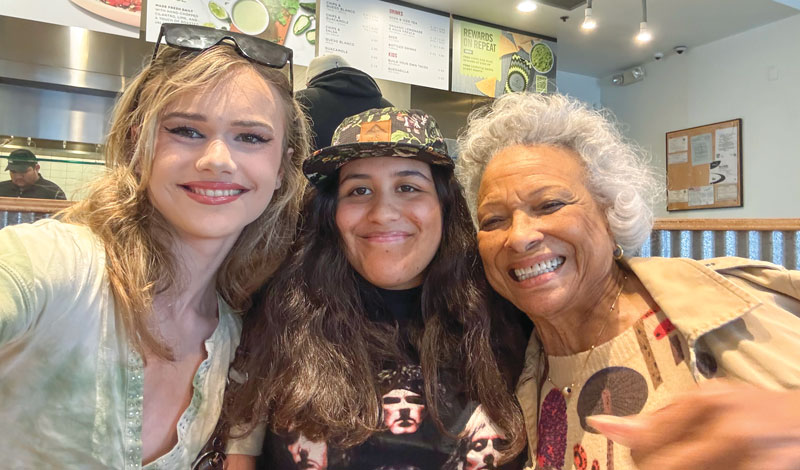
Today, my friends tell me they see me everywhere—on TV, on billboards, you name it. I’m living proof that you can make a dream a reality and grow with that dream over time. So what drives me, really, is encouraging others—but especially, encouraging the youth.
There’s a young woman in my district I’ve known a long time, who was feeling alone in her first year of high school. She’s on the spectrum and was struggling to make friends, so I put myself in her corner. We’d go out for ice cream, then chant for her to make friends—I encouraged her to share Nam-myoho-renge-kyo. As she did, she began making friends, becoming better understood by her peers. Soon, she had more friends than she knew what to do with and was inviting them to discussion meetings. They enjoyed the meetings and began bringing friends of their own. From this one young woman, joy spread from person to person. Awakening one youth to infinite hope—for me, that’s what it’s about.
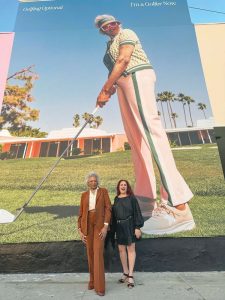
We saw a clip of you that recently went viral, of you getting quite the surprise.
Lavelle: Oh, you’re talking about the building on Melrose Avenue—I didn’t know I’d been put up on that building! In April, I flew out to Palm Springs for a shoot modeling sportswear. But I didn’t know when or where they’d use the photos they took—certainly I didn’t think they’d cover a building here in LA with me standing two stories high.
It must be thrilling to be featured larger than life.
Lavelle: Well, it is—it was. A very fun surprise. But that feeling can’t compare with giving someone hope. For me, it’s an opportunity to share this Buddhism, to encourage people, all people, young and old, to dream big. To see that there’s no separation between work and faith.
You are reading {{ meterCount }} of {{ meterMax }} free premium articles