
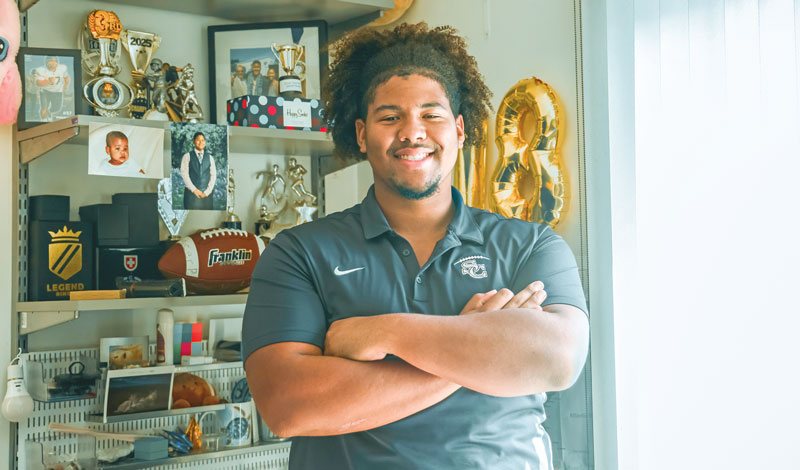
Living Buddhism: Spencer, you’ll be graduating high school in May and from there heading to Utah Tech University to play Division 1 football and further your education. We understand you had offers from many top-notch institutions—an ideal outcome for a student athlete. But it wasn’t guaranteed—in fact, one report card almost upended everything.
Spencer Parham: Right. You’re talking about the first report card of my junior year. Eight weeks in, my mother sat down with me to look it over and jumped. She looked at me like she’d just seen a ghost. Then I took a look and saw why.
Not good?
Spencer: To put it mildly. I was doing well in most of my classes—A’s and B’s across the board. But neither of us noticed this at first. Our eyes were glued on one grade, the one posted beside Honors English: 0%. It was a gut punch. Apparently, all the efforts I’d been making in that class didn’t matter at all.
That night, chanting Nam-myoho-renge-kyo with my mom, I struggled against an enormous amount of self-doubt. But as I chanted, my distracted, frustrated thoughts quieted down, and out of them came one prayer, for one outcome: Victory.

Just to confirm, you’re planning to major in environmental science at Utah Tech, not English.
Spencer: True.
Not every science major would take such a demanding course outside their field, especially on such a crucial year for scholarships. Why take it in the first place?
Spencer: Well, I’ve always loved a good book. That said, it’s true that my interests lean toward the sciences. The fact is, I took the class because I’d found the subject difficult—because it had given me the most trouble two years in a row. It was the grade, both freshman and sophomore year, that the rest of my grades had made up for. Chanting for a victorious junior year, a crucial year for scholarships and recruitment, I decided I wanted to show myself and everyone else that there was no subject I could not excel in if I put my mind to it. In any case, the Soka spirit is to tackle head-on the things that give us the most trouble. That’s the way to truly grow.
Given that mindset, the “0%” on that report card must have really shocked both you and your mother. Help us understand—how’d this come about?
Spencer: Our question exactly. There was only one thing I could think of—something I’d kept mostly to myself until then. It was just a feeling, but one that had been growing since the first day of class: I felt like my teacher didn’t like me. At least, there seemed to be some huge, unspoken misunderstanding between us, which seemed to only grow with time.
Say a little more about that.
Spencer: Well, the class for me seemed to start on the wrong foot. On the first day, the teacher introduced himself by saying that he did not like sports. Odd, I’d thought; my school is renowned for producing academic and athletic talent. As a matter of fact, the whole class was filled with talented student athletes. But if my worry was that this was some sort of signal—that he’d be particularly harsh on my friends—I quickly found that worry was misplaced. My friends all had their issues and would sometimes protest—a low grade they’d been given or a deadline they’d missed juggling responsibilities at school, on the field, at work and at home. But all their issues seemed to result in outcomes that satisfied everyone. They’d receive an extension or the opportunity to resubmit for more credit. He was strict, sure, but pretty evenhanded. Which was why it was so confusing that he was never this way with me.
For instance?
Spencer: For instance, our first assignment—a quiz on the contents of our binders to ensure we each had everything needed for the semester ahead. I completed the assignment and uploaded it to the portal online, where all our work and our grades are posted.
As the classroom buzzed about our very first grade, I opened my portal to look at mine. And I found something that didn’t check out—a single dash where my grade should have been. I raised my hand to ask about this, and when he called on me, I did.
“All grades are out,” he said flatly, in a way that told me that was the end of that. I poked around the room a bit and found that all my friends had received a grade. Confused, I sat down, wondering whether there was some misunderstanding.
One week passed, then another. Our second assignment came, and I leapt at the chance to demonstrate that I’d been engaging with the work—reading, analyzing and enjoying the book—F. Scott Fitzgerald’s The Great Gatsby. On the portal, we uploaded the notes that we’d taken, something I’d stayed up late writing and rewriting to ensure the work was my best. It was near midnight when I submitted my notes, and when I did, I felt good, like I’d really done my best.
The next day, in class, the room was abuzz. Not everyone had submitted the assignment. He called out the names of those who’d yet to turn it in and, to my surprise, my name was among them. After class, I went up to show him my work. I held out my phone, which I had opened onto my portal. He didn’t look at the phone, or even at me, saying simply, “All grades are out in the portal.” The feeling I felt, in that moment right then, if I had to name it came close to betrayal. It confirmed for me something I’d begun to suspect—that he did not like me and did not want me to succeed.
A heavy feeling. What did you do?
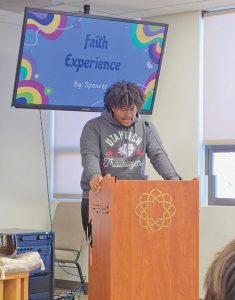
Spencer: The place I felt most comfortable opening up about my feelings was at my zone’s monthly Soka Family Day meeting for future division members. It was a space where all of us could share openly about any challenges we were going through, talk among ourselves and grow. At first, I didn’t know exactly what to say—I didn’t know what I was doing wrong. I could only share that I was struggling in class—in one class, in particular. I said that though I wasn’t sure how to improve my situation, I was making a determination morning and evening in front of the Gohonzon, praying strongly for one thing: Victory.
Reading Ikeda Sensei’s encouragement with friends in faith gave me the resolve to show actual proof by winning in this situation. It became about something more than just me—it became about encouraging my friends.
“Realizing genuine happiness,” Sensei says, “begins by challenging and winning over our own cowardice and laziness. Human revolution means to overcome the negative aspects of the self, and our Soka Gakkai activities are the arena in which we can do so” (The New Human Revolution, vol. 8, revised edition, p. 38).
I always left SGI activities feeling that my struggle was important. I still felt that I had a mountain to climb, but I was going to climb it. I wanted to inspire my friends to tackle their problems too, so we could reach the summit together. This gave me the confidence that I could open up elsewhere, with others, and that I could encourage them too with my experience.
You mean your friends at school?
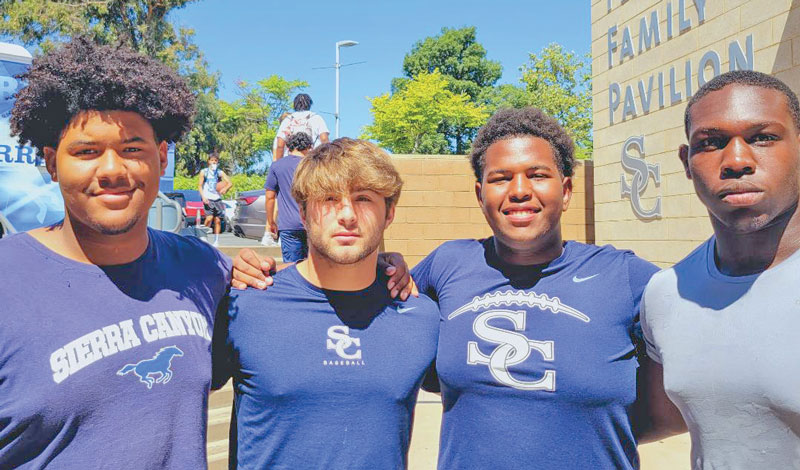
Spencer: Right. And my teammates, in particular. Honestly, the self-doubt had crept onto the field—I wasn’t performing at the top of my game. When the report card came at the start of October, it shook my confidence completely.
That night, my mom sent an email to my teacher and the dean, asking for a meeting with the four of us. And then my mom and I sat down in front of the Gohonzon and chanted for victory.
Tell us about that meeting.
Spencer: Well, we sat down, and I opened my portal and presented each of my uploaded assignments. We puzzled over them together and they saw what I saw—that not one assignment had received a grade, either good or bad, but showed no indication that the assignment had been uploaded at all.
The dean asked for my phone and took a close look. There was something wrong with my portal, he said. We realized there was a glitch, unique to my profile, that no one else had but me. This, for me, came as a huge relief. My teacher did not have it out for me. There was just a misunderstanding I was relieved to address—my hard work meant something after all.
Breakthrough!
Spencer: For sure. But then, the bad news. The dean tried to let me down easy. Though I’d uploaded every assignment, though all had been submitted on time, they had not been received on deadline, which meant they had to be marked late—school policy, no way around it. And school policy also required that no late assignment receive a grade above a C.
When I heard this, I thought right away about college recruiters. My GPA would go down, and they couldn’t fail to notice. Could I explain to them why? Would they listen?
Doubt crept in—sometimes in class, sometimes on the field, sapping my energy and focus. But I began every day by chanting Nam-myoho-renge-kyo and every evening in the same way. This helped me go to school with my head held high, knowing victory was up to me to decide. Week after week, I pulled that grade up, showing myself and my friends that we all have the power to turn a negative situation around. If anything, in prayer, I turned it into the fuel to push myself further than ever.
That year, I played the best I ever had and got my highest grades. Offers started coming in—from the Air Force Academy and state schools and private universities—and my prayer became to attend the best school for me.
I shared my breakthrough with my district, my friends in faith and at school.
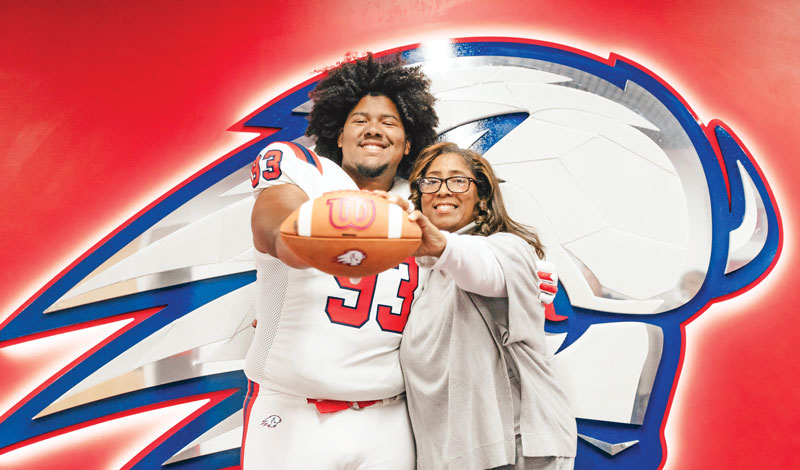
They weren’t the only ones you shared this with. On top of all this, something happened that summer. Can you tell us about your internship?
Spencer: Of course. That summer, I was admitted to a program for students from the U.S. and the U.K. interested in pursuing careers in marine biology. The application included a written essay, in which I wrote about my experience in my honors English class. I not only got in, I received a scholarship and spent that summer on the Florida coast studying firsthand the habits of sharks. I made many new friends and many new memories, all of which I’d made possible, I felt, through heartfelt prayer and daily efforts.
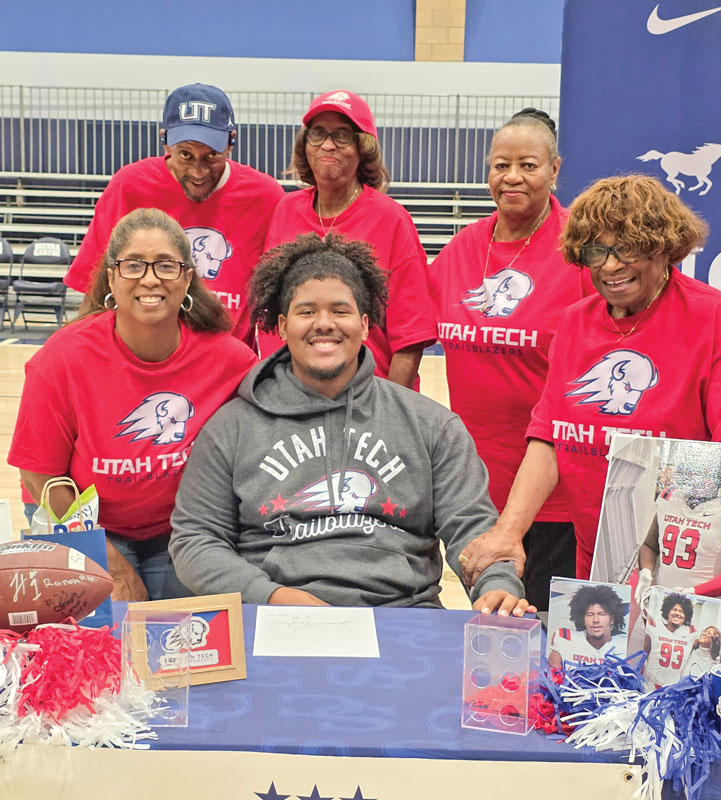
In May, I graduate high school, and in August, I begin my college career. I’m so excited for whatever challenges this next chapter holds. By chanting daimoku for myself and my friends, by taking Sensei’s guidance to heart, I’ve no doubt I’ll create a victory again—I decide on it every day.
You are reading {{ meterCount }} of {{ meterMax }} free premium articles