
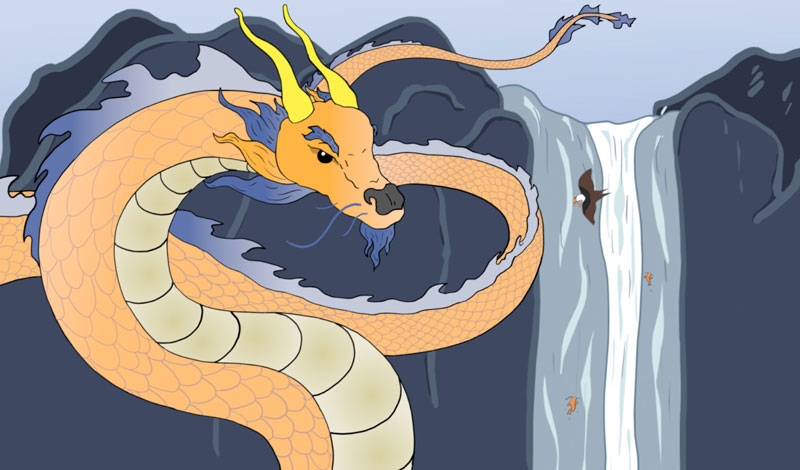
A waterfall called the Dragon Gate exists in China. Its waters plunge a hundred feet, swifter than an arrow shot by a strong warrior. It is said that a great many carp gather in the basin below, hoping to climb the falls, and that any that succeeds will turn into a dragon. Not a single carp, however, out of a hundred, a thousand, or even ten thousand, can climb the falls, not even after ten or twenty years. Some are swept away by the strong currents, some fall prey to eagles, hawks, kites, and owls, and others are netted, scooped up, or even shot with arrows by fishermen who line both banks of the falls ten cho[1] long. Such is the difficulty a carp faces in becoming a dragon. …
Attaining Buddhahood is no easier than for … carp to climb the Dragon Gate.
—“The Dragon Gate,” The Writings of Nichiren Daishonin, vol. 1, p. 1002
Nichiren’s Encouragement to Young Nanjo Tokimitsu
Nichiren Daishonin wrote “The Dragon Gate” in November 1279 to 21-year-old Nanjo Tokimitsu. After his father’s untimely death, Tokimitsu became the steward of Ueno Village as a teenager and soon grew into a courageous disciple.
At the time of this letter, Nichiren’s followers in nearby Atsuhara faced severe persecution, leading to three farmers being put to death for refusing to abandon their beliefs. Despite the risks, Tokimitsu used his position to protect fellow practitioners, sheltering some in his own home and helping secure others’ release from imprisonment. Drawing the ire of the authorities, he suffered unjust taxes so severe that he struggled to support his family.
Nichiren praises Tokimitsu as “Ueno the Worthy,” sharing the Dragon Gate story to assure him that continuing to act with such selfless resolve amid hardships leads to Buddhahood.
In Chinese lore, it is said that after carp become dragons, they have the vital role of making it rain. Some may prefer remaining burdenless like the carp. But just as dragons enjoy far greater freedom, when we vow to spread the Law and help others, we can develop an expansive, unrestrained state of life.
—Prepared by the SGI-USA Study Department
Ikeda Sensei’s Guidance
Through this example, Nichiren highlights for Tokimitsu that remaining steadfast in one’s Buddhist practice to the very end is an undertaking fraught with as many difficulties as a carp faces in climbing the Dragon Gate and turning into a dragon. The strong currents of the waterfall that drive the fish back can be likened to the conditions of an evil age defiled by the five impurities[2] as described in the Lotus Sutra; while the birds of prey and fishermen can be likened to the three obstacles and four devils and the three powerful enemies that hinder one’s efforts to attain Buddhahood.
Persevering in faith in the evil age of the Latter Day of the Law is like swimming upstream against a powerful current. It is hard enough just to resist the insidious forces exerted by our own earthly desires and fundamental darkness. Shakyamuni compared these forces to a strong current or flood.[3] Nichiren explains that this is even more true in the Latter Day, when even seemingly remarkable human wisdom and ingenuity can be inundated by an inexorable tide of deluded impulses fueled by the three poisons of greed, anger and foolishness—an ever-growing tide that wreaks havoc as a force of evil.
Precisely because it is so difficult to carry out faith in the Mystic Law in such an age, the bond of mentor and disciple in Buddhism takes on decisive importance. Likewise, a harmonious community of fellow practitioners solidly united in purpose—in what Nichiren terms “the spirit of many in body, one in mind”—is also indispensable. The Soka Gakkai possesses the bond of mentor and disciple that is strong enough to withstand any adversity. And its members—noble ordinary people who are polishing their lives by striving in faith with the same commitment as their mentor—are allied together in solid unity. Moreover, countless members, like magnificent dragons born through the triumphant ascent of the waterfall, are leading lives of profound dignity and confidence forged through continually challenging themselves in their faith and self-development. (Learning From the Writings: The Hope-filled Teachings of Nichiren Daishonin, pp. 119–20)
July 17, 2026 World Tribune, p. 10
References
- Approximately 120 yards. ↩︎
- Five impurities are the impurity of 1) the age; 2) desire; 3) living beings; 4) thought or view; and 5) life span. According to The Words and Phrases of the Lotus Sutra, the most fundamental of these five are the impurities of thought and desire, which result in the impurity of living beings and the impurity of life span. These in turn give rise to the impurity of the age. ↩︎
- See “The Kalpa of Decrease,” The Writings of Nichiren Daishonin, vol. 1, p. 1121. ↩︎
You are reading {{ meterCount }} of {{ meterMax }} free premium articles