
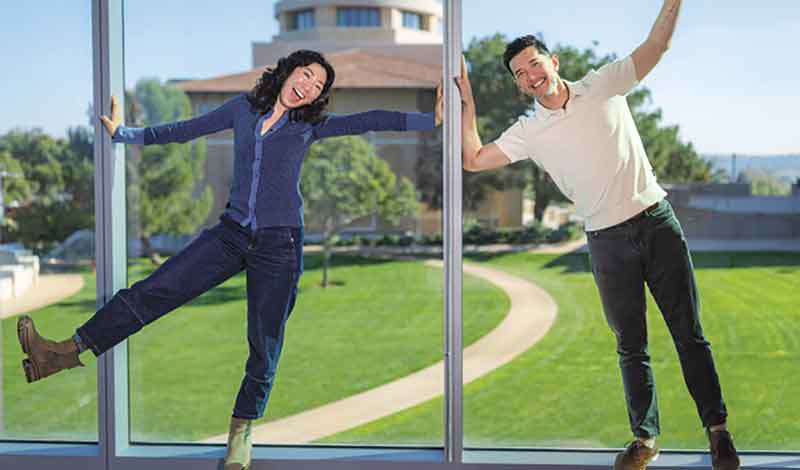
Soka University of America alumni Michael Sasaki (Class of 2005) and Miho Saito (Class of 2014) are being recognized internationally for their short film The Brain That Cried Wolf, a work that approaches mental health, identity and fear with honesty, humor and compassion. The film was recently named runner-up for Best LGBTQIA Short Film at the Hague International Film Festival, affirming its resonance with audiences far beyond its original context.
The film draws directly from Sasaki’s personal experiences navigating mental health challenges. Rather than seeking to make a grand statement, he says his intention was simple: to tell a truthful story that might encourage someone else.
“I wasn’t trying to change the world,” Sasaki said. “I was just telling a story, and somehow it crossed boundaries and reached people on the other side of the world.”
Saito echoed that sentiment, noting that her original wish was simply to “make someone laugh who is going through a hard time.” Yet the international response revealed something deeper.
“It reminded me that suffering is universal—and so is hope,” she said. “If it’s personal, it’s going to touch somebody.”
Both alumni credit their Soka education with shaping not only their artistic skills but also their approach to collaboration, dialogue and respect for diverse perspectives. Sasaki described the university as a place that trained him to see his own viewpoint as one among many.
“When you have people of different backgrounds working together, and you’re open to that, the collaboration becomes like a dance,” he said. “That’s how you create something more beautiful than any single perspective.”
This spirit of dialogue proved essential during the film’s early development, when Sasaki wrestled with doubt about whether to move forward with such a personal project. A heartfelt conversation among the core team became a turning point—a moment Sasaki connects to a formative experience from his student days, when he learned that one is never fully “ready” before stepping forward.
“That became our breakthrough,” he said. “Once we decided to take that step, everything came together.”
Saito reflected that her time at Soka encouraged her to explore freely, cross disciplines and trust her inner voice—even when that meant taking on unfamiliar roles such as editing, producing or acting.
“We’re taught to chase the joy of learning and to protect what’s in our hearts,” she said. “That’s what I try never to betray as an artist.”
Both alumni see filmmaking as a form of service—a way to contribute to society by opening space for understanding, compassion and connection.
“Our university founder, Daisaku Ikeda, spoke about artists as ‘architects of peace,’” Saito said. “That’s not just about what we make, but how we treat people and how we work together.”
As they continue their creative journeys, Sasaki and Saito encourage young people to remain patient, authentic and service-oriented.
“Find your own voice and stand by it,” Sasaki advised. “And ask how you can use it to encourage someone else.”
Go to soka.edu for more information.
You are reading {{ meterCount }} of {{ meterMax }} free premium articles