
This series, prepared by the SGI-USA Study Department, features timeless stories in Nichiren Daishonin’s writings (also called the Gosho) that continue to offer practical wisdom for us today.
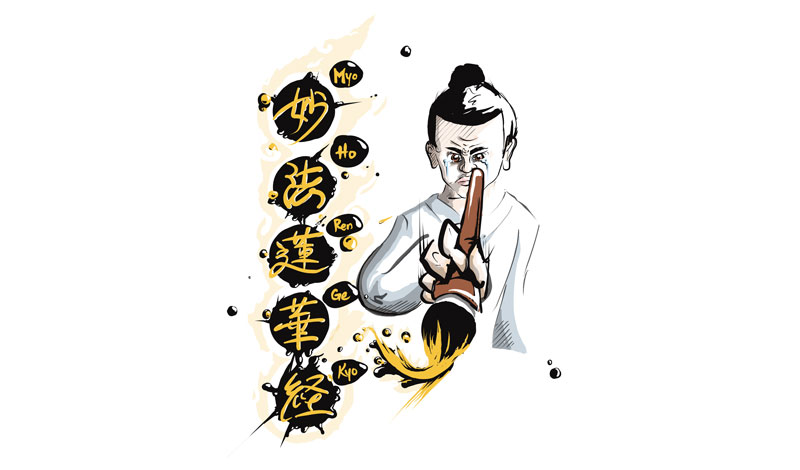
Long ago in China, there was a man named Wu-lung, who was sought throughout the land for his masterful calligraphy. However, there were some jobs he strictly refused; as a devout Taoist, he would not inscribe anything from a Buddhist text.
On his deathbed, Wu-lung summoned his son, I-lung—a talented calligrapher in his own right. “Not only have you inherited my skill,” he said, “but you write with an even better hand than I.” With his final breaths, he told his son, “No matter what evil influence may work upon you, you must never copy the Lotus Sutra.”[1]
I-lung went on to become China’s finest calligrapher, while always honoring his father’s last wish.
Until, one day, the emperor called on I-lung to transcribe the Lotus Sutra for a Buddhist ceremony. I-lung refused, but the ruler ordered him to at least inscribe the title of its eight volumes.
Left with no choice, I-lung took up his brush, writing: “Myoho-renge-kyo, volume one,” “Myoho-renge-kyo, volume two” and so on. While doing so, he agonized over betraying his promise to his father.
The Protective Power of the Lotus Sutra Is Boundless
Regarding the Lotus Sutra, Nichiren Daishonin writes:
All the characters in which the Lotus Sutra is written represent living Buddhas. But because we have the eyes of common mortals, we see them as characters. It is like the example of the Ganges River. Hungry spirits see the waters of the river as fire, human beings see them as water, and heavenly beings see them as amrita [or sweet dew]. The waters are the same in all cases, but each type of being sees them differently, according to the effects of its karma.[2]
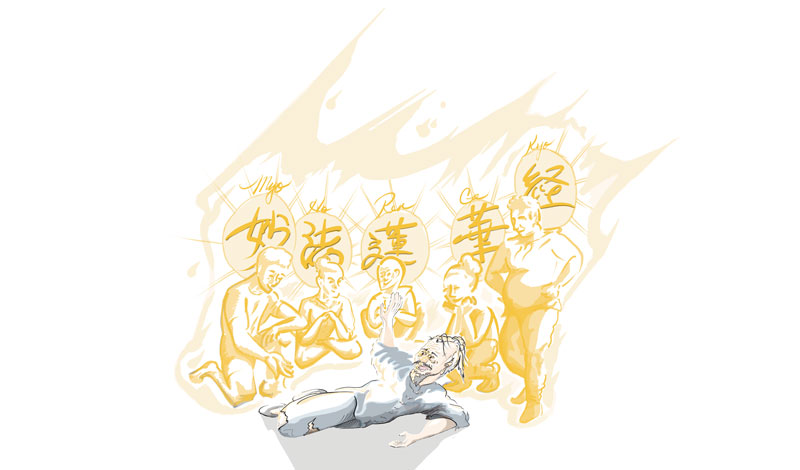
Soon after I-lung wrote “Myoho-renge-kyo,” his father came to him in a dream. Tormented in death, Wu-lung explained how much he’d suffered for having slandered the Buddha’s teachings in life. But recently, something wondrous happened, he said. “The single character myo came flying through the air and took the form of a golden-hued Buddha. This Buddha said, ‘Even those who have destroyed good causes will, through the Lotus Sutra, never fail to attain enlightenment.’
“Then ho, ren, ge and kyo appeared. Each character you wrote, my son, became a Buddha that came to my rescue. They transformed my hell into the Land of Tranquil Light.”[3]
By inscribing “Myoho-renge-kyo”—an act of respect to the Lotus Sutra—I-lung freed his father from hellish suffering.
I-lung was baffled. Why did this simple act help his deceased father? Expressing the ties they share as father and son, Wu-lung replied:
How ignorant you are! Your hand is my hand, and your body is my body. The characters you write are the characters I write. Although you had no faith in your heart, you nevertheless wrote the titles with your hand. Therefore, I have already been saved.[4]
I-lung’s story spread from China all the way to Japan, inspiring countless people to take faith in the Lotus Sutra with the awareness of an important point: Even if a family member opposes one’s Buddhist practice, continuing in faith in spite of their doubts is actually the highest act of respect and gratitude for them, as it will eventually lead them to attain Buddhahood.
The Ultimate Practice of Chanting Nam-myoho-renge-kyo
The Lotus Sutra’s “Teacher of the Law” chapter lists five practices for upholding its teachings: embracing, reading, reciting, expounding and transcribing them. Among these, Nichiren teaches that transcribing the sutra actually “produces the lowest grade of blessings”[5]—whereas chanting Nam-myoho-renge-kyo encompasses all five practices.[6] Considering the benefit I-lung produced through his transcriptions, just imagine the power we bring forth by chanting Nam-myoho-renge-kyo. Elsewhere Nichiren says:
Now when Nichiren and his followers perform ceremonies for the deceased, reciting the Lotus Sutra and chanting Nam-myoho-renge-kyo, the ray of light from the daimoku reaches all the way to the hell of incessant suffering and makes it possible for them to attain Buddhahood then and there.[7]
Each daimoku we chant and every cause we make for kosen-rufu activates the Mystic Law’s enormous beneficial power, protecting and guiding our loved ones and countless others to absolute happiness.
—Prepared by the SGI-USA Study Department
November 20, 2026 World Tribune, p. 9
References
- “Wu-lung and I-lung,” The Writings of Nichiren Daishonin, vol. 1, p. 1100. ↩︎
- “Letter to Horen,” WND-1, 517. ↩︎
- See “Letter to Horen,” WND-1, 515. ↩︎
- “Wu-lung and I-lung,” WND-1, 1101. ↩︎
- “Letter to Horen,” WND-1, 516. ↩︎
- See “The Real Aspect of the Gohonzon,” WND-1, 833. ↩︎
- The Record of the Orally Transmitted Teachings, p. 17. ↩︎
You are reading {{ meterCount }} of {{ meterMax }} free premium articles